
c. 15th century BC
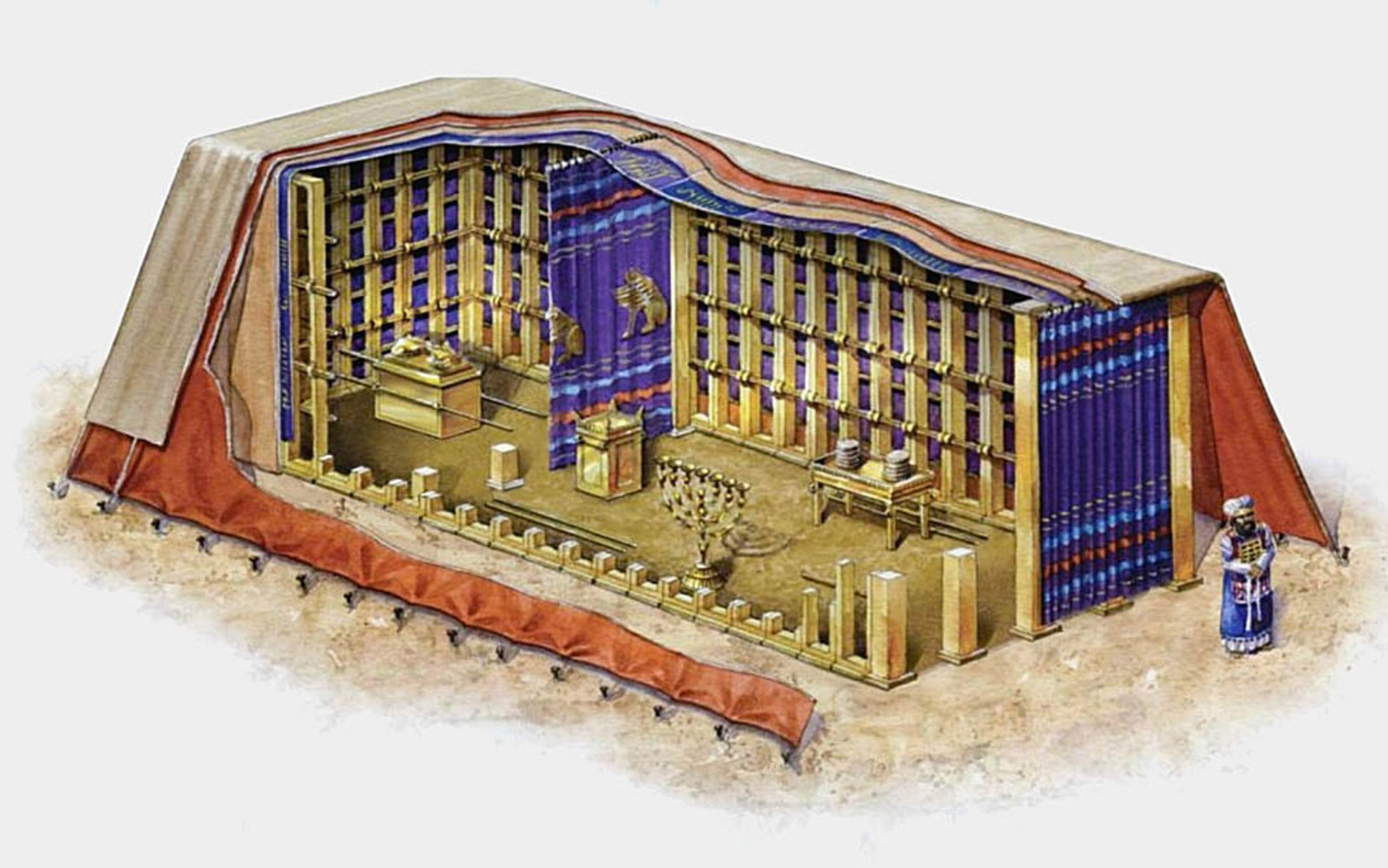
The Tabernacle of Meeting
On the veil in the middle of the sanctuary (between the Holy Place and the Holy of Holies) cherubim were depicted (Ex 26:31), as also on the curtains (walls) around (Ex 26:1; Ex 36:8), which the artist of this drawing did not show. The tabernacle is an image (icon) of the heavenly reality (Ex 25:8-9,40; Heb 9:24; Act 7:44). God commanded the sanctuary to be revered (Lev 19:30; Lev 26:2).
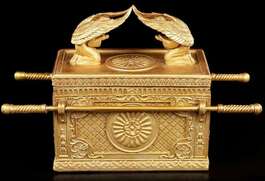
The Ark of the Covenant
Two cherubim were depicted on the ark (Scripture references). The prophet Joshua bowed down before the Ark of the Covenant (Josh 7:6).
[larger]
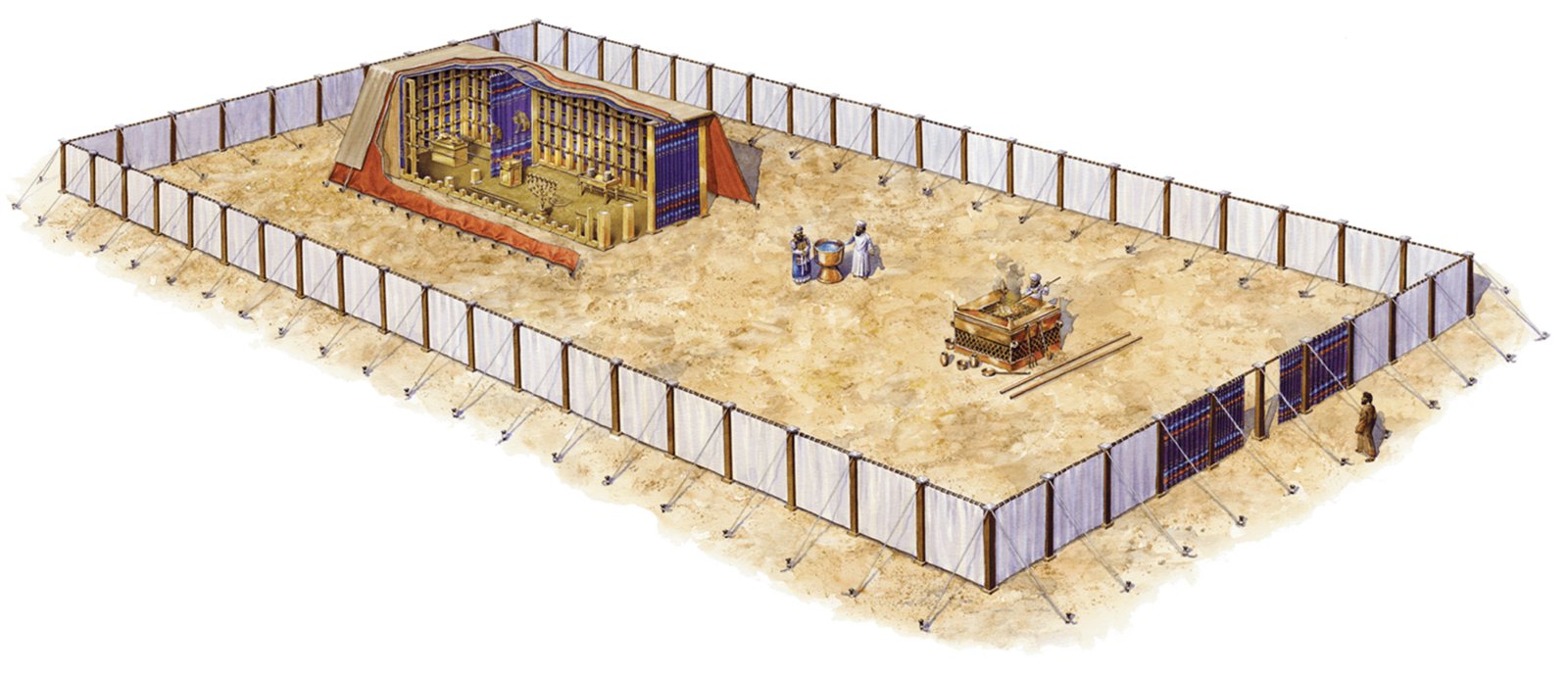
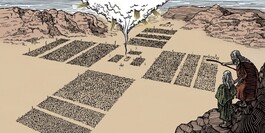
The Camp of Israel
Israel moved in the shape of a cross (Scripture references).
[larger]
c. 10th century BC
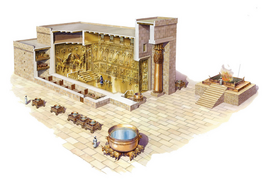
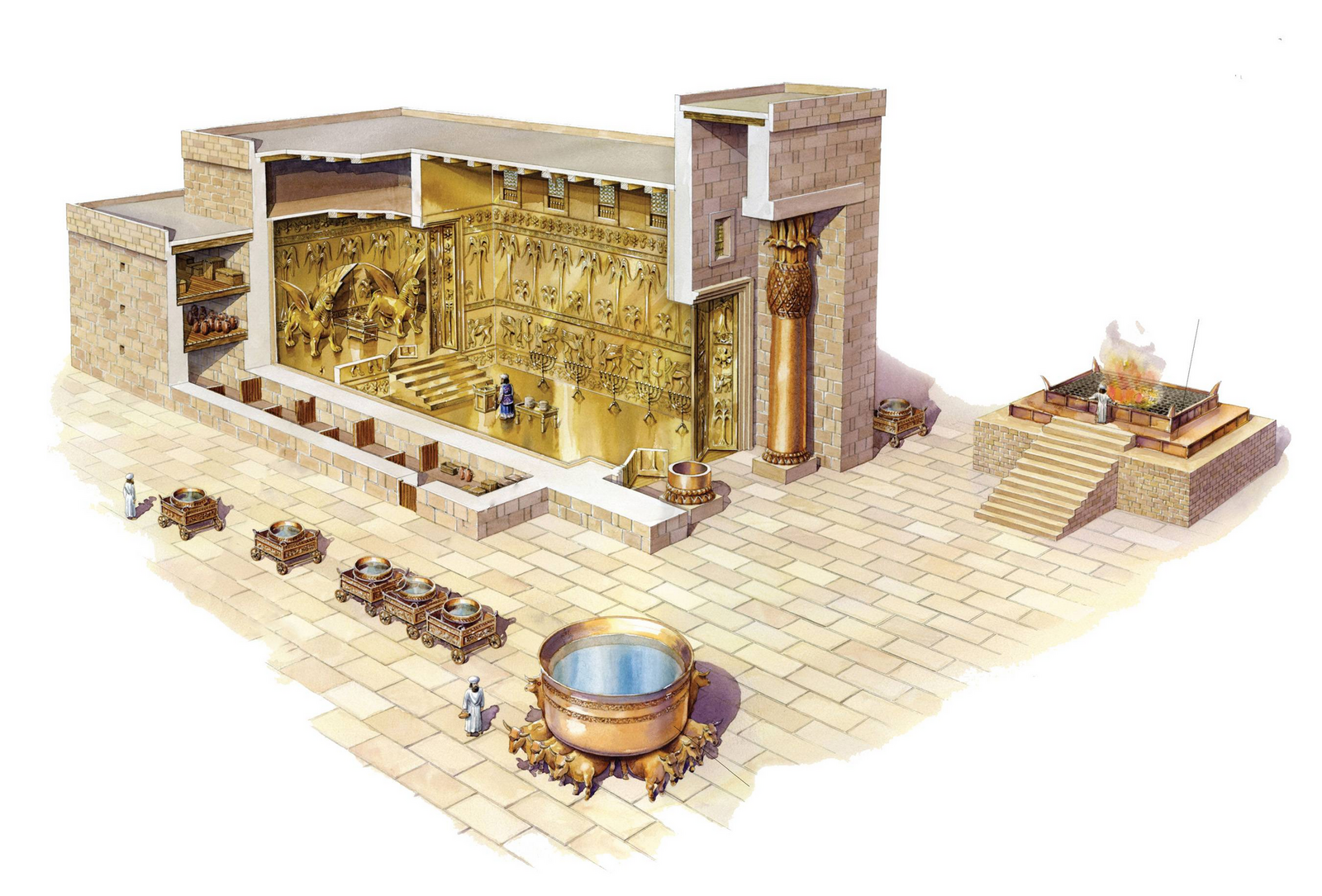
The Temple in Jerusalem built by Solomon
Carved images of cherubim were on the walls of the temple (1 Kin 6:32), on the entrance door (1 Kin 6:32; 1 Kin 6:35) and on the veil before the entrance to the Holy of Holies (2 Chr 3:14; 1Mac 1:22). In the Holy of Holies stood two large gilded wooden statues of cherubim (1 Kin 6:23). On the cover of the Ark of the Covenant two statues of cherubim were made (Ex 25:18-20). In the temple court, on the great stands for the basins, lions, oxen and cherubim were depicted (1 Kin 7:28-29). (More).
The prophet David bowed down toward the temple (Ps 5:7; Ps 99:5; Ps 132:7), honoring God through this image.
[larger]
2nd Century
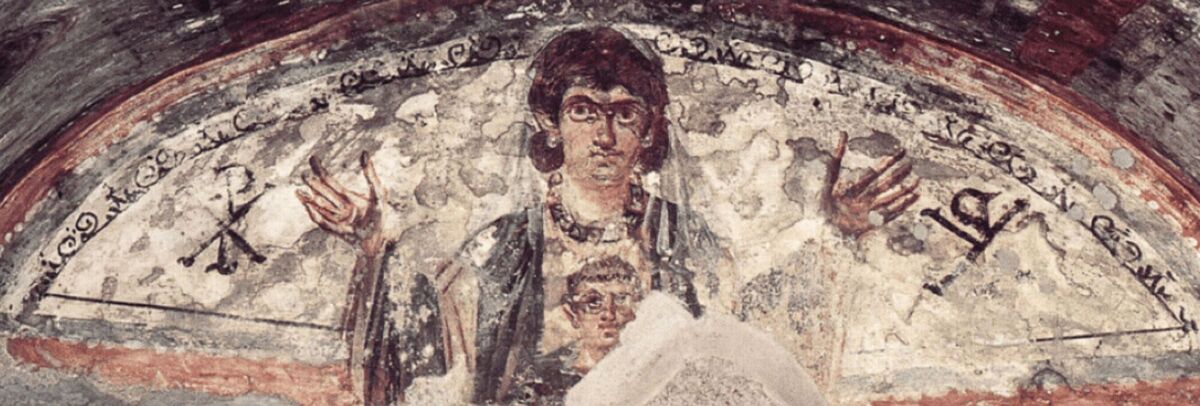
The Theotokos with the Child Jesus; a prophet points to a star (Rome)
2nd – early 3rd century. The Catacomb of Priscilla[6]. This is the oldest image of the Theotokos. The man beside the Theotokos is perhaps holding a book in his left hand and pointing to a star with a finger of his right hand.
[larger] [version 2] [version 3] [version 4] [version 5]

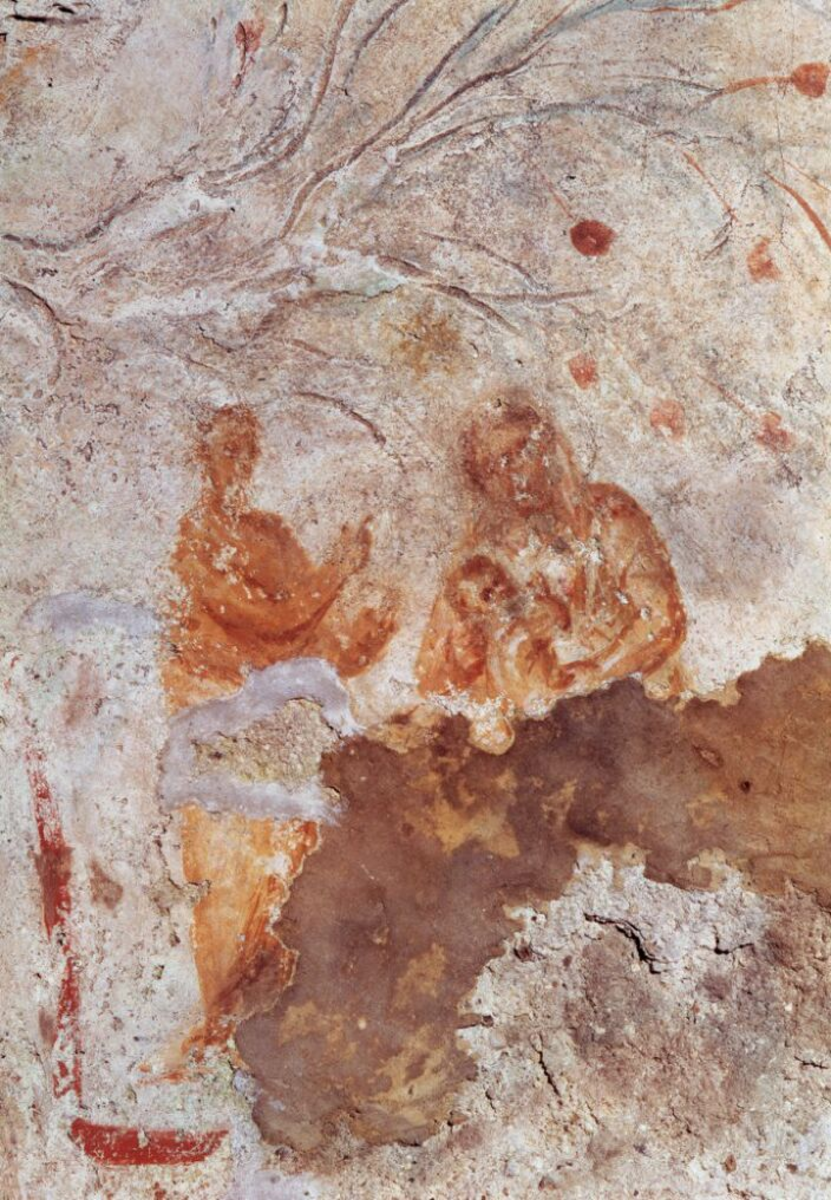
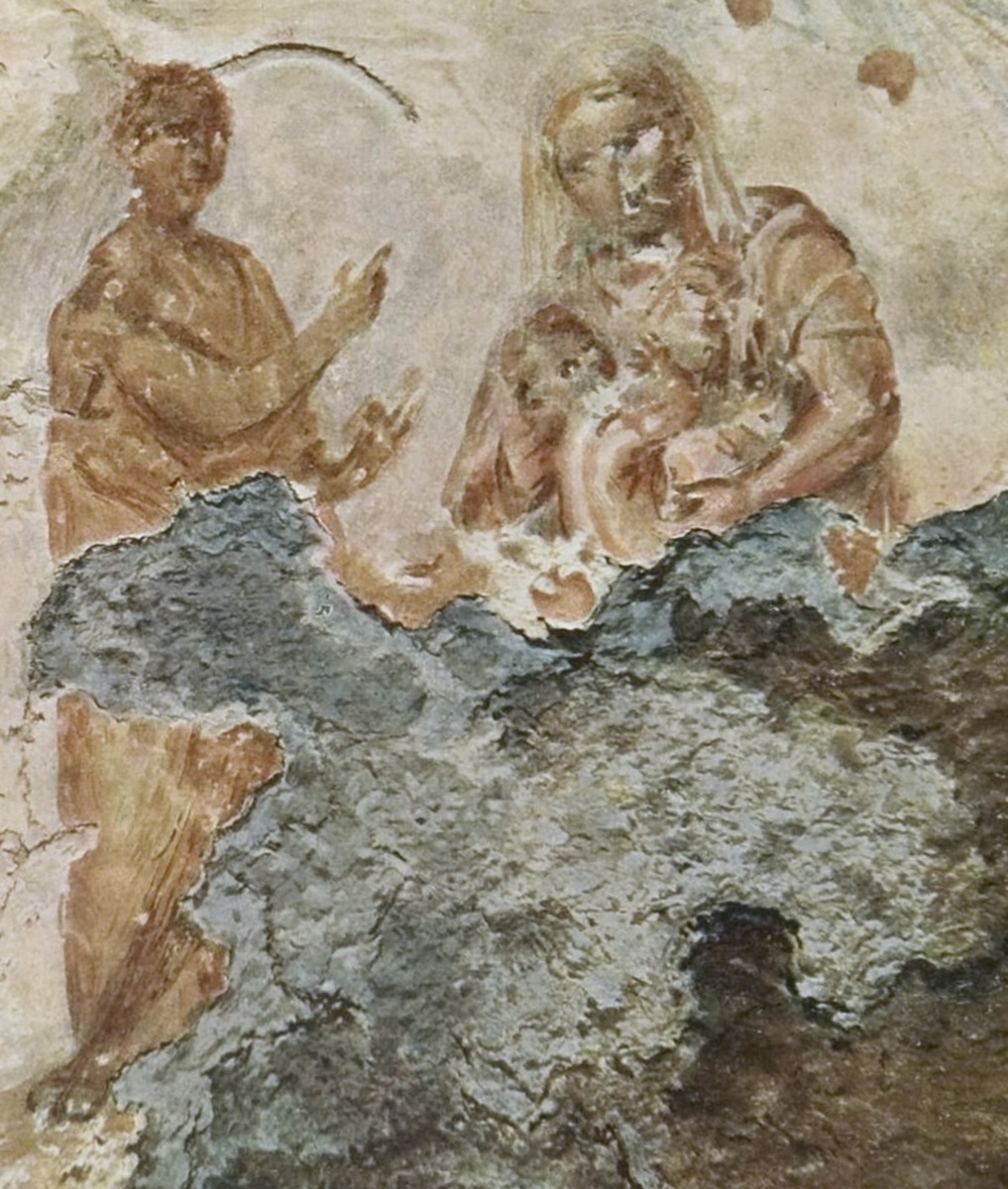
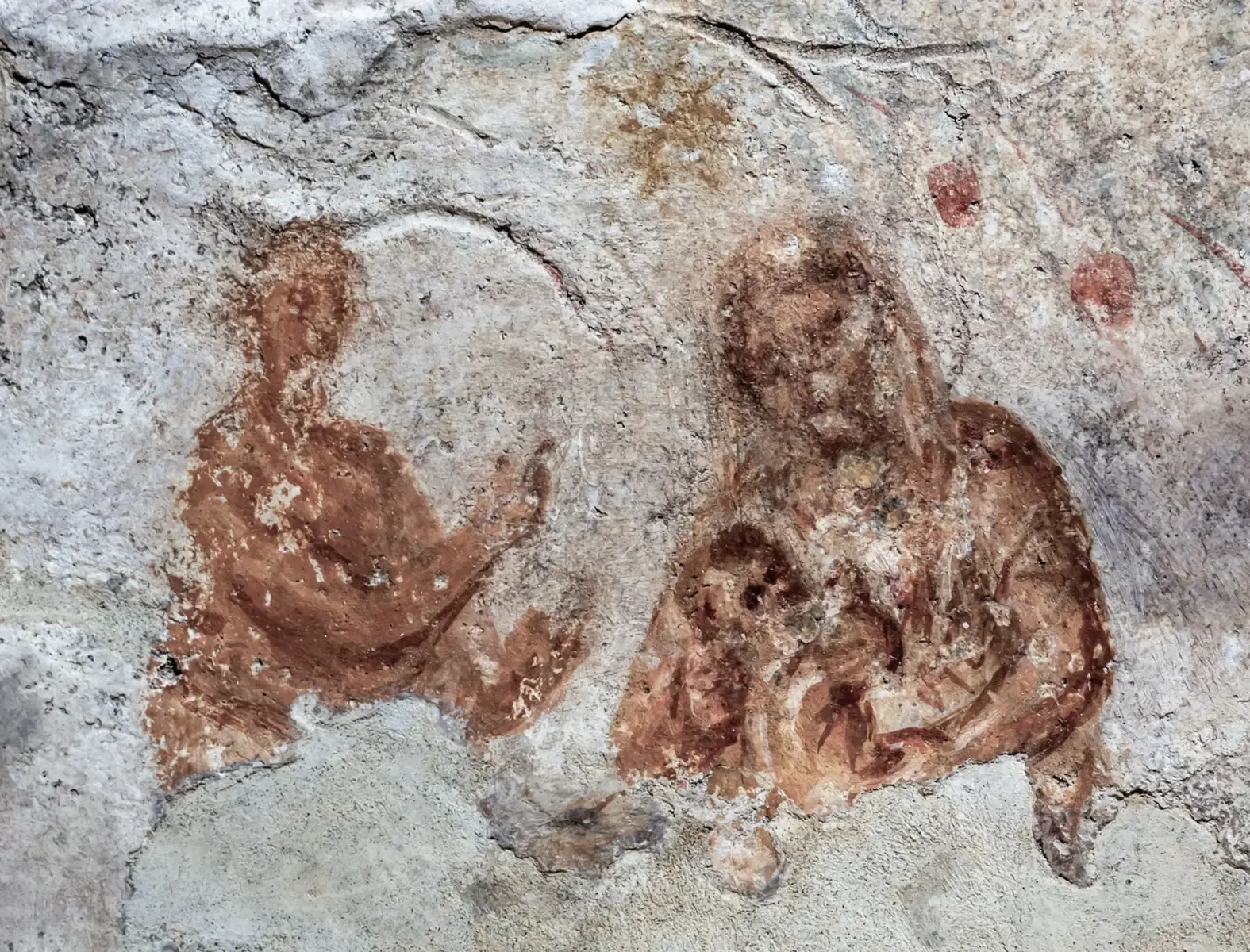
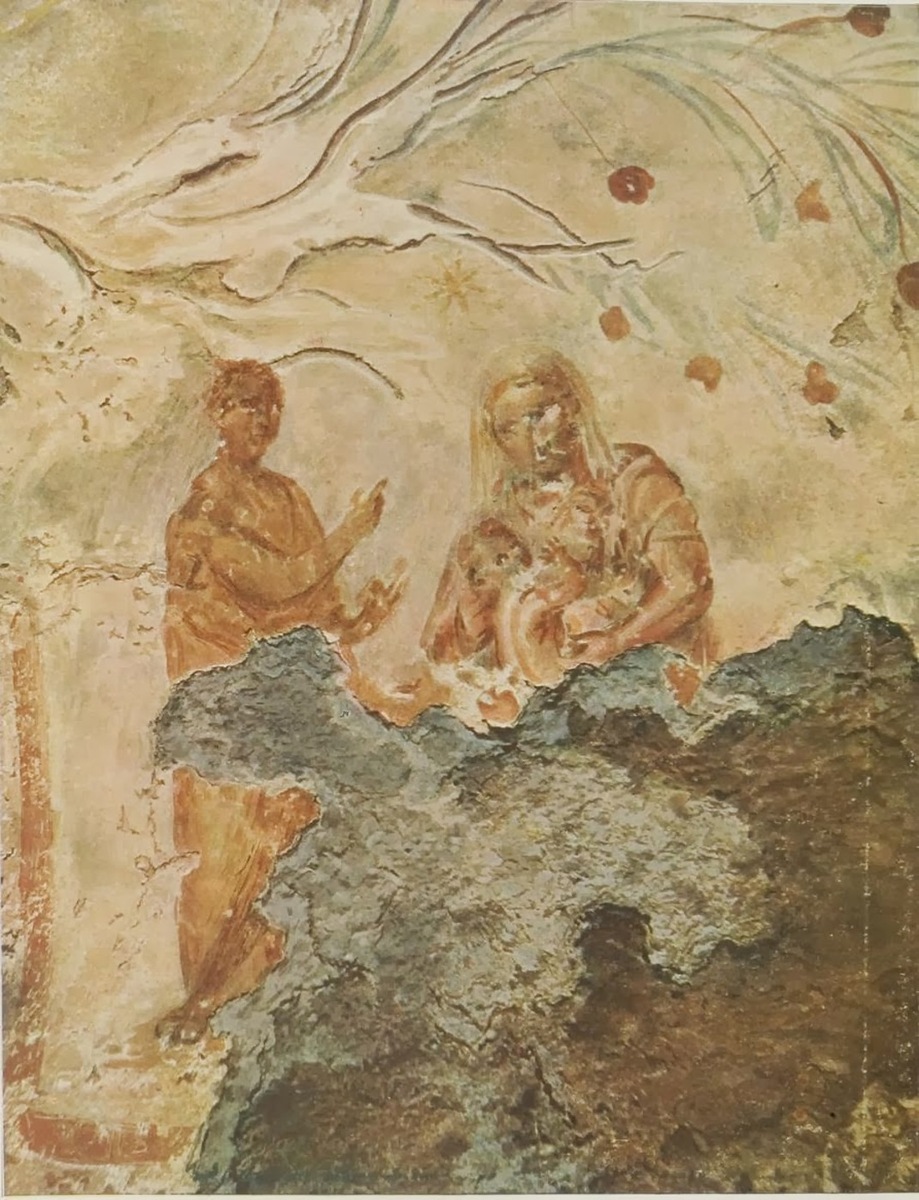
The man beside the Theotokos may be the prophet Isaiah, who uttered the prophecy:
“Therefore the Lord himself will give you a sign. Look, the young woman is with child and shall bear a son, and shall name him Immanuel” (Is 7:14; in the Septuagint, which the Church reads: ἡ παρθένος, “the virgin”)
Or Balaam:
“I see him, but not now; I behold him, but not near — a star shall come out of Jacob, and a scepter shall rise out of Israel; it shall crush the borderlands of Moab, and the territory of all the Shethites” (Num 24:17)
Or the artist, instead of an explanatory inscription, simply used this device. He invites us to take the book, read the prophecy of the rising star and understand that he has depicted the birth of the One of whom this prophecy speaks, that is, the birth of the Savior from the Virgin.
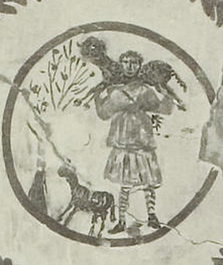
Christ as the Good Shepherd
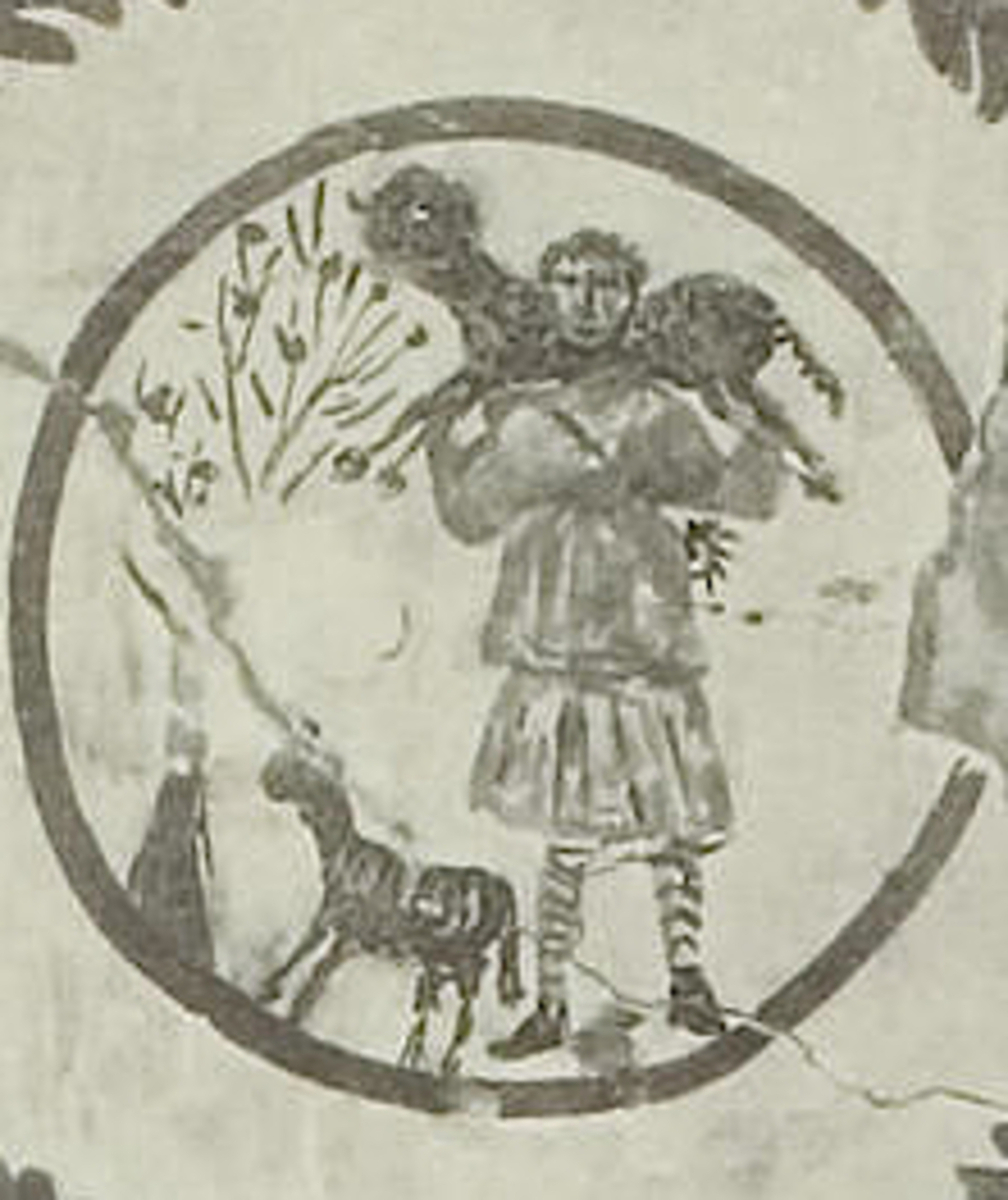
Late 2nd century. Rome. The Catacomb of Callixtus (Callixitus Catacomb, Crypt of Lucina).
[larger]
3rd Century
The Theotokos “Orans” (Rome)
Catacomba Maggiore, Rome[26][27]. In the foreground the Virgin Mary and the Child Christ are depicted.


Christ, the apostles, the martyrs Gorgonius, Peter, Marcellinus and Tiburtius (Rome)
The Catacombs of Marcellinus and Peter


[larger]

A woman prays to the Good Shepherd (Rome)
3rd century. The Catacomb of Priscilla[6].
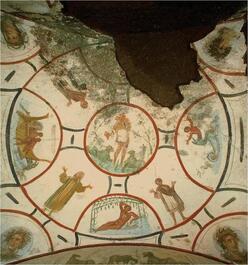
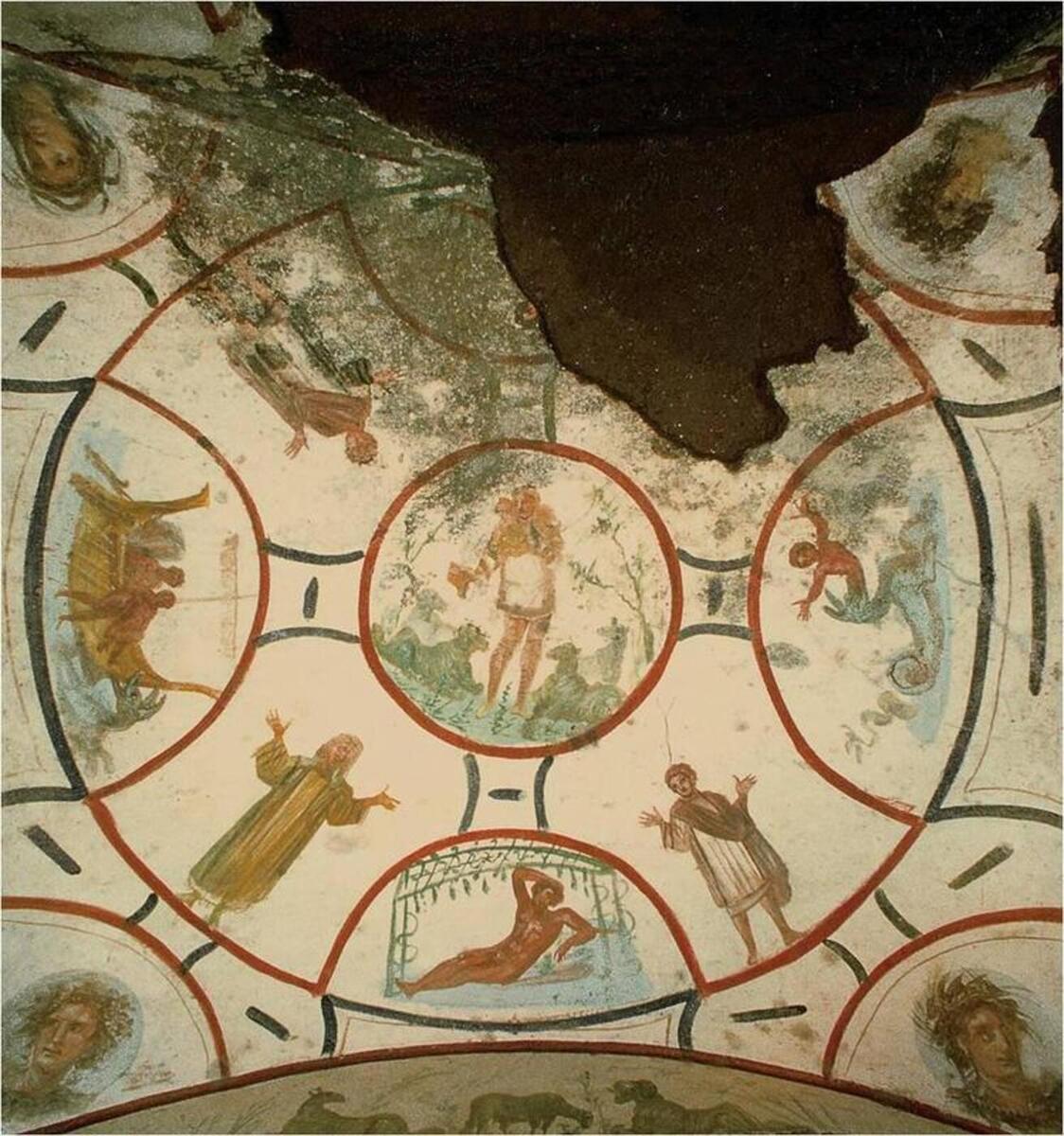
The images form one composition. The artist arranged them so that the praying people painted around look and raise their hands toward the top of the room, where Christ is depicted as the Good Shepherd (John 10:11). All the scenes around the Good Shepherd share one theme: salvation from death.
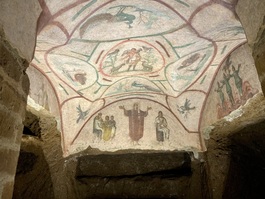
[larger] [version 2] [version 3] [version 4]
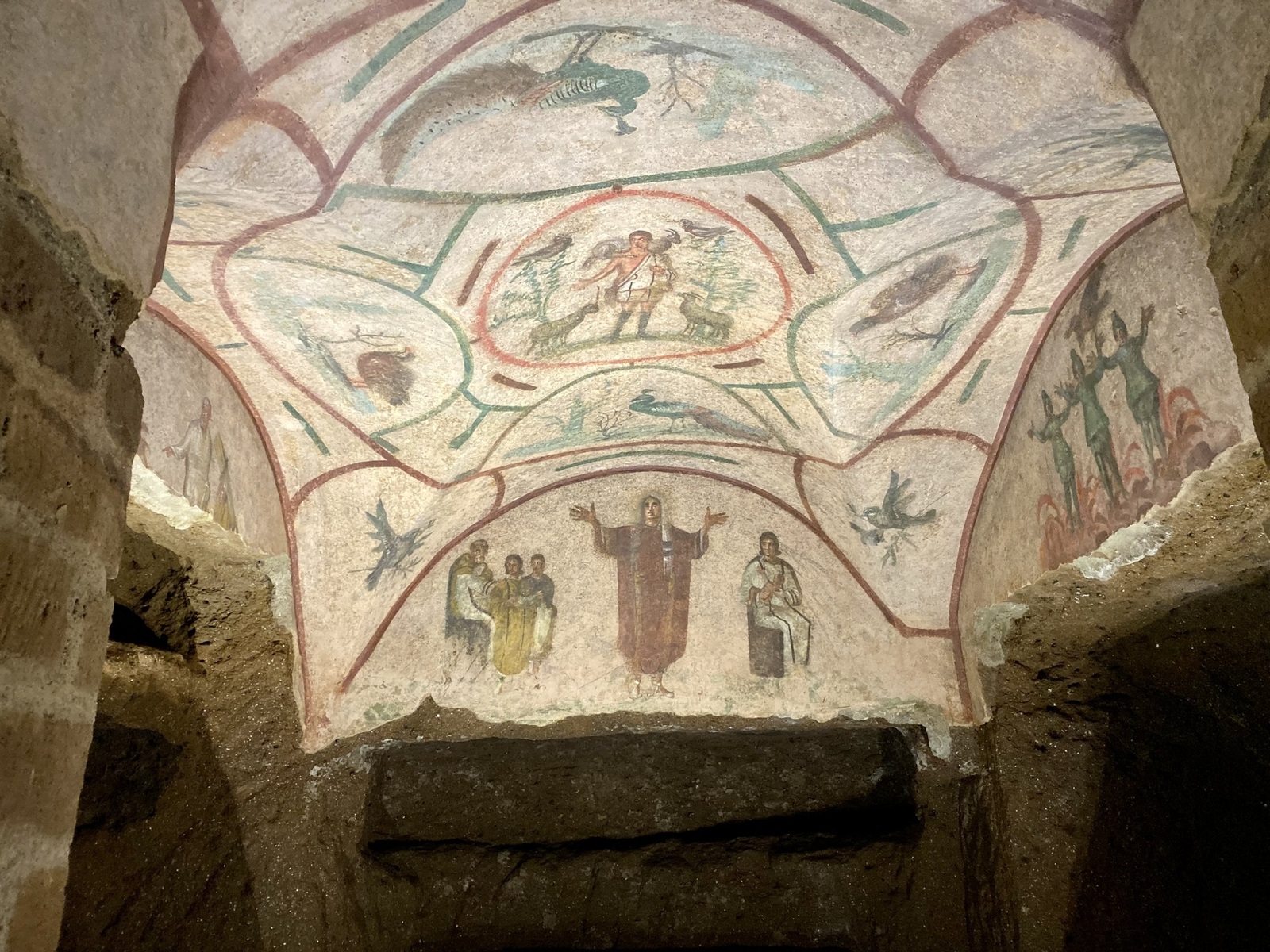
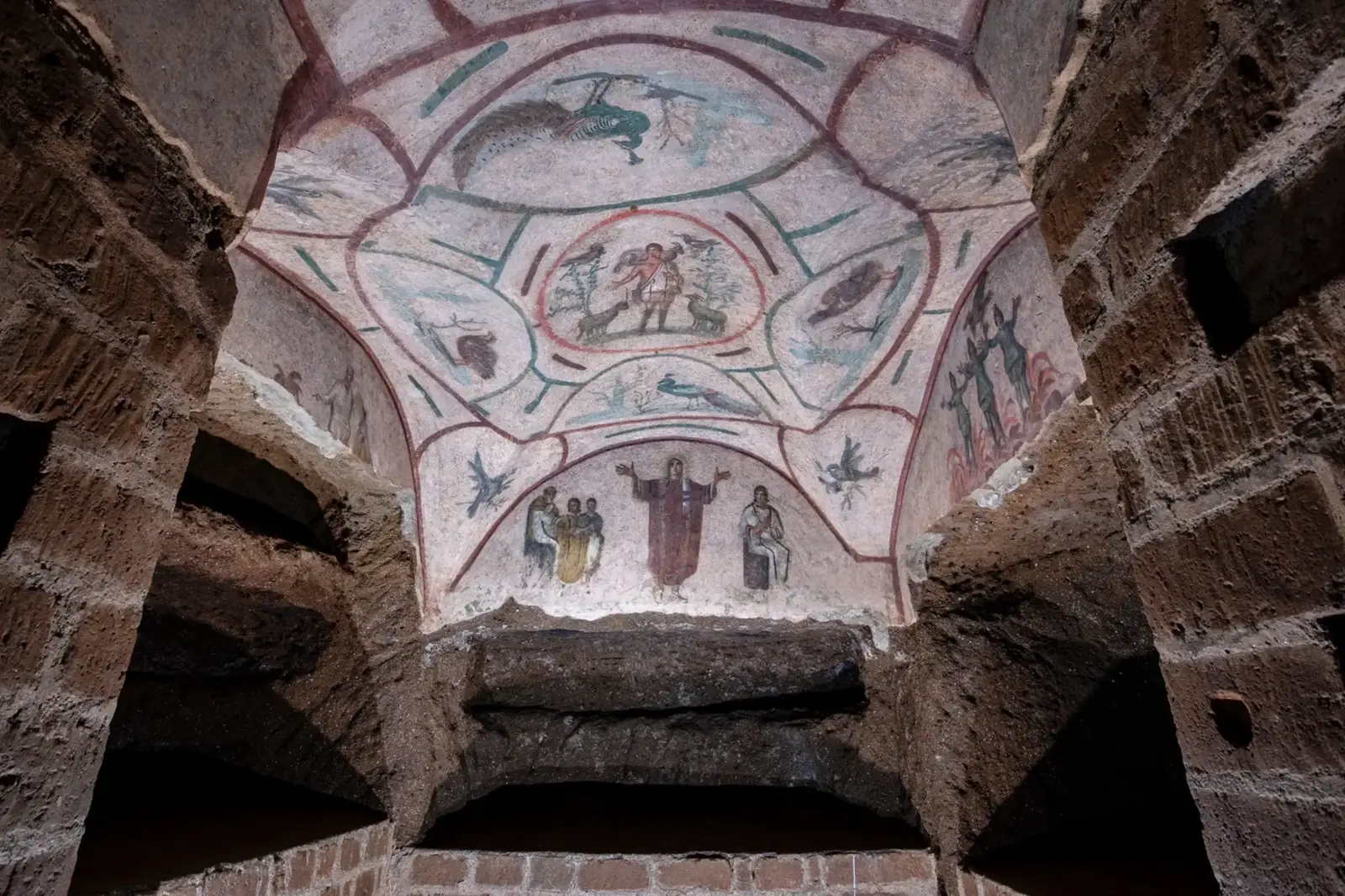
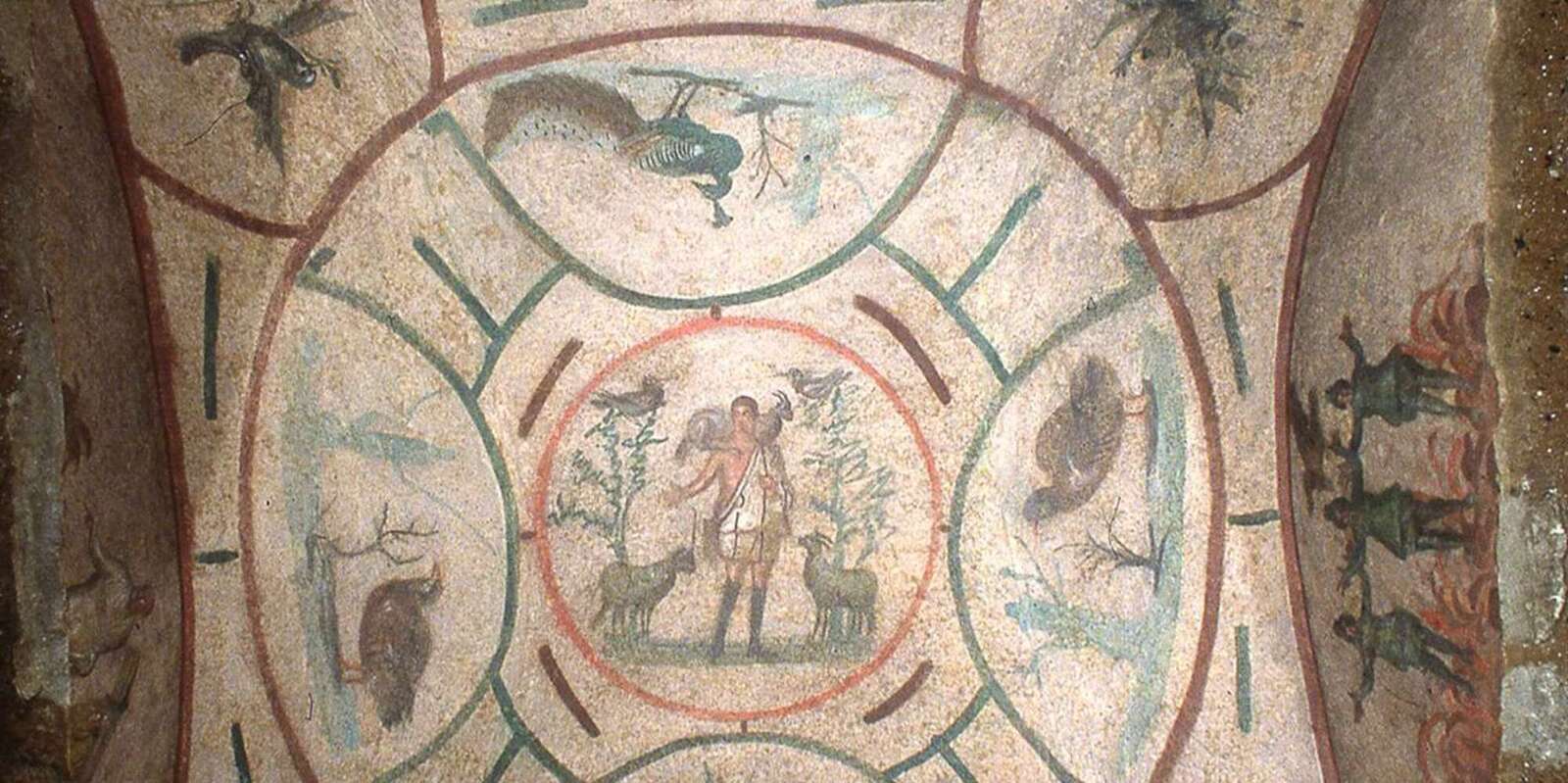
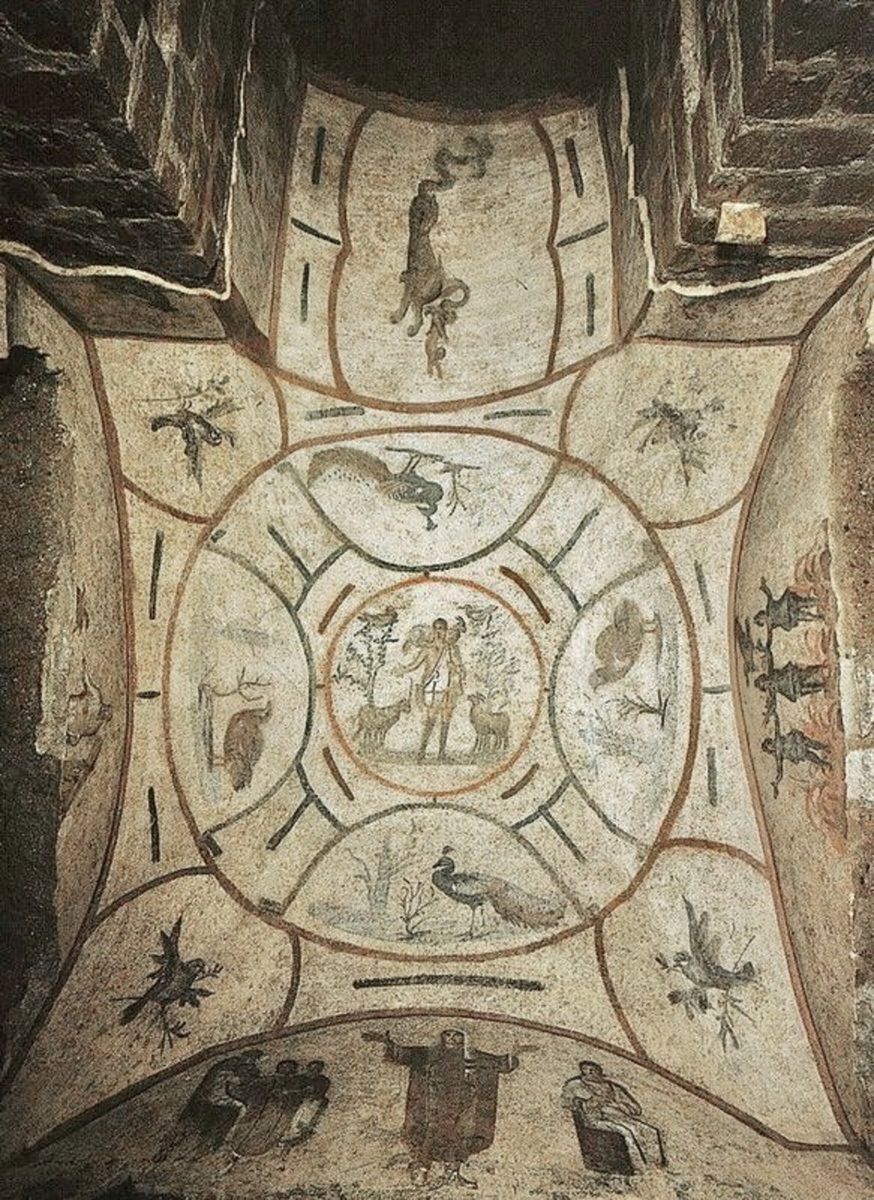
The Good Shepherd is Christ (Luke 15:6-7; John 10:1-21; Ps 23).


A woman with her head covered prays with her hands raised (probably Sarah: Gen 18:1-15 and Gen 21:1-7).

[larger]

On the right, an Old Testament scene: the three youths (Shadrach, Meshach and Abednego) pray with their hands raised (Dan 3).


On the left, an Old Testament scene: Abraham and Isaac with the wood for the sacrifice (Gen 22:1-19).

[larger]

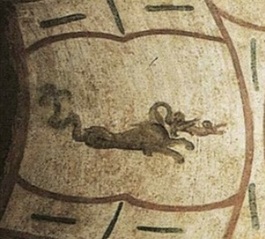
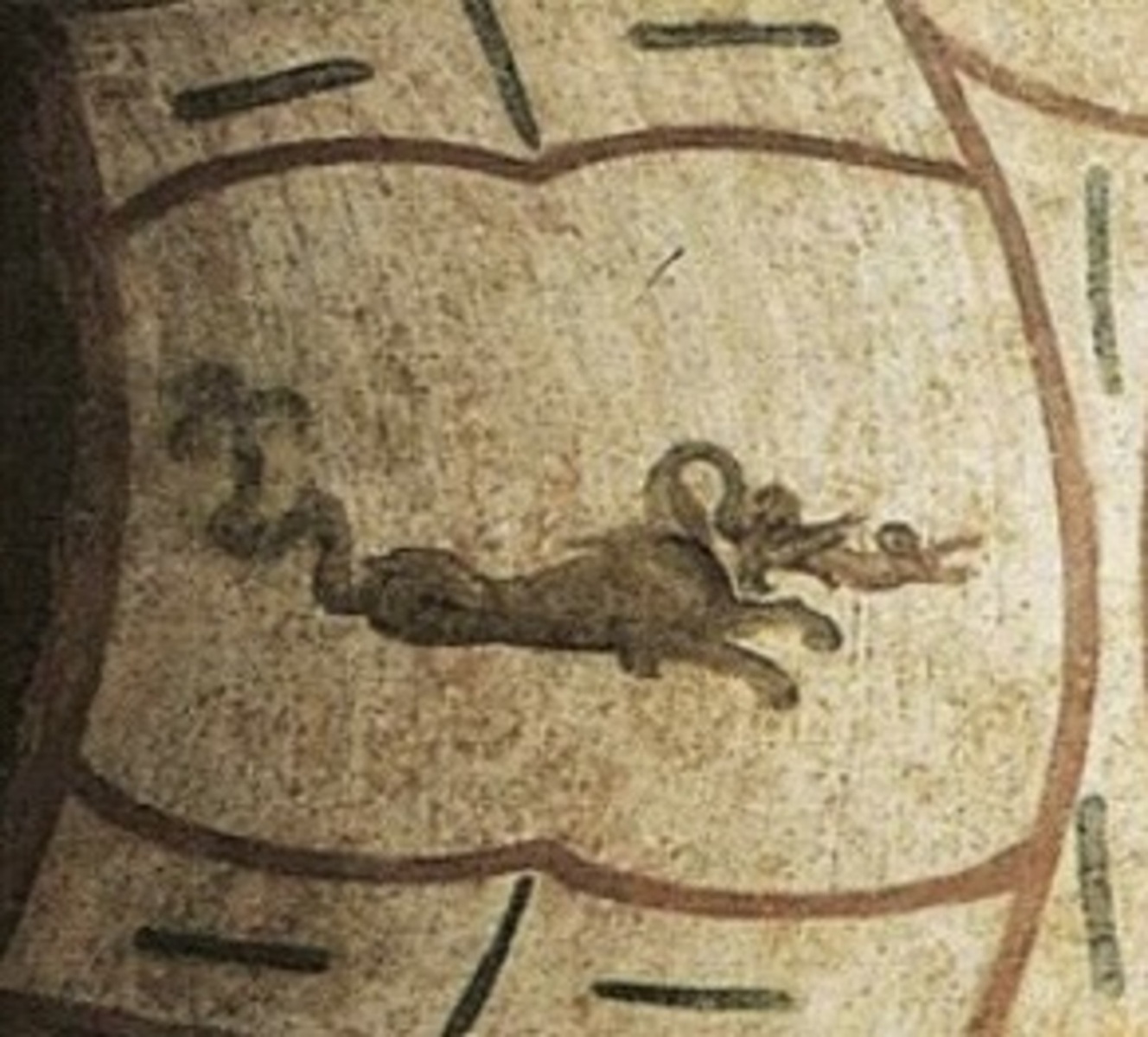
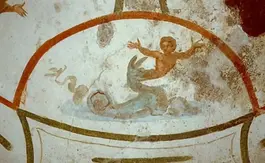
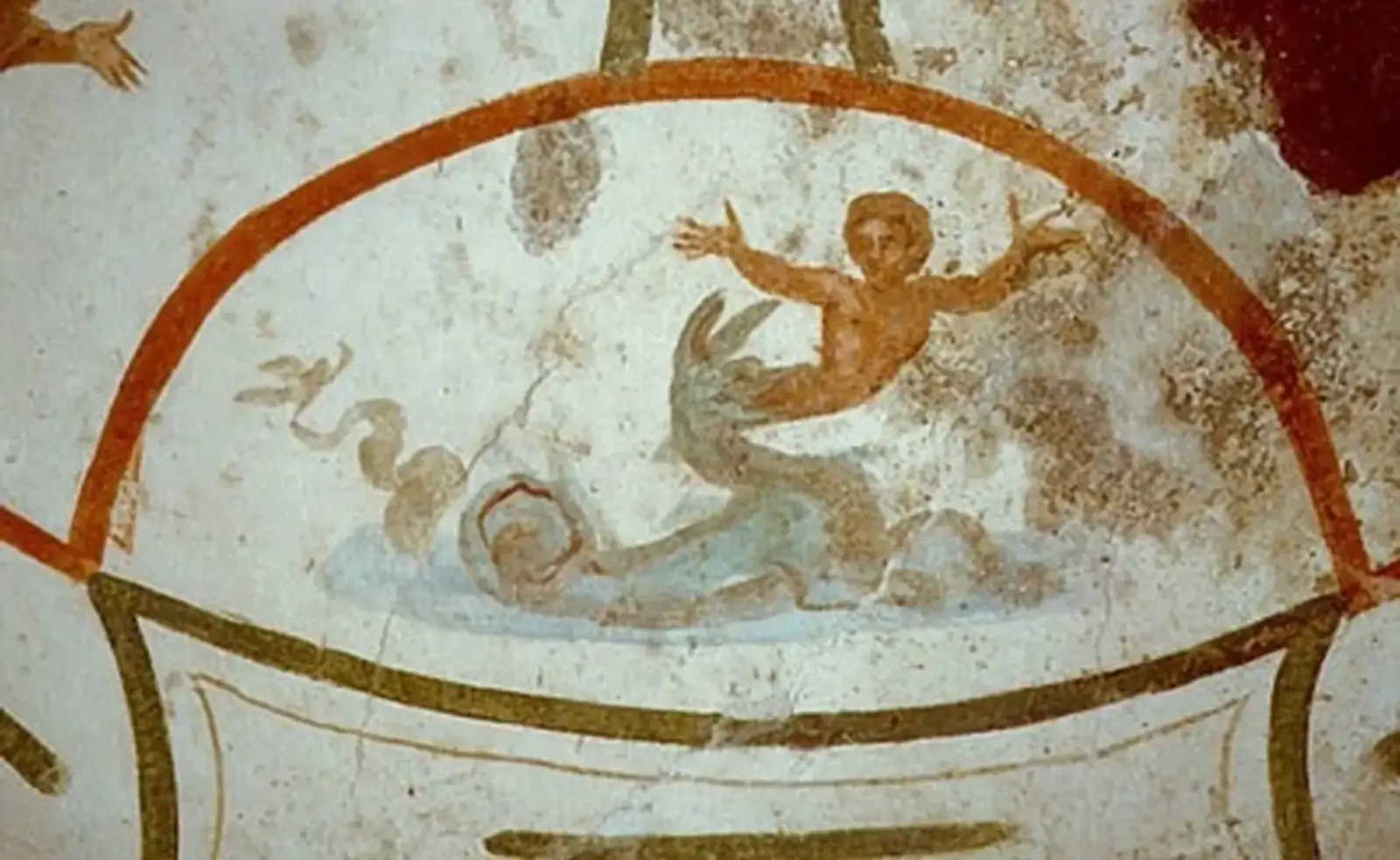
Above the entrance the prophet Jonah is shown being swallowed by the sea creature (Jon 1:17).
[larger]
The scene from the life of the praying woman on the front wall of the room deserves a closer description.

[larger]

The events of the front scene
Each section of the room’s composition shows one scene. All the scenes are important parts of Christian themes. At the top is the scene with the Good Shepherd, on the left the scene of Abraham, on the right the three youths, in the passage the prophet Jonah. So one may suppose that the artist kept this rule (one section, one important scene) on the front wall too, which is hard to interpret with certainty. What follows is only a suggestion. Since Old Testament scenes are shown on all sides (except the center), the front wall may show the story of Hagar (Gen 16, Gen 21). If so, first Abraham is shown with Hagar being sent away with her son Ishmael (1), then the prayer of Sarah (2), then Hagar feeding her child (3).
Let us look at this version more closely:
1. Hagar sent away. Most certainly the seated figure is Abraham (he has the same hair and beard as in the fresco of Abraham opposite). The figure in yellow is probably Hagar (yellow may have marked the status of a slave). She seems to be holding a skin of water (Gen 21:14). Behind her is perhaps her son Ishmael, who at the time of the sending away must have been over 15 years old (Ishmael was born when Abraham was 86 Gen 16:16, Isaac was born when Abraham was 100 Gen 21:5, and Hagar is sent away when Isaac had grown and been weaned Gen 21:8-13). It looks like a woman in an apron, but if so, it can only be Hagar herself (an unmarried woman’s head is uncovered), and then the one holding the water skin is Ishmael. Either way, the two remaining figures are most likely Hagar and Ishmael. It may also be that this composition is not made of separate sections but is one whole picture, since the woman with the child looks at the woman with raised hands.

[larger]

2. The prayer of Sarah. Sarah is shown in red clothes with her head covered, praying to God. The red clothes show high status, and the covered head shows that she is married.

[larger]

3. Hagar feeds her child. In favor of the Hagar version is the fact that her head is uncovered (that is, she is unmarried), and her hair has the same shape as that of the person in yellow in the first scene. Her characteristic glance also gives her away: she is looking at Sarah, with whom her relations were tense. Interestingly, the artist painted her exactly as Abraham sits on the left: on a chair and in exactly the same clothes (vertical stripes, two stripes on the sleeve, a cloak).


The idea of the whole room: salvation from death
The composition of this cubiculum has one beautiful idea: salvation from death. The overall story rises in levels from bottom to top:
The lowest level: the buried Christians, who believed in Christ, the conqueror of death.
The middle level: biblical stories of salvation from death:
the three youths in the Babylonian furnace are saved from death by fire;
the prophet Jonah is saved from death in the belly of the sea creature;
Isaac is saved from being sacrificed; a ram is offered in his place;
Hagar and her son Ishmael are saved from death in the wilderness.
The next level: Christian symbols, the peacock (resurrection, immortality, eternal life) and the partridge (the soul). One partridge stands by a living plant (a symbol of life), the other by a withered one (a symbol of death). The peacocks stand likewise.
The center of the ceiling: the Good Shepherd, who saves believers from death. Notably, there is one more small reference to salvation from death here: to the left and right of the Shepherd sit the raven and the dove with an olive branch, which Noah sent out from the ark. So those saved from death in the ark are led by these birds to the Savior from death, Christ.
The Church at Dura-Europos (Syria)
244. Besides Old Testament events, the church at Dura-Europos had frescoes with New Testament scenes: the rescue of the apostle Peter from drowning and the healing of the paralytic at the Sheep Pool. See also the article.
Christ as the Good Shepherd (the main view in the baptistery)

[larger]

The rescue of the apostle Peter from drowning


The healing of the paralytic at the Sheep Pool


Christ as the Good Shepherd; the prophet Jonah
Late 3rd – early 4th century. Rome. The Catacombs of Marcellinus and Peter.
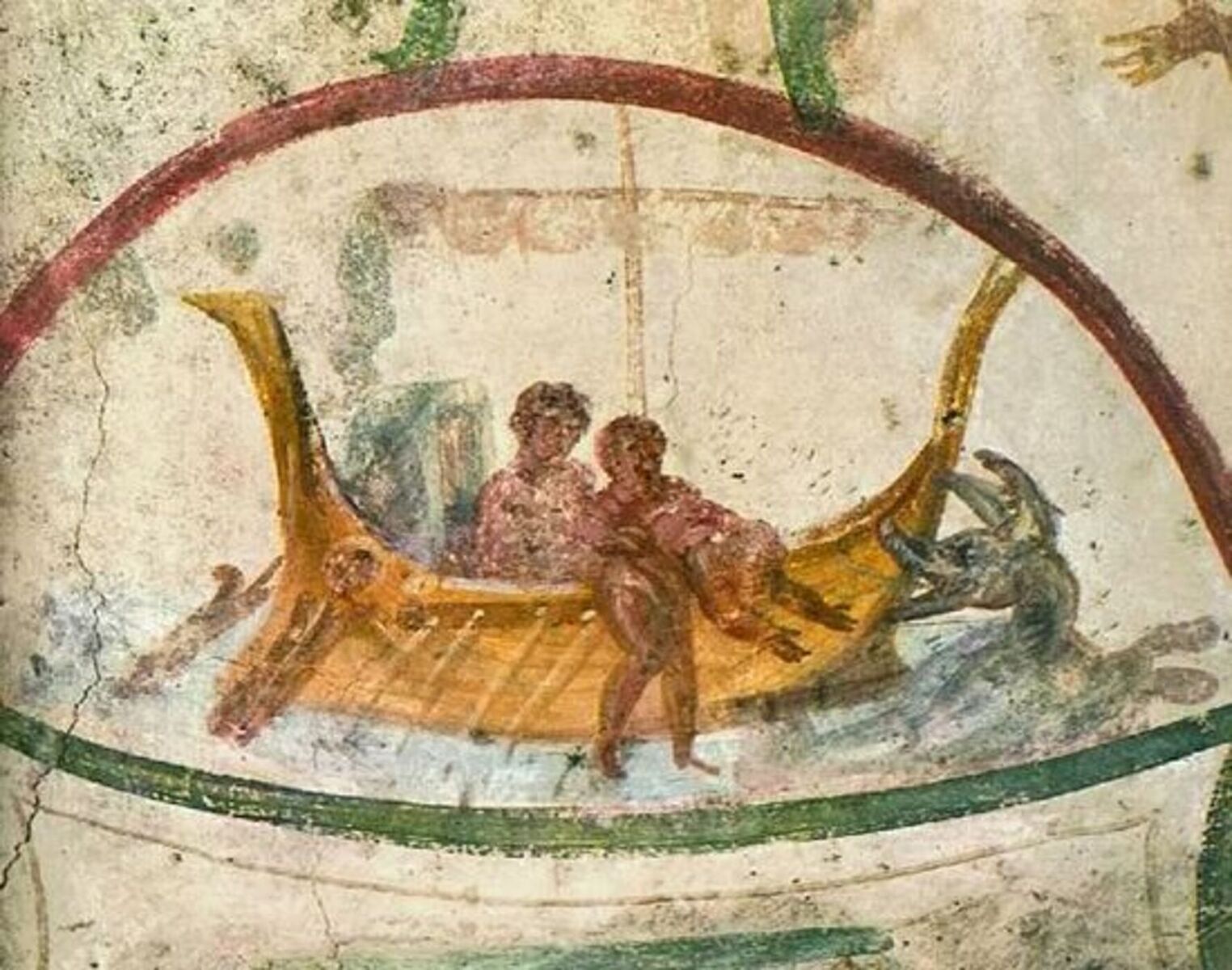
In the center is Christ as the Good Shepherd. Jonah is shown on both sides of the center. In the fresco on the left Jonah is thrown from the ship, and on the right the whale swallows him.
[larger]
The prophet Jonah
[larger]
[larger]
Christ as the Good Shepherd
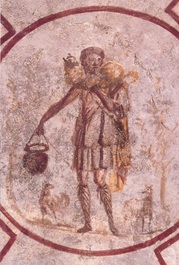
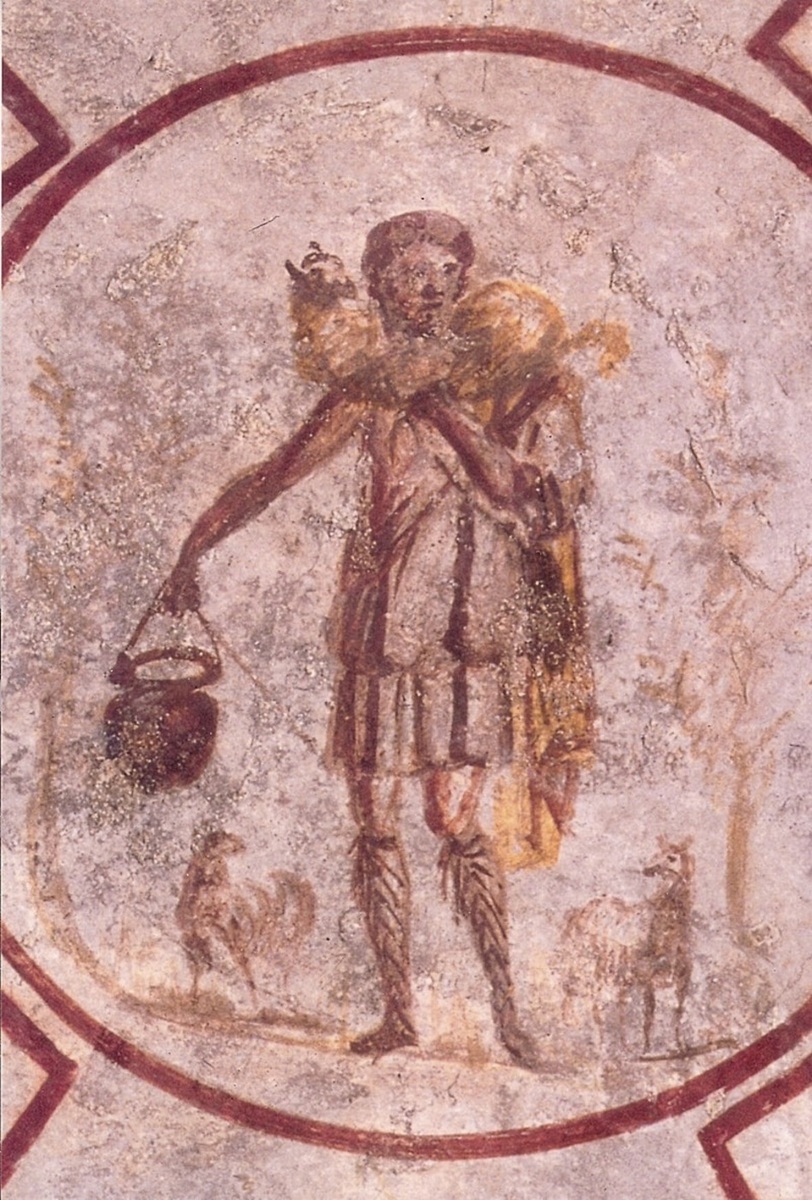
3rd century. Rome. The Catacomb of Callixtus (Callixitus Catacomb, Crypt of Lucina). One may suppose that the pail holds milk, a symbol of the Eucharist (see Clement of Alexandria).
[larger]
The Good Shepherd, Hisartepe necropolis, Nicaea (İznik)
c. 3rd century. The find is recent and the date is tentative (more). This necropolis was used from the 2nd to the 5th century.
Coordinates: 40.78204218462122, 29.928491677648932. The local name in Turkish: Hasartep Nekropolü.

[larger]


[larger] [version 2] [version 3] [version 4] [version 5] [version 6] [version 7]


[larger] [man and woman] [woman]


A wedding ring (Byzantium)
3rd–4th century. The Metropolitan Museum of Art, Fifth Avenue, USA. (Greek χάρις, “grace”)

[larger]

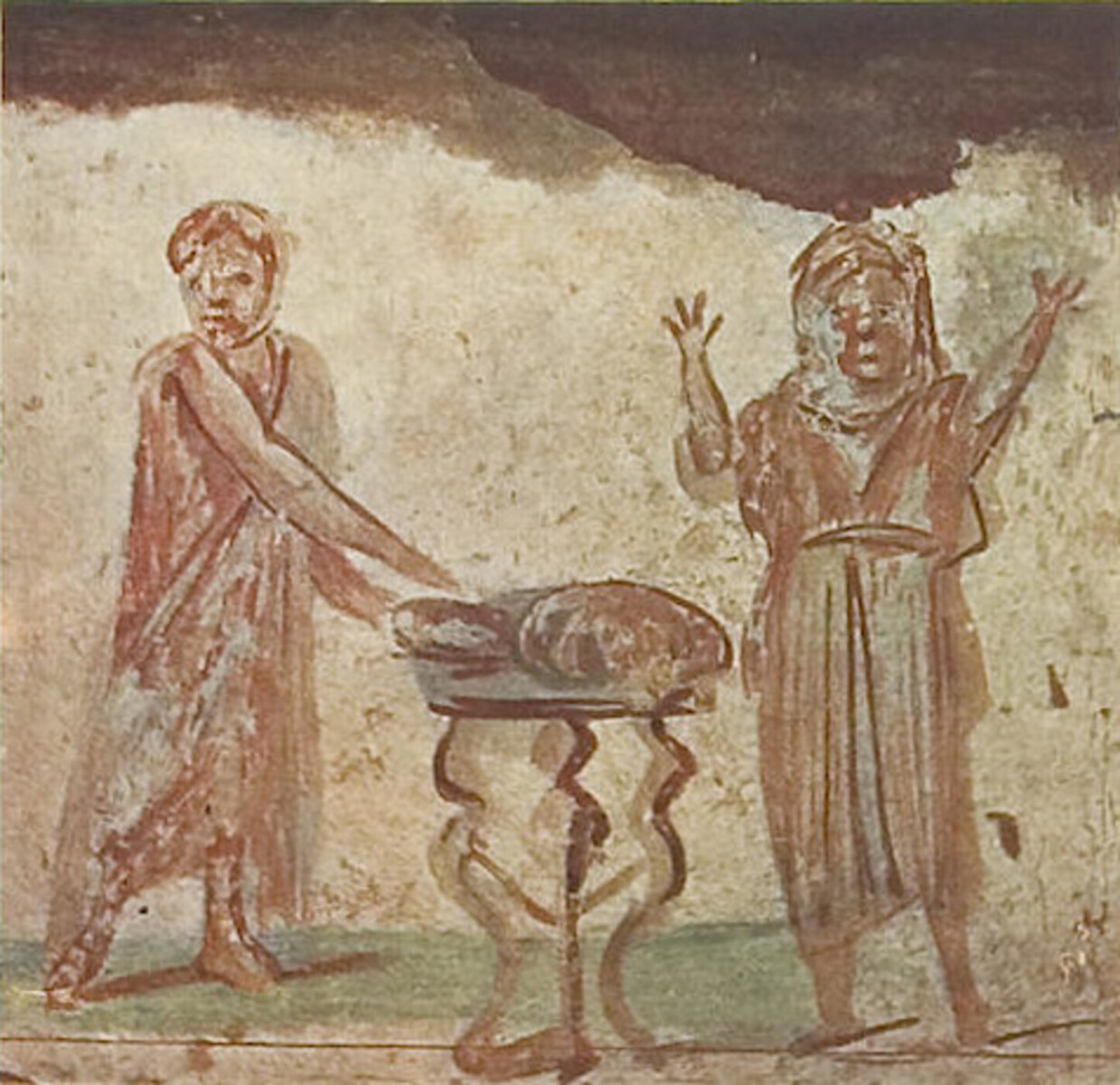
The celebration of the Eucharist
3rd century. Rome. The Catacomb of Callixtus (Callixitus Catacomb, Crypt of Lucina). Probably a priest is shown with a deacon serving with him. So the Eucharist is celebrated in Orthodox churches today too: the priest raises both hands, and the deacon points to the holy gifts.
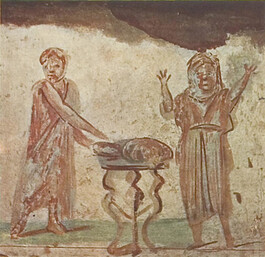
[larger]
4th Century
Christ (Rome)
The Catacomb of Commodilla.

[larger]


Christ and the apostles (Rome)
c. 350. [8][9] The Mausoleum of Santa Costanza.

[larger]


[larger]


[larger]

The Baptistery of San Giovanni in Fonte (Naples)

[larger]


[larger]

Christ and angels, the Second Coming (Thessaloniki, Byzantium)
Late 4th century. [17][18] The Rotunda of St George the Victorious (originally the tomb of Emperor Galerius).


The mosaic is poorly preserved. Of the image of Christ only a piece of the halo, a hand and the cross remain. The faces of the angels around are clearly visible.

[larger]

Holy bishops, soldiers, physicians (Thessaloniki, Byzantium)
Late 4th century. [17][18] The Rotunda of St George the Victorious (originally the tomb of Emperor Galerius).
Among the mosaics are images of holy bishops, soldiers, physicians and musicians with the names Romanus, Cyril, Leo, Onesiphorus, Eucarpius, Basiliscus, Porphyrius, Philemon, Priscus, Therinus, Cosmas and Damian.

[larger]


[larger]


[larger]


[larger]


[larger]


[larger]

Sts Cosmas and Damian

[larger]

An image of Christ crucified between the thieves (Rome)
Early 4th century [the doors are usually dated to c. 430]. The Basilica of Santa Sabina, one of the door panels. A carved relief of the Crucifixion.

[larger]

The Lord’s Entry into Jerusalem (Byzantium)
Early 4th century. The Metropolitan Museum of Art, Fifth Avenue, USA. 67.3 × 212.1 × 61.9 cm.

[larger]

Christ, a slab (Chersonesus)
300–500. The Louvre, France. The museum states that the other part is kept in the Hermitage. Words addressed to the apostle Peter are engraved on it.

[larger]

Christ the Teacher (Rome)
The Catacomb of Domitilla. Painting in the lunette of a cubiculum.

[larger]

The Lord Jesus Christ (Rome)
3rd–5th century. The Catacomb of Generosa [7]

[larger]


[larger] [version 2] [version 3] [version 4] [version 5] [version 6] [version 7]


[larger]


[larger]


[larger]


[larger]

Saints Viatrix and Simplicius (or Rufus) (Rome)
3rd–5th century. The Catacomb of Generosa [7]

[larger]

The apostles Peter and Paul (Rome)
c. 380. The Catacomb of Santa Tecla (St Thecla), fresco [24]
The apostles shown are Peter, Paul, Andrew and John.


The apostles Peter and Paul (Byzantium)
Mid-4th century. Christ gives the crowns of martyrdom to the apostles Peter and Paul. The Metropolitan Museum of Art, Fifth Avenue, USA. Rome or Byzantium. 13.8 × 12.5 × 5 cm.

[larger]

Mid-4th century. The Metropolitan Museum of Art, Fifth Avenue, USA. Rome or Byzantium. 8.5 × 14 × 13.3 cm.


Late 4th century. The Metropolitan Museum of Art, Fifth Avenue, USA. Glass, gold leaf.


Mid-4th century. The apostles Peter and Paul, Peregrina. The Metropolitan Museum of Art, Fifth Avenue, USA. 11.5 × 13.3 × 1.2 cm.

[larger]

The apostles Peter and Paul (Rome)
4th century. A slab used to close a child’s burial niche (loculus) in the catacombs. Rome, Vatican Museums, Pius Christian Museum.

[larger]

The Theotokos with the Child Christ (Rome)
3rd–4th century. The Catacomb of Domitilla.


[larger]

A cross with an image of Christ (Byzantium)
395–641. The Louvre, France. 8.5 × 20 × 1.2 cm.

[larger]

An icon (Egypt)
395–641. The Louvre, France. 24 × 17.5 cm

[larger]


[larger]

An ampulla with an icon of St Menas (Byzantium)
395–641. The Louvre, France.

[larger] [reverse side]


395–641. The Louvre, France. Ampullae like this are found in very large numbers in various museums. More examples: 1, 2, 3, 4, 5, 6, 7, 8, 9, 10, 11, 12, 13, 14, 15.

[larger]


[larger]

A lead ampulla with an image of the Theotokos and Christ (Italy, Bologna)
4th–5th century. “Such ampullae with holy oil from the holy places were brought in great numbers by pilgrims from the East, namely from Palestine, to which pilgrimages became established from the end of the 4th century and in great numbers in the first half of the fifth” [27]

[larger]

5th Century
The Theotokos with the Child Jesus, the martyrs Felix and Adauctus, the widow Commodilla (Rome)
5th–6th century. The Catacomb of Commodilla. In the left foreground is the widow Commodilla, a wealthy Roman woman in whose memory the catacomb church was built.


Christ and the Theotokos (Byzantium)
400–500. Material: gold. 3.7 × 4 × 0.3 cm; weight: 4.04 g. The Louvre, France.

[larger]

The martyr Lawrence (Ravenna)
425. The Mausoleum of Galla Placidia[1][2][25]. In the open cabinet are the 4 Gospels: Mark, Matthew, Luke and John. The saint, holding a cross and an open Gospel, goes toward the gridiron, under which a fire is burning.

[larger]

The apostle Paul (Ephesus)
A late 5th-century fresco in the Grotto of St Paul[4].

[larger]

The apostle Paul (Naples)
Late 5th century. The Catacombs of San Gennaro, fresco. Probably the apostle Paul is depicted.

[larger]

Thecla of Iconium, martyr (Ephesus)
The Grotto of Sts Paul and Thecla. She came to faith through the preaching of the apostle Paul, a martyr of the first centuries. In 2013 the grotto was desecrated by Islamist militants[4].

[larger]

The Great Martyr Demetrius of Thessaloniki and an angel (Thessaloniki, Byzantium)
5th–6th century. The Basilica of St Demetrius in Thessaloniki. A mosaic in the western part of the church [10]

[larger]

The Great Martyr Demetrius of Thessaloniki and a child (Thessaloniki, Byzantium)
5th–6th century. The Basilica of St Demetrius in Thessaloniki. A mosaic on the west wall of the south aisle [10]

[larger]

A senator’s house, Santa Pudenziana (Rome)

[larger]

Santa Maria Maggiore (Rome)

[larger]


[larger]

Christ, the three youths, the Magi (Northern Italy)
400–450. The Louvre, France. Silver, 6.3 × 12.3 × 7.1 cm.

[larger]


[larger]

An icon: the apostle Peter dictates the Gospel to St Mark (Egypt)
440–670. The Metropolitan Museum of Art, Fifth Avenue, USA. 13.5 × 10 × 0.8 cm. See also: 1, 2, 3, 4, 5.

[larger]

An unknown saint (Byzantium, Egypt)
5th–6th century. The Metropolitan Museum of Art, Fifth Avenue, USA. 44 × 32.5 cm.


An ampulla with an image of St Menas (Coptic Egypt)
5th–7th century. The Hermitage, Russia.

[larger]

5th–6th century. An ampulla with an image of St Menas (Egypt). The Metropolitan Museum of Art, Fifth Avenue, USA.

[larger]

5th–6th century. An ampulla with an image of St Menas (Egypt). The Metropolitan Museum of Art, Fifth Avenue, USA.

[larger]

A ring with an image of Christ (Egypt, Luxor)
5th–7th century. The Hermitage, Russia.

[larger]

6th Century
The Lord Jesus Christ (Sinai)
6th century. St Catherine’s Monastery, Egypt [3].

[larger] [version 2] [version 3]


The Theotokos with the Child Jesus, Saints Theodore and George (Sinai)
6th century. St Catherine’s Monastery. An encaustic icon, Egypt.


The apostle Peter (Sinai)
6th century. St Catherine’s Monastery. An encaustic icon, Egypt.

[larger] [version 2] [version 3]


The Theotokos and the Christ Child (Byzantium)
6th century. The Metropolitan Museum of Art, Fifth Avenue, USA.


A ring with an icon of the Theotokos and the Christ Child (Byzantium)
6th–7th century. The Metropolitan Museum of Art, Fifth Avenue, USA.

[larger]

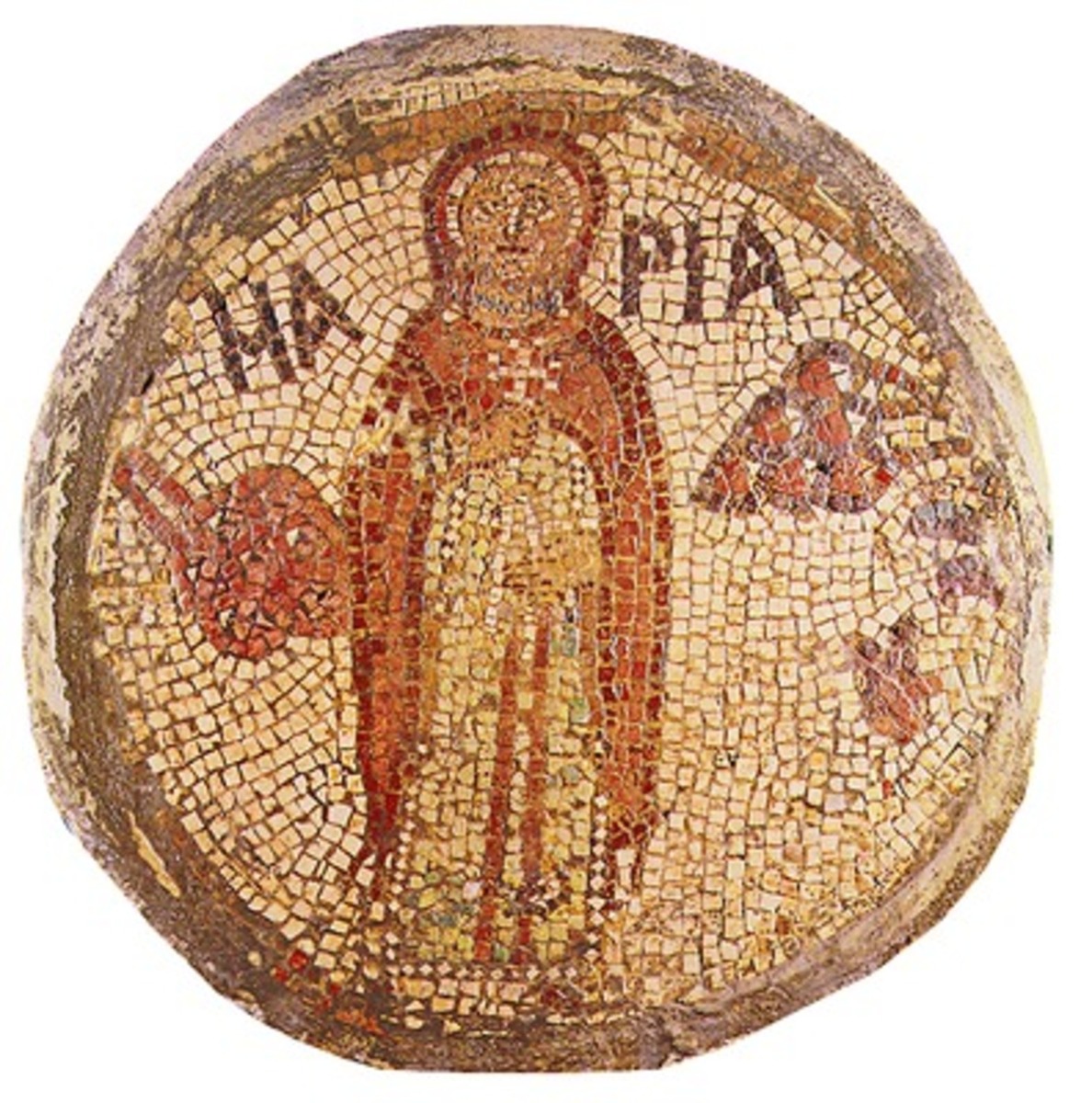
Saint Mary
611, Gerasa
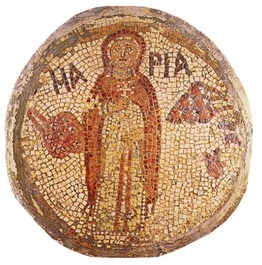
[larger]
Christ, a medallion (Antioch)
500–625. Material: silver, gilding. 14.9 × 14.1 × 1.1 cm. The Louvre, France.

[larger]

500–625. The Louvre, France.

[larger]

A tapestry with icons: Christ, the Theotokos, the archangels Michael and Gabriel, the apostles (Egypt, Byzantium)
500. The Cleveland Museum of Art, USA. Wool, 178.7 × 110.5 cm.
The museum’s commentary:
Made of wool threads in more than twenty colors, this rare tapestry was in its day more expensive than a painting. Its historical price reflected how highly contemporaries valued the masterly blending of colors achieved by the weavers. Hung on a wall, this woven icon allowed the faithful to venerate the Virgin and the Christ Child inside an Orthodox church. They are surrounded by angels and apostles, with their names written in Greek. To be spiritually effective, an icon (a sacred image) had to follow the established pictorial tradition of its image as closely as possible.
The inscription on the lintel of the architectural frame translates from the Greek as “Saint Michael, Saint Mary, Saint Gabriel”. The broad leafy border is decorated with fruit and flowers, and at the bottom with medallions bearing busts of the apostles, whose names are written beside them in Greek and translate as “Andrew, Matthew, the apostle Paul, Luke, James, Philip, Mark, Thomas, John, Matthias, Peter and Bartholomew”.

[larger]

A tapestry with icons. The three youths(?), a chi-rho (Egypt, Byzantium)
500s. The Cleveland Museum of Art, USA. Wool, linen. 110.5 × 76.8 cm.

[larger]

A tapestry with icons. The Theotokos, the Magi, the prophet Jonah (Egypt, Byzantium)
500–550. The Cleveland Museum of Art, USA. Linen. 99.7 × 104.8 cm.
The museum’s commentary:
… On the left of the upper register the Virgin Mary with the Christ Child is shown on a stool with cross-shaped legs. As the Coptic inscription states, the three kings approach from the right, bearing gifts. The left of the middle register probably shows the Baptism of Christ, while three other figures, separated by columns, seem to illustrate the New Testament miracle in which Christ fed a great crowd with only five loaves and two fish. In the lower register the Old Testament scene of the prophet Jonah being swallowed by the whale is still recognizable.
Greek inscriptions identify various scenes from the Old and New Testaments. Above the first of the Magi in the upper register two letters “XP” can be made out, from the Greek word for gold (χρυσός, chrysós). On the left of the middle register two figures are shown: the first is almost completely destroyed, and the second is identified by the inscription “EIΩANNHC” (John). The lower register shows Jonah cast up on the shore, with a large fish beside him, accompanied by the inscription “EIΩNAC” (Jonah). Moses, almost entirely lost, can be identified only by his inscription “MWCHC” (Moses).

[larger]

Eucharistic chalices and censers with icons (Byzantium, Syria, Attarouthi)
500–650. The Metropolitan Museum of Art, Fifth Avenue, USA. Silver, gilding. On the chalices are icons of the Lord and the saints, and inscriptions saying by whom and to whom they were donated.
These finely made liturgical objects, chalices, censers, a strainer and an image of the dove of the Holy Spirit, belonged to a Christian church in the rich trading town of Attarouthi in Syria, then one of the richest lands of the Byzantine Empire. The chalices, censers and strainer were used at the Divine Liturgy, or Eucharist, the sacrament in which Christians partake of the consecrated wine and bread in memory of the Last Supper and the death of Christ.
According to their inscriptions, written in Greek with a few spelling variations, many of these objects were donated by local people to the town’s main church, dedicated to St Stephen, and to a smaller church dedicated to St John (probably John the Forerunner [the Baptist]).
At the beginning of the 7th century Syria fell first to the Sasanian Persians and then to the armies of Islam. These works were probably buried in haste in a protective container when the Byzantine army was retreating before those attacking the region.


John the Forerunner with long hair, the Theotokos in the orans posture (with raised hands), a saint in the orans posture, a soldier saint with a staff and a shield, the young Christ with a cross-nimbus, and another soldier saint in armor slaying a dragon (St George?), under arcades. The Metropolitan Museum of Art, Fifth Avenue, USA. 21.3 × 16 cm.
The Greek inscription: “For her salvation Eudoxia offered [this] as a gift to St Stephen of the village of Attar[outhi]”.

[larger] [version 2] [version 3] [version 4] [version 5]


A Eucharistic chalice with an icon of St John the Forerunner, a holy deacon (probably Stephen), holy bishops and crosses. The Metropolitan Museum of Art, Fifth Avenue, USA. 20.5 × 15.1 cm, 369 g, 1100 ml
The Greek inscription: “To St John of the village of Attarouthi”.

[larger]

A Eucharistic chalice with an icon of Christ, the Theotokos, John the Forerunner and George the Victorious. The Metropolitan Museum of Art, Fifth Avenue, USA. 24.3 × 16.8 cm.
The Greek inscription: “St Stephen of the village of Attarouthi”.

[larger] [version 2] [version 3]


A Eucharistic chalice with an image of the young Christ with a cross-nimbus, a holy deacon with a censer (probably St Stephen), the Virgin Mary in prayer and a young saint with a staff. Size: 23.9 × 17 cm, 356 g. The Metropolitan Museum of Art, Fifth Avenue, USA.
The Greek inscription: “In fulfillment of a vow and for the salvation of the one whose name the Lord knows”.

[larger] [version 2] [version 3] [version 4]


A censer with an image of the young Christ with a cross-nimbus, St John the Forerunner, the Virgin Mary in prayer, a holy deacon (probably St Stephen) and crosses. Silver and gilded silver with a copper lining. Size: 41.5 × 13.2 × 12.6 cm. The Metropolitan Museum of Art, Fifth Avenue, USA.
The Greek inscription: “For the repose of the soul[s] of Erta and Stephen, the children of Kyriakos”

[larger] [version 2] [version 3] [version 4] [version 5]


A censer with an image of the young Christ with a cross-nimbus, two archangels and crosses. 8.2 × 13.2 cm. The Metropolitan Museum of Art, Fifth Avenue, USA.
The Greek inscription: “To St John of the village of Attarouthi”.

[larger] [version 2] [version 3] [version 4]


Eucharistic chalices with images of Christ and the saints, a paten with a cross (Syria, Byzantium)
500–700. The Cleveland Museum of Art, USA: 1, 2, 3, 4.
These four silver liturgical vessels, a paten and three chalices (inv. 1950.378–81), form what is now called the “Beth Misona Treasure”, named after the village in northern Syria for which they were made.
Although the exact place and circumstances of the find are unknown, the people of Beth Misona, like other Christian communities in Syria and Palestine, were probably forced to bury the church silver to hide it from the Persians or Arabs who conquered their lands in the first half of the 7th century.
The paten, on which the Eucharistic portions lay during the Liturgy, is decorated with an engraved Latin cross surrounded by a dedicatory inscription. It names the donor of the paten, Domnus, and its original location, the church of St Sergius in Beth Misona.
The chalices have wide cups decorated with busts of Christ, the Theotokos and the apostles Peter and Paul. One of the chalices has a dedicatory inscription with the name of the donor, Kyriakos son of Domnus, and of the priest of the church who received this pious gift, Zeno.
The Greek inscription: “+ The priest KYRIAKOS, son of DOMNUS, (offered this chalice) to St Sergius in the time of the priest Zeno”

[Christ] [Theotokos] [Apostle] [Apostle] [top view]


[Christ] [Theotokos] [Apostle] [Apostle] [top view]


[Christ] [Theotokos] [Apostle] [Apostle]


c. 500. A paten. The Cleveland Museum of Art, USA.

[larger]

A censer. The Baptism and Crucifixion of the Lord Jesus Christ (Byzantium)
500–899. Size: 13.4 × 9 cm. The Louvre, France.

[larger]


[larger]

A vase. Christ, the Theotokos, John the Baptist, apostles, angels (Constantinople)

[larger] [reverse side] [Christ] [Theotokos] [John the Baptist] [angel] [angel] [apostle] [apostle] [apostle]


A pectoral cross with an icon (Byzantium)
6th century. Gold, paste, rock crystal, glass; stamping, granulation. Chain length: 33 cm; cross: 4.9 × 3.8 cm. The Hermitage, Russia.

[larger]

A pendant. The Crucifixion of Christ (Egypt)
500–700. Size: 3.3 × 1.9 cm. The Louvre, France.

[larger]

An icon of two saints (Byzantium)
6th century; 25.5 × 22 × 1.3 cm. Perhaps the evangelists Matthew and John. The Metropolitan Museum of Art, Fifth Avenue, USA.


Icons of the apostles Peter and Paul (Antioch)
550–600. The apostle Peter. The Metropolitan Museum of Art, Fifth Avenue, USA. Silver. 38.1 × 55.9 × 2.2 cm.

[larger] [even larger]


550–600. The apostle Paul. The Metropolitan Museum of Art, Fifth Avenue, USA. Silver. 38.1 × 55.9 × 2.2 cm.

[larger] [even larger]


An icon (Syria?, Byzantium)
500s. The Cleveland Museum of Art, USA.

[larger]

An image of a soldier saint (Coptic Egypt)
6th–7th century. The Hermitage, Russia.

[larger]

An ampulla with an icon of the apostle Paul (?) and St Thecla (Egypt)
500–700. The Louvre, France.

[larger]


[larger]

An ampulla with an icon of the apostle Andrew (Smyrna)
500–600. The Louvre, France. 7 × 5 × 2.8 cm.

[larger]

Ampullae with an icon of St Menas
610–650. An ampulla with an image of St Menas (Egypt). The Metropolitan Museum of Art, Fifth Avenue, USA. 8.5 × 6.9 × 1.8 cm.

[larger]

500–750. The Louvre, France. 13 × 10.6 × 3.4 cm.

[larger]


[larger]

Christ (Ravenna)
The church of Sant’Apollinare in Classe, Ravenna, Italy.

[larger]

Christ and the apostles (Ravenna)
Mosaic of the presbytery. The church of San Vitale, Ravenna, Italy.

[larger]

Christ, angels and Vitalis (Ravenna)
6th century. The Basilica of St Vitalis of Milan, Ravenna.

[larger]

The right-believing Emperor Justinian (Ravenna)
6th century. The Basilica of St Vitalis of Milan, Ravenna.

[larger]

The right-believing Empress Theodora (Ravenna)
6th century. The Basilica of St Vitalis of Milan, Ravenna.

[larger]

The forefather Abraham (Ravenna)
6th century. The Basilica of St Vitalis of Milan, Ravenna.

[larger]

Abel and Melchizedek (Ravenna)
6th century. The Basilica of St Vitalis of Milan, Ravenna.

[larger]

Marcellinus, Pollio, Peter, saints (Rome)
6th century. The Catacomb of Pontian. Fresco.

[larger]

Christ coming on the clouds, the apostles and Sts Cosmas and Damian (Rome)
6th century (530). The Basilica of Sts Cosmas and Damian. [19][20]

[larger]

The apostle Peter and St Cosmas (beyond them St Theodore)

[larger]

The apostle Paul and St Damian (beyond them Pope Felix)

[larger]

A holy angel

[larger]

Christ and the apostles (Rome)
6th century (578–590). The Basilica of St Lawrence outside the Walls (San Lorenzo fuori le Mura) [21][22]
Beside the apostle Paul are Sts Stephen and Hippolytus. Beside the apostle Peter is St Lawrence.

[larger]


[larger]

The apostles Peter and Paul (Franks)
6th–8th century. The Metropolitan Museum of Art, Fifth Avenue, USA (also here). Ivory. 29.2 × 11.4 × 0.5 cm.

[larger]

Saints (Byzantium, Egypt)
6th–7th century. The Metropolitan Museum of Art, Fifth Avenue, USA.

[larger]

St Phocas (Byzantium, Chersonesus)
6th century. A stamp for making eulogia with a relief image of St Phocas of Sinope standing in a boat. The Hermitage, Russia.

[larger]

An ampulla with two images of saints (Asia Minor, Ephesus)
6th century. The Hermitage, Russia.

[larger]

An ampulla with images of an evangelist and a saint: John the Theologian and Prochorus (Ephesus)
6th century. The Hermitage, Russia.

[larger]

A molybdobull (lead seal) with an image of Sts Peter and Paul and a Latin inscription (Byzantium)
6th–7th century. The Hermitage, Russia. Another exhibit.

[larger]


[larger]

A molybdobull with an image of Christ (Byzantium)
6th–7th century. The Hermitage, Russia.

[larger]

A molybdobull with an image of Christ and a monogram (Byzantium)
6th–7th century. The Hermitage, Russia.

[larger]

7th Century
An icon of Christ on a wedding ring (Byzantium)
600–700. Greek inscriptions on the ring: ΟΜΟΝΟΙΑ, “concord”; ΕΙΡΙΝΗΝ ΤΗΝ ΕΜΙΝ ΔΙΔΟΜ, “my peace I give you” (John 14:27). The Louvre, France.

[larger] [version 2] [version 3]


An ampulla with an icon. Christ, the Crucifixion and the Ascension (Palestine, Byzantium)
Early 600s. The Cleveland Museum of Art, USA. Tin-lead alloy with leather parts.

[larger] [version 2] [version 3]


The Theotokos and the Great Martyr Theodore Stratelates (Thessaloniki, Byzantium)
7th–10th century (?). The Basilica of St Demetrius in Thessaloniki. A mosaic on the south face of the north pier.

[larger]

The Great Martyr Demetrius and the founders, an archbishop and a prefect (Thessaloniki, Byzantium)
7th century. The Basilica of St Demetrius in Thessaloniki. Mosaic.

[larger]

St George and children (Thessaloniki, Byzantium)
7th century. The Basilica of St Demetrius in Thessaloniki. The mosaic is in the western part of the sanctuary.

[larger]

St Sergius (Thessaloniki, Byzantium)
7th century. The Basilica of St Demetrius in Thessaloniki. A mosaic on a sanctuary pier.


An icon of the holy prophet David (Constantinople, Byzantium)
629–630. The Metropolitan Museum of Art, Fifth Avenue, USA. Silver. 26.6 × 4 cm, 1397 g. See also: 1, 2.

[larger]

A molybdobull with an image of a saint and an inscription (Byzantium)
7th century. The Hermitage, Russia.

[larger]

A molybdobull with a bust of Christ and a monogram (Byzantium)
7th century. The Hermitage, Russia.

[larger]

A molybdobull with an image of Christ and a monogram (Byzantium)
7th century. The Hermitage, Russia.

[larger]

8th Century
The Theotokos and the Child Jesus (Constantinople, Byzantium)
The Church of the Wisdom of God (Hagia Sophia).

[larger]

The Archangel Gabriel (Constantinople, Byzantium)
The Church of the Wisdom of God (Hagia Sophia).

[larger]

Christ, the Crucifixion and the Resurrection (Metz, France)
870. The Louvre, France.

[larger]

Christ, the Crucifixion (Reims, France)
870–880. The Louvre, France.

[larger]

9th Century
The Ascension of Christ (Thessaloniki, Byzantium)
9th–10th century. The Rotunda of St George the Victorious (originally the tomb of Emperor Galerius). Fresco [17][18]

[larger]

Christ, a bronze medallion (Byzantium)
9th–10th century. Round images are called medallions. The British Museum. Diameter: 3.5 cm.
Circular medallion; bronze; bust of Christ with cruciferous nimbus holding the book of the gospel in his left hand; inscription either side.

[larger]

The Dormition of the Theotokos (Byzantium)
Late 9th century. The Metropolitan Museum of Art, Fifth Avenue, USA. Material: ivory. 18.6 × 14.8 × 1.1 cm.
New York. The Metropolitan Museum of Art. "The Glory of Byzantium,". Images of the Koimesis, or the Dormition in the West, show the Virgin lying on a bier, while her soul, represented as a baby, is offered by Christ to attendant angels who will take it to heaven. The apostles, led by Saints Paul and Peter, stand witness.

[larger]

Christ, the Theotokos, John the Baptist, apostles and other saints (Constantinople)
940–960. The Louvre, France.

[larger]

A plaque with an image of Christ and the apostles (Italy)
9th century. The Hermitage, Russia. Size: 12.2 × 10.5 cm

[larger]

10th Century
Christ, the Theotokos, John the Baptist (Byzantium)
10th century. The British Museum. Material: ivory. Height: 15.5 cm.
Panel; ivory; carved with standing figures, Christ with the Virgin Mary and St John, below a pierced canopy; four holes for attachment in the raised border.

[larger]

The Theotokos and the Christ Child (Constantinople, Byzantium)
950–1025. The Cleveland Museum of Art, USA.

[larger]

A pendant with an image of Christ and the Theotokos (Byzantium)
1000–1300. The Metropolitan Museum of Art, Fifth Avenue, USA. Chalcedony cameo; gold mount with pearls, emeralds, garnets, sapphires and sardonyx inlay. Overall: 7.2 × 5.5 × 1.6 cm. Chalcedony: 1 1/2 × 1 1/4 in. (3.8 × 3.2 cm)

[larger]


[larger] [even larger]


A cross with an image of Christ (Byzantium)
10th–11th century. Bronze. 6.6 × 4.2 cm. The Hermitage, Russia.

[larger]

A cross with an image of Christ (Byzantium)
10th–11th century. Bronze. 7.7 × 7 cm. The Hermitage, Russia.

[larger]

A cross with icons of saints (Chersonesus)
10th century. Bronze, engraving. The Hermitage, Russia.

[larger]

St Demetrius of Thessaloniki (Byzantium)
950–1000. The Metropolitan Museum of Art, Fifth Avenue, USA. Material: ivory. 19.7 × 12.1 × 1 cm.
Standing erect, a spear in his hand and a shield at his side, Saint Demetrios is shown ready to protect the Christian faithful. The name of the popular Byzantine military saint is inscribed in two parts in Greek. Martyred in Thessalonike, the second most important city of the empire in the early centuries of the church, he has long been the patron saint of that metropolis. Images of saints in military dress are rare in Early Byzantine art (they appear on the chalices of the Attarouthi Treasure) but typical of the Middle Byzantine period.

[larger]

11th Century
A processional cross: Christ, the Theotokos, the archangels Michael and Gabriel (Byzantium)
1000–1050. The Metropolitan Museum of Art, Fifth Avenue, USA. 59.5 × 43 × 2.2 cm.

[larger]

A processional cross: Christ, the Theotokos, John the Baptist (Byzantium)
1050. The Cleveland Museum of Art, USA.

[larger]

A processional cross: St Sabbas (Byzantium)
1050. The Metropolitan Museum of Art, Fifth Avenue, USA. In the center of the reverse is St Sabbas, and at the ends other holy monks. Silver. 32.4 × 44.8 × 5.7 cm.

[larger]

A processional cross: Christ (Chersonesus)
11th century. Material: bronze, iron; casting, chasing, engraving. Size: 36.5 × 27.5 cm. The Hermitage, Russia.

[larger]

Part of the icon “Christ Pantocrator” (Byzantium, Crimea)
1050–1100. The Hermitage, Russia.

[larger]

The Theotokos with the Christ Child (Constantinople)
1000–1015. The Louvre, France.

[larger]

The Theotokos Orans (Constantinople)
1000–1200. The Louvre, France.

[larger]

The Theotokos, the Archangel Michael, St Theodore (Byzantium)
11th–12th century. The British Museum. 108 × 95 mm.
Relief icon; rectangular bronze plaque cast in low relief with full-length Hodegetria flanked by the Archangel Michael and St Theodore, each wearing a girdled tunic beneath a chlamys with decorated tablion; the figures are identified by intaglio inscriptions; the whole is surrounded by a raised border with a running vine scroll; traces of solder at sides and back.

[larger] [even larger]


An icon of St Demetrius (Byzantium)
1040–1060. The Louvre, France. 9.4 × 6.3 × 0.6 cm.

[larger]

A molybdobull with an image of St Demetrius and an inscription (Byzantium)
11th century. The Hermitage, Russia.

[larger]

A molybdobull with a half-length image of a saint (Byzantium)
11th century. The Hermitage, Russia.

[larger]

A hanging seal with an image of a saint (Byzantium)
11th century. The Hermitage, Russia.

[larger]

A hanging seal with an image of a saint (Byzantium)
11th–12th century. The Hermitage, Russia.

[larger]

12th Century
Christ, the Theotokos, the prophet John (Constantinople, Byzantium)
The Church of the Wisdom of God (Hagia Sophia). A fresco of the church[5]

[larger]

Christ (Constantinople, Byzantium)
The Church of the Wisdom of God (Hagia Sophia).

[larger]


[larger]

The Theotokos (Constantinople, Byzantium)
The Church of the Wisdom of God (Hagia Sophia).

[larger]

John the Baptist, prophet (Constantinople, Byzantium)
The Church of the Wisdom of God (Hagia Sophia).

[larger]

The Theotokos with the Child Jesus (Constantinople)
First third of the 12th century. The Vladimir icon of the Theotokos. Wood, tempera.

[larger]

The Theotokos (Byzantium, Syria, Tartus)
12th century. The British Museum. Material: ivory, 41 × 47 mm.
Relief icon; pale grey-green steatite; rounded at the top and square below; bust of the Virgin, her mantle drawn over her head, with St Andrew's cross on it; her hands held in front with palms outwards, inscription either side of her.

[larger] [even larger]


The Great Martyr Demetrius of Thessaloniki and a deacon (Thessaloniki, Byzantium)
12th century. A mosaic on the east face of the south pier.

[larger]

An icon of the Theotokos Hodegetria (Byzantium, Chersonesus)
Second half of the 12th century. The Hermitage, Russia. 6.8 × 5 cm

[larger]

13th Century
The Lord Almighty (Mount Athos)
Hilandar Monastery, the Holy Mountain Athos.

[larger]

The Theotokos with the Child Jesus (Hodegetria, Mount Athos)
Hilandar Monastery, the Holy Mountain Athos.

[larger]

14th Century
The Lord Almighty
Iconographer Manuel Panselinos.

[larger]

The Theotokos (Thessaloniki)
1310–1315. Orans. A fresco in the church of St Nicholas Orphanos in Thessaloniki, Greece.

[larger]

The Entry of the Most Holy Theotokos into the Temple (Constantinople)
c. 1316–1321. Kariye Camii, the Chora Monastery, Istanbul (Constantinople), Turkey.

[larger]

15th Century
The apostle Paul (Rus’)
1410s. By St Andrei Rublev. The State Tretyakov Gallery, Moscow, Russia.

[larger]

Icon Collections
A collection of catacomb iconography, Word file: link
Works of the iconographer Manuel Panselinos (13th–14th centuries): https://vk.com/album-20034910_224123875