
Orthodox Christians are accused of idolatry: icons are called idols, and the veneration of icons is called idolatry. This article examines these accusations, going through the subject of the veneration of icons according to Holy Scripture.
First we will offer a short answer, then we will look at the criticism in a little more detail, and in conclusion we will give the most detailed answer with an examination of Scripture.
The Shortest Defense of the Veneration of Icons
In the times before the Incarnation of God, when establishing the law for Old Testament Israel, God did not reveal images of Himself, and He also forbade making images of false gods (idols) and venerating them (Ex. 20:4-5; Deut. 5:8-9; Deut. 4:15-19), but God commanded His holy servants to be depicted (Ex. 25:1; 26:1; 25:18-20), and the prophets bowed down before sacred objects bearing images (Josh. 7:6; Ps. 5:7). The Orthodox have exactly the same attitude toward the veneration of sacred objects with images as the prophets had.
Moreover, by God’s design the temple itself is an icon of heaven (Ex. 25:8-9,40; Heb. 9:24; Act. 7:44). God commanded the temple to be revered (Lev. 19:30; 26:2); the temple was revered, and people bowed down before it (Ps. 5:7; 99:5; 132:7). This is precisely the Orthodox veneration: in venerating the image, we venerate the prototype.
Any justification that anyone may wish to apply to the prophets’ veneration of sacred objects with images is applicable to the Orthodox veneration as well (because it is one and the same), just as any condemnation that anyone may wish to turn against the Orthodox veneration is also turned against the prophets’ veneration.
The point here is not at all images and their veneration. Since an idol is any false notion of God, the point is how 1) the image itself and 2) the meaning with which the venerator invests it relate to the truth. If at least one of the two is fundamentally false, then it will be idolatry[1], which leads a person away from the truth. This is exactly the problem: an idol does not lead to God; a false notion of God does not lead to the true God, since a lie does not lead to the truth, but away from it[2].
Let us briefly test this statement in a dialogue with an opponent of the veneration of icons:
Opponent of icons: Bowing before objects is idolatry.
Orthodox: So the prophets of God, bowing before the temple and the ark with images, became idolaters?
Opponent: God only said to depict, but He did not say to venerate or to bow down.
Orthodox: So the prophets did what they should not have done, what was not written, not commanded — that is, they fell into idolatry?
Opponent: The prophets did not bow to the temple or the ark themselves, but referred this bowing to God.
Orthodox: Exactly. The Orthodox also bow not to wood and paint, but to the person depicted, which is what the teaching says: through the image we venerate the prototype, just as the prophets did. There is no difference.
And so on. This rule will always work, because there is no difference between the prophets’ veneration and the Orthodox veneration. Now let us examine the question in more detail.
Opponents of Icons Say: “The Word of God Clearly Says: Do Not Make Images, but You Make Them”
Answer: this is an Old Testament prohibition from the Law of Moses on depicting God alone, as is clear from the context:
the first 4 commandments are specifically about God (Ex. 20:4-5; Deut. 5:8-9),
when establishing the prohibition, God gives its reason: at the time the Law was given, God did not reveal precisely His own image (Deut. 4:15-19): since you did not see God, do not depict Him.
Thus the prohibition concerns images of God specifically, but as for His holy servants, God not only did not forbid depicting them, He even commanded it (Ex. 25:1; 26:1), and the righteous bowed down to the temple and to the sacred objects with these images (Josh. 7:6; Ps. 5:7; 99:5; 132:7).
The Old Testament church had icons, and they were venerated. First of all, the Old Testament temple itself is an icon. As an earthly building, by God’s original design it was to become an image of what takes place in heaven. God commanded the prophet Moses to build the temple not because He needed a temple (God did not need it: Isa. 66:1; Ps. 50:13; Isa. 1:11), but He commanded the temple to be made precisely as an icon of heaven, as an image of the heavenly reality shown to the prophet (Ex. 25:8-9,40; Heb. 9:24; Act. 7:44). God commands this icon to be revered (Lev. 19:30; 26:2). The prophet David bows down to it (Ps. 5:7; 99:5; 132:7). When wicked kings set up pagan idols in the temple (2 Kin. 21:3-7), that is, damaged the image of the heavenly reality, God rejected the temple (2 Kin. 23:27).
It is precisely because the temple is an icon of heaven that in the New Testament it undergoes changes (in its internal arrangement and images), since the heavenly reality changes too. In the Old Testament only angels dwelt in the heavenly reality in a spiritually visible way. God was completely invisible and immaterial, and people did not yet attain life in heaven (more).
In the New Testament, or rather with the coming of the Lord Jesus Christ, great changes took place:
God became visible in His humanity (John. 1:18; 1 John. 1:1-2);
God took His throne in heaven visibly (Eph. 1:20-21; Rev. 3:21);
People appeared in heaven, having received the possibility of attaining life with the Lord Jesus Christ (Rev. 6:9-11; 14:1,3-5);
God makes the New Covenant (Jer. 31:31; Heb. 8:8; Luke. 22:20; 1 Cor. 11:25). The Old Covenant ended together with the Law of Moses (Rom. 7:6; Gal. 3:21-25; Eph. 2:14-16). The prohibition on depicting God loses its force, since it was part of the Law of Moses, which was abolished with the coming of Christ (more).
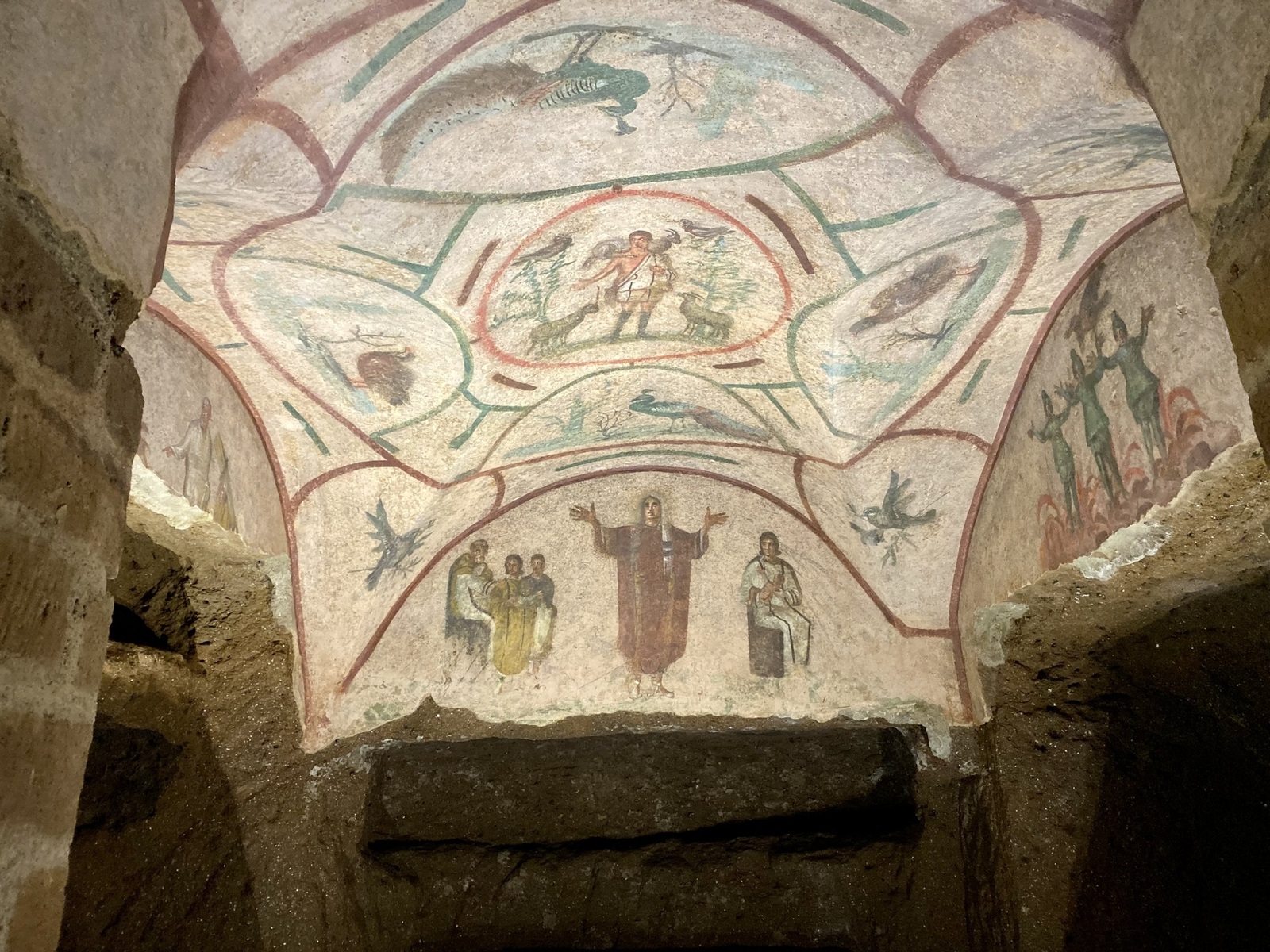
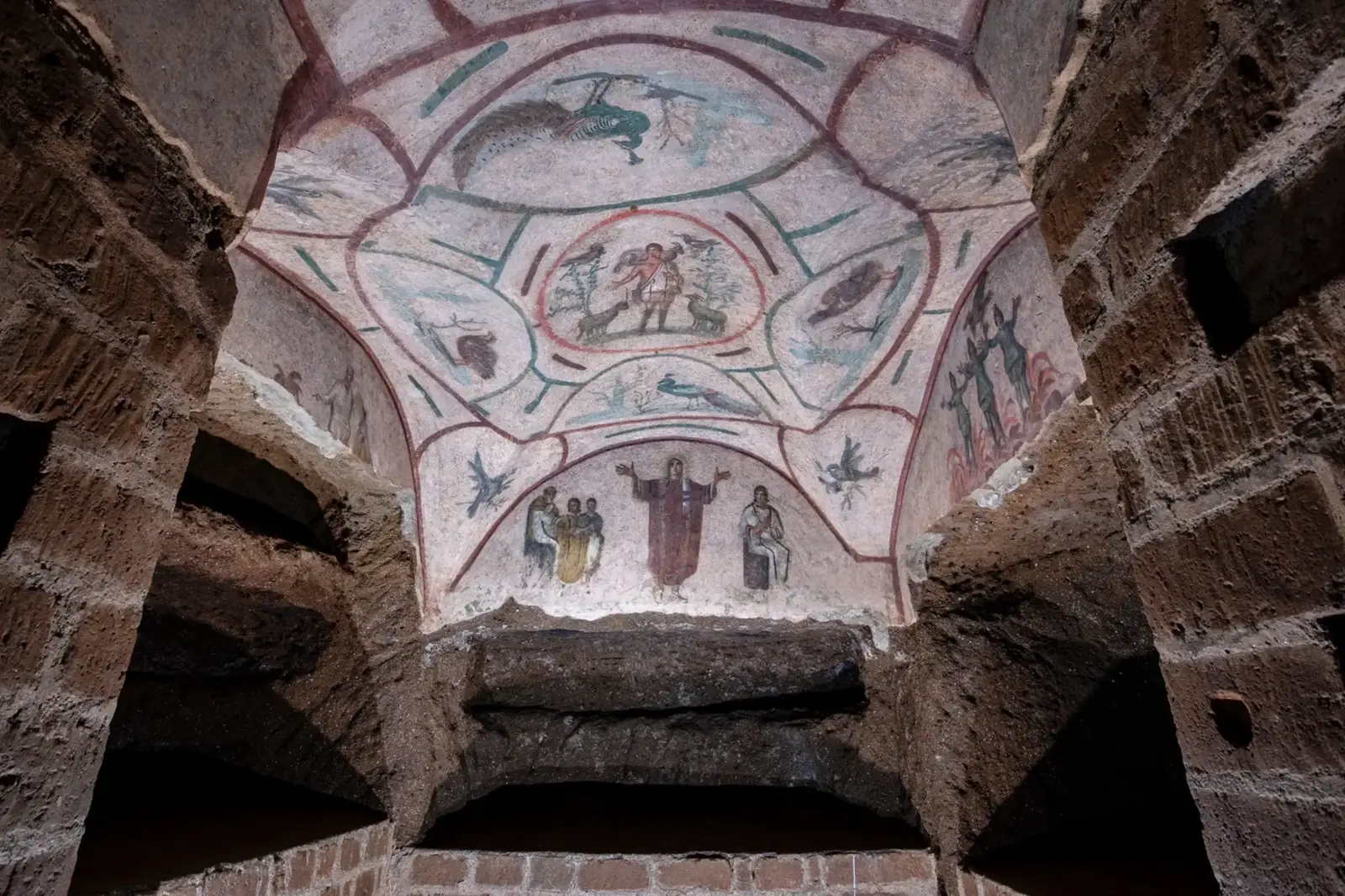
So the Old Testament temple was an image of the Old Testament heavenly reality, which changed in the New Testament. The former one no longer exists. And since the temple by God’s original design was an image of the heavenly reality, after that reality changed there is no longer any sense in depicting the old one. Therefore Christians from the most ancient times have depicted the new heavenly reality, placing at the head of everything the image of Jesus Christ (God), who has manifestly taken His throne in heaven, and around Him — the images of His holy servants: now no longer only angels, but also people.
A symbolic event is the damage to the temple in Jerusalem after the sacrifice of Christ:
“Then, behold, the veil of the temple was torn in two from top to bottom; and the earth quaked, and the rocks were split, and the graves were opened; and many bodies of the saints who had fallen asleep were raised; and coming out of the graves after His resurrection, they went into the holy city and appeared to many” (Matt. 27:51-53)
And in the 70s the temple was destroyed altogether by the Romans, giving way for all the following millennia to a new image of the heavenly reality — the Orthodox church.

[larger]

More ancient icons here: https://bibleox.com/ru/ru/w/древние-иконы
Not only the Old Testament image of the heavenly reality became obsolete, but also the Old Covenant itself, an integral part of which was the Law of Moses, which has now lost its significance. Besides the prohibition on depicting God, there are many other provisions that no longer apply in the New Testament:
“And whoever blasphemes the name of the LORD shall surely be put to death. All the congregation shall certainly stone him, the stranger as well as him who is born in the land. When he blasphemes the name of the LORD, he shall be put to death” (Lev. 24:16)
Blasphemy against the name of God is a sin against the 3rd commandment. The punishment under the Law of Moses is death (Lev. 24:16). As far as is known, opponents of icons do not teach that people should be killed for blasphemy against God. They demand that the Old Testament prohibition on depicting God be kept, showing the quote with the words “this is the word of God”, but the commandment to put blasphemers to death is also the word of God, it is also written clearly, yet they do not do it. Why? Because the Law of Moses has been abolished.
The 4th commandment establishes the Sabbath rest — abstaining from work (Ex. 20:8-10; Deut. 5:12-15; Lev. 19:3; Lev. 19:30). The punishment under the Law of Moses is death. This too is the word of God, it is also written clearly, but opponents of icons do not teach that people should be killed for breaking the Sabbath rest, and most of them do not even keep the Sabbath rest itself. Why? Because the Law of Moses has been abolished.
Thus, to forbid depicting God incarnate means:
to Judaize: to continue living according to the Law of Moses (incidentally, it is for the same reason that some collect the tithe);
to indirectly deny the Incarnation of God: either to deny that Christ is God, or to deny that He is visible.
Now let us examine the question in even more detail.
The 2nd Commandment of the Law of Moses
Opponents of icons consider icons a violation of the second commandment of the Law of Moses:
“You shall not make for yourself a carved image — any likeness of anything that is in heaven above, or that is in the earth beneath, or that is in the water under the earth; you shall not bow down to them nor serve them” (Ex. 20:4-5; Deut. 5:8-9);
The 10 commandments of Moses are divided into 2 parts (two tablets):
Four commandments about love for God;
Six commandments about love for one’s neighbor.
The 2nd commandment belongs to the expression of love for God and does not forbid any images and bows whatsoever, but forbids the making of objects to be venerated as gods instead of the only true God. In other words, this commandment forbids the worship of false gods. That is precisely why we see in the Bible both images and bows that do not contradict this commandment. More on this below.
“Do Not Make an Image”
God Commands Images to Be Made in His Temple
Although images are forbidden by the 2nd commandment, the same God who gave this commandment now commands images of cherubim to be made in His temple (the Tabernacle) on the curtains of the Tabernacle, on the veil leading into the Holy of Holies, and golden sculptures of cherubim to be made on the cover of the Ark of the Covenant:
“Then the LORD spoke to Moses, saying: <…> Moreover you shall make the tabernacle with ten curtains of fine woven linen and blue, purple, and scarlet thread; with artistic designs of cherubim you shall weave them” (Ex. 25:1; 26:1)
“You shall make a veil woven of blue, purple, and scarlet thread, and fine woven linen. It shall be woven with an artistic design of cherubim” (Ex. 26:31)
“And you shall make two cherubim of gold; of hammered work you shall make them at the two ends of the mercy seat” (Ex. 25:18)
In the later temple, which Solomon built, there were even more different images and sculptures:
“And he made the veil of blue, purple, crimson, and fine linen, and wove cherubim into it” (2 Chr. 3:14)
“In the Most Holy Place he made two cherubim, fashioned by carving, and overlaid them with gold” (2 Chr. 3:10)
“Inside the inner sanctuary he made two cherubim of olive wood, each ten cubits high” (1 Kin. 6:23)
The detailed arrangement of the temple: https://bibleox.com/ru/ru/w/иерусалимский-храм (in Russian)
To make the temple objects, God gave the craftsmen the gift of the Holy Spirit:
“Then the LORD spoke to Moses, saying: ‘See, I have called by name Bezalel the son of Uri, the son of Hur, of the tribe of Judah. And I have filled him with the Spirit of God, in wisdom, in understanding, in knowledge, and in all manner of workmanship, to design artistic works, to work in gold, in silver, in bronze, in cutting jewels for setting, in carving wood, and to work in all manner of workmanship’” (Ex. 31:1-5)
God Commanded an Image of a Serpent to Be Made
God also commands a bronze serpent to be made, so that people looking at it would be miraculously saved from snakebites:
“Then the LORD said to Moses, ‘Make a fiery serpent, and set it on a pole; and it shall be that everyone who is bitten, when he looks at it, shall live’” (Num. 21:8)
It is very important that this serpent was an image of Jesus Christ and was to point to His future sufferings on the Cross:
“And as Moses lifted up the serpent in the wilderness, even so must the Son of Man be lifted up, that whoever believes in Him should not perish but have eternal life” (John. 3:14-15)
This serpent was later destroyed by King Hezekiah, when the Israelites began to consider the serpent itself a god, giving it its own false name (Nehushtan), which had nothing to do with the true God. They forsook the true God, breaking the second commandment:
“and broke in pieces the bronze serpent that Moses had made; for until those days the children of Israel burned incense to it, and called it Nehushtan” (2 Kin. 18:4)
Do Not Bow Down to Images
Although bowing down to images is forbidden, the righteous constantly bow to people, to various objects, to angels; other people bow to prophets. No one condemns them for idolatry, because these bows are not made to false gods (idols).
Bowing to God in the Form of Angels
Abraham bows to God in the form of three men:
“Then the LORD appeared to him [IN THE FORM OF AN IMAGE] (Greek: θεὸς — God; Hebrew: יְהוָ֔ה — Yahweh) by the terebinth trees of Mamre, as he was sitting in the tent door in the heat of the day. So he lifted his eyes and looked, and behold, three men were standing by him; and when he saw them, he ran from the tent door to meet them, and bowed himself to the ground” (Gen. 18:1-2)
Why did God appear in the form of an image? Because God is invisible by nature; no one has ever seen Him (1 Tim. 6:16; John. 1:18).
Bowing to an Angel
It should be noted first that angels are spirits (Heb. 1:13-14), and spirits do not have flesh and bones (Luke. 24:39), that is, angels too appear to people in the form of people. Accordingly, if someone bows to an angel, he bows to the visible image of an invisible spirit (an angel):
“So He said, ‘No, but as Commander of the army of the LORD I have now come.’ And Joshua fell on his face to the earth and worshiped, and said to Him, ‘What does my Lord say to His servant?’” (Josh. 5:14)
Bowing to a Prophet
“Now when the sons of the prophets who were from Jericho saw him, they said, ‘The spirit of Elijah rests on Elisha.’ And they came to meet him, and bowed to the ground before him” (2 Kin. 2:15)
Bowing to the Temple
David bowed to the temple, which in itself was an icon of heaven (Lev. 19:30; 26:2), and was filled with images of the holy angels (Ex. 25:1; 26:1):
“But as for me, I will come into Your house in the multitude of Your mercy; in fear of You I will worship toward Your holy temple” (Ps. 5:7) (Greek: προσκυνήσω πρὸς ναὸν ἅγιόν σου — “I will bow down toward Your holy temple”)
And God commanded the temple to be revered (Lev. 19:30; 26:2).
Bowing to God’s Footstool (the Temple)
“Exalt the LORD our God, and worship at His footstool (pedestal, a stand for the feet, that is, the temple — note) — He is holy” (Ps. 99:5) (Greek: προσκυνεῖτε τῷ ὑποποδίῳ τῶν ποδῶν αὐτοῦ — “bow down to the footstool of His feet”)
“Let us go into His tabernacle; let us worship at His footstool” (Ps. 132:7)
Bowing Before the Ark
Joshua the son of Nun bowed before the Ark of the Covenant, on which there were sculptures of the holy cherubim:
“Then Joshua tore his clothes, and fell to the earth on his face before the ark of the LORD until evening, he and the elders of Israel; and they put dust on their heads” (Josh. 7:6)
Bowing to a Staff
To a staff: “Then he said, ‘Swear to me.’ And he swore to him. So Israel bowed himself on the head of the bed” (Gen. 47:31). In the LXX translation — to the staff (Greek: προσεκύνησεν Ισραηλ ἐπὶ τὸ ἄκρον τῆς ῥάβδου αὐτοῦ — “Israel bowed down upon the top of his staff”; also Heb. 11:21)
More examples: https://bibleox.com/ru/ru/w/поклоны (in Russian)
Pagan Faith in an Idol Breaks the 2nd Commandment
Pagan faith in an idol leads to the breaking of the 2nd commandment, since in any case it requires the worship of a false god who does not exist. Moloch, Baal, Zeus, Jupiter and Perun do not exist — they are false gods.
Pagan faith in an idol is of three kinds, beginning with the most widespread:
The idol is the god itself. The object made by the pagan (the idol) is itself the deity.
The idol is an image of a false deity, as if located far away, but which supposedly ought to look like this.
The idol is an invented image of a natural element (deified): the sea, the wind, rain, fire, the earth.
In all three cases a false god who does not exist is venerated. This is faith in a lie.
It is the first kind that we meet in the Bible. The most widespread pagan faith, a description of which can be found on the pages of the Bible, is the deification of the object itself (matter). A pagan could make himself a god from material at hand, or deify an already existing natural object or phenomenon: animals, a tree, a stone, mountains, the Sun, stars, the wind, the sea, a thunderstorm and other matter. The prophets denounce idolatry, saying that from one part of a tree the pagan prepared his food, and the other part of the same tree he called his god:
“He cuts down cedars for himself, and takes the cypress and the oak; he secures it for himself among the trees of the forest. He plants a pine, and the rain nourishes it. Then it shall be for a man to burn, for he will take some of it and warm himself; yes, he kindles it and bakes bread; indeed he makes a god and worships it; he makes it a carved image, and falls down to it” (Isa. 44:14-15)
“Now Laban had gone to shear his sheep, and Rachel had stolen the household idols that were her father’s. <…> And now you have surely gone because you greatly long for your father’s house, but why did you steal my gods?” (Gen. 31:19,30)
“calls upon a piece of wood <…> carved images were worshiped” (Wis. 14:1,16)
“The king said: ‘Do you not think that Bel is a living god? Do you not see how much he eats and drinks every day?’” (Bel and the Dragon (Dan. 14:6); translated from the Russian Synodal)
“Of what use to an idol is a sacrifice? For it can neither eat nor smell” (Sir. 30:19)
“this Paul has persuaded and turned away many people, saying that they are not gods which are made with hands. So not only is this trade of ours in danger(!) of falling into disrepute” (Act. 19:24-27)
Other similar passages from the Bible: https://bibleox.com/ru/ru/w/языческая-вера-в-идола (in Russian)
Ancient philosophers, as thinking people, in defending their pagan faith came to realize that material worked by human hands cannot be a god. They could express other judgments, saying that it is only an image of a god or an invented image of an element. But the 2nd commandment is still broken, because they worship a false god, and not the true God.
A pagan god becomes false not only because of its name or image. The lie about god shows itself also in the number of gods, in their abilities, their essential properties, and most importantly — in God’s will for His creation, which is revealed in the commandments.
For clarity, let us compare point by point.
Pagan Gods
a false name (Moloch, Baal, Zeus, Perun, etc.),
a false appearance (various human-like images),
false abilities (limited; many pagan gods have different abilities),
a false will (not the one the true God expressed in the commandments),
false essential properties (not eternity, not omnipresence, not omniscience, not boundlessness, not immortality, not holiness),
he calls to another place (a false one) and by another path (a false one).
The God in Whom the Orthodox Church Believes
the name of the true God from Holy Scripture (He Who Is, the Father, the Son, the Holy Spirit, Jesus Christ and others);
images through which He Himself revealed Himself to the world (the three angels with Abraham — Gen. 18:1-2, the dove — Luke. 3:22, and finally, in the form of a man, which the Son of God truly became — Jesus Christ);
it depicts the almighty Creator of the universe;
who calls to the fulfillment of the divine commandments (Christ is depicted with an open book in which His commandments are written);
it depicts God calling to life with Him through the way of the Cross (Christ is depicted on the Cross with a cruciform halo).
Thus the pagan considers the image to be a god, or an image of a (false) god, while the Orthodox Church depicts the true God, not considering the object itself (the icon) to be a god.
The Orthodox Church also depicts the friends of God: the Virgin Mary, the Theotokos, the angels, the apostles, the righteous. This is not a lie. They all really exist. And neither these holy people and angels themselves, nor their images, are considered gods.
All icons in the Orthodox Church are venerated on a par with the Gospel and the Cross as sacred objects. Their veneration refers to the true God and to His truly existing friends.
The Reason for the 2nd Commandment
So God not only did not forbid making images of the saints, but even commanded them to be made (Ex. 25:1; 26:1), but He did forbid, by the second commandment, making images of Himself. He explains the reason for the prohibition: when God gave the law, He did not reveal any image of Himself, so that the Israelites would not try to depict Him and then begin to serve the images and sculptures (statues) themselves as gods, instead of the only true God:
“Take careful heed to yourselves, for you saw no form when the LORD spoke to you at Horeb out of the midst of the fire, lest you act corruptly and make for yourselves a carved image in the form of any figure: the likeness of male or female, the likeness of any animal that is on the earth or the likeness of any winged bird that flies in the air, the likeness of anything that creeps on the ground or the likeness of any fish that is in the water beneath the earth. And take heed, lest you lift your eyes to heaven, and when you see the sun, the moon, and the stars, all the host of heaven, you feel driven to worship them and serve them, which the LORD your God has given to all the peoples under the whole heaven as a heritage” (Deut. 4:15-19)
This warning was very well founded, because at that time the whole planet Earth was pagan and worshiped such idols. Today one even has to explain that the pagan literally considered a product he had made with his own hands to be a god.
With the Coming of Christ, Changes Take Place
1. The Old Covenant and the Law of Moses Come to an End
“But now we have been delivered from the law, having died to what we were held by, so that we should serve in the newness of the Spirit and not in the oldness of the letter” (Rom. 7:6)
“Therefore the law was our tutor to bring us to Christ, that we might be justified by faith. But after faith has come, we are no longer under a tutor” (Gal. 3:24-25)
“For He Himself is our peace, who has made both one, and has broken down the middle wall of separation, having abolished in His flesh the enmity, that is, the law of commandments contained in ordinances, so as to create in Himself one new man from the two, thus making peace” (Eph. 2:14-15)
Christ makes the New Covenant, thereby bringing to an end the Old Covenant with the Law of Moses (Rom. 7:6; Gal. 3:21-25; Eph. 2:14-16). The prohibition on depicting God was part of the Law of Moses, which was abolished with the coming of Christ (more). The commandments given by God through Moses lose their literal meaning: we do not keep the Sabbath rest (and do not kill those who break the Sabbath rest), we do not sacrifice animals, we are not circumcised, we do not celebrate the Jewish feasts, we do not give the tithe, and very many other commands of the Law of Moses we do not fulfill. The Old Covenant and the Law of Moses have been abolished as such, and New Testament believers are called to be ministers of the spirit, not of the letter (2 Cor. 3:6), that is, to understand the reasons for this or that divine institution, to penetrate into their meaning and to keep the essence of the commandment.
The literal meaning of the 2nd commandment forbade depicting only God, but not His holy servants (Ex. 25:1; 26:1).
The essence of the 2nd commandment is not to worship false gods.
Accordingly, the Orthodox Church depicts the saints because this was never forbidden, but was even commanded (Ex. 25:1; 26:1), and the righteous bowed before those images (Josh. 7:6; Ps. 5:7). The depiction of God, on the other hand, was forbidden only in the Old Testament by the Law of Moses, because no one had seen God. And since the Law of Moses has been abolished, the prohibition on depicting God, as part of the Law of Moses, has also been abolished.
2. God Became Visible, Having Taken Human Nature (Having Become Incarnate)
In the Old Testament God forbids depicting Him, explaining that when the people received the Law, God did not reveal His image to them (Deut. 4:15-19). However, in making the New Covenant and giving a new teaching (Eph. 2:15), God revealed Himself, becoming visible in His human nature and abolishing the Law of Moses, and therefore now not only the saints can be depicted, but also God Himself in the form in which He revealed Himself:
“No one has seen God at any time. The only begotten Son, who is in the bosom of the Father, He has declared Him” (John. 1:18)
“That which was from the beginning, which we have heard, which we have seen with our eyes, which we have looked upon, and our hands have handled, concerning the Word of life — the life was manifested, and we have seen, and bear witness, and declare to you that eternal life which was with the Father and was manifested to us” (1 John. 1:1-2)
3. The Heavenly Reality Changes
The temple, as an earthly building, was by God’s design from the beginning an image of the heavenly reality: God commanded the prophet Moses to build the temple not because God needed a temple (He did not need it: Isa. 66:1; Ps. 50:13; Isa. 1:11), but He commanded the temple to be made precisely as an icon of heaven, as an image of the heavenly reality shown to the prophet (Ex. 25:8-9,40; Heb. 9:24). In the Old Testament there was one heavenly reality, and in the New — another. Formerly only angels dwelt in the heavenly reality in a spiritually visible way, since God is completely immaterial and invisible (the Son of God had not yet taken on visible human nature), while people did not yet attain life in heaven, but after death went down to Hades (more).
However, after the coming of Christ changes take place:
Christ God took His throne in heaven visibly (Eph. 1:20-21; Rev. 3:21);
People appeared in heaven (besides Christ Himself), having gained access to life with Christ in heaven (Rev. 6:9-11; Rev. 14:1,3-5; Heb. 12:22-24);
The heavenly reality has changed. The former one no longer exists. The temple in Jerusalem became an image of the past, not the present, heavenly reality. Therefore Christians from the most ancient times have depicted the new heavenly reality, placing at the head of everything the image of Jesus Christ (God), who has manifestly taken His throne in heaven, and around Him — His holy servants, now including people.
A symbolic event is the damage to the temple in Jerusalem after the sacrifice of Christ:
“Then, behold, the veil of the temple was torn in two from top to bottom; and the earth quaked, and the rocks were split, and the graves were opened; and many bodies of the saints who had fallen asleep were raised; and coming out of the graves after His resurrection, they went into the holy city and appeared to many” (Matt. 27:51-53)
And in the 70s the temple was destroyed altogether by the Romans, giving way for all the following millennia to a new image of the heavenly reality — the Orthodox church.
[larger]
More ancient icons here: https://bibleox.com/ru/ru/w/древние-иконы
God Made His Own Icons
No one has ever seen God:
“No one has seen God at any time. The only begotten Son, who is in the bosom of the Father, He has declared Him” (John. 1:18)
And yet God appeared many times in the form of an image (an icon):
God Appeared to Abraham in the Form of Three Angels
The three angels are not God as He really is, not what He is even before the creation of the world. That is, this is an image (in Greek — εἰκόνα [icon]) of God, and Abraham bows before an icon of God:
“Then the LORD appeared to him [IN THE FORM OF AN IMAGE] (Greek: θεὸς — God; Hebrew: יְהוָ֔ה — Yahweh) by the terebinth trees of Mamre, as he was sitting in the tent door in the heat of the day. So he lifted his eyes and looked, and behold, three men were standing by him; and when he saw them, he ran from the tent door to meet them, and bowed himself to the ground” (Gen. 18:1-2)
When Abraham bowed to the image of God in the form of three angels, did he serve God or images of God? Obviously, God.
God Visibly Wrestled with Jacob
“Then Jacob was left alone; and a Man wrestled with him until the breaking of day. <...> And He said, ‘Your name shall no longer be called Jacob, but Israel; for you have struggled with God and with men, and have prevailed.’ <...> So Jacob called the name of the place Peniel: ‘For I have seen God face to face, and my life is preserved’” (Gen. 32:24,28,30)
God Spoke with the Prophet Moses Through an Image
“Then He said, ‘Hear now My words: If there is a prophet among you, I, the LORD, make Myself known to him in a vision; I speak to him in a dream. Not so with My servant Moses; he is faithful in all My house. I speak with him face to face, even plainly, and not in dark sayings; and he sees the form of the LORD. Why then were you not afraid to speak against My servant Moses?’” (Num. 12:6-8)
God Descended Like a Dove upon Jesus Christ
“And the Holy Spirit descended in bodily form like a dove upon Him, and a voice came from heaven which said, ‘You are My beloved Son; in You I am well pleased’” (Luke. 3:22; Matt. 3:16; Mark. 1:10; John. 1:32)
Man Is an Icon of God
“So God created man in His own image (εἰκόνα — icon — image); in the image of God He created him; male and female He created them” (Gen. 1:27)
“This is the book of the genealogy of Adam. In the day that God created man, He made him in the likeness (εἰκόνα — icon) of God” (Gen. 5:1)
“Whoever sheds man’s blood, by man his blood shall be shed; for in the image (εἰκόνι — icon) of God He made man” (Gen. 9:6)
“for God created us for incorruption, and made us in the image (εἰκόνα) of his own eternity” (Wis. 2:23)
Jesus Christ Is the Image (Icon) of God the Father
“Let this mind be in you which was also in Christ Jesus, who, being in the form of God, did not consider it robbery to be equal with God” (Phil. 2:5-6)
“who being the brightness of His glory and the express image of His person, and upholding all things by the word of His power, when He had by Himself purged our sins, sat down at the right hand of the Majesty on high” (Heb. 1:3)
“whose minds the god of this age has blinded, who do not believe, lest the light of the gospel of the glory of Christ, who is the image (εἰκὼν) of God, should shine on them” (2 Cor. 4:4)
“giving thanks to the Father <...> and conveyed us into the kingdom of the Son of His love, <...> He is the image (εἰκὼν) of the invisible God, the firstborn over all creation” (Col. 1:12-15)
“Philip said to Him, ‘Lord, show us the Father, and it is sufficient for us.’ Jesus said to him, ‘Have I been with you so long, and yet you have not known Me, Philip? He who has seen Me has seen the Father; so how can you say, “Show us the Father”?’” (John. 14:8-9)
Whoever Does Not Honor the Image of the Father Does Not Honor the Father
“He who does not honor the Son does not honor the Father who sent Him” (John. 5:23)
Whoever Rejects the Image of the Father Does Not Have the Father
“Whoever denies the Son does not have the Father either; he who acknowledges the Son has the Father also” (1 John. 2:23)
Whoever Hates the Image of the Father Hates the Father
“He who hates Me hates My Father also. <…> but now they have seen and also hated both Me and My Father” (John. 15:23-24)
All Creation Must Bow Before the Image of the Father
“that at the name of Jesus every knee should bow, of those in heaven, and of those on earth, and of those under the earth” (Phil. 2:10)
God Heals Through the Image of the Saints
God grants people healing not only through the clothing left by the holy apostles (Act. 19:12), but even through the image of an apostle (his shadow):
“so that they brought the sick out into the streets and laid them on beds and couches, that at least the shadow of Peter passing by might fall on some of them. Also a multitude gathered from the surrounding cities to Jerusalem, bringing sick people and those who were tormented by unclean spirits, and they were all healed” (Act. 5:15-16)
God Does Not Give an Answer to Idolaters
“that I may seize the house of Israel by their heart, because they are all estranged from Me by their idols” (Ezek. 14:5)
“For when you offer your gifts and make your sons pass through the fire, you defile yourselves with all your idols, even to this day. So shall I be inquired of by you, O house of Israel? As I live,” says the Lord GOD, “I will not be inquired of by you” (Ezek. 20:31)
However, opponents of icons usually admit that Orthodox venerators of icons can have communion with God. But it is written in Scripture that God does not answer idolaters.
Can an Icon Save
The Orthodox are accused because someone may use expressions such as “the icon saved” or “the icon healed”. It is God who saves and heals, and although we do not usually use expressions like “the icon saved”, they are permissible if what is meant is that not the material of the icon itself, but God through the material, healed and saved.
An Apostle Saves
“if by any means I may provoke to jealousy those who are my flesh and save some of them” (Rom. 11:14)
“I have become all things to all men, that I might by all means save some” (1 Cor. 9:22)
A Wife Saves
“For how do you know, O wife, whether you will save your husband? Or how do you know, O husband, whether you will save your wife?” (1 Cor. 7:16)
The Apostolic Call to Save People
“And on some have compassion, making a distinction; but others save with fear, pulling them out of the fire, hating even the garment defiled by the flesh” (Jude. 1:22-23)
“Take heed to yourself and to the doctrine. Continue in them, for in doing this you will save both yourself and those who hear you” (1 Tim. 4:16)
Can Anyone Besides Christ Really Save?
Neither the apostle, nor wives and husbands, are saviors in the sense in which the Lord Jesus Christ is the Savior — the only Redeemer and Deliverer of mankind from death and hell, who grants resurrection and eternal life with God. However, the expressions “I will save”, as one can see, are allowed by the apostles. We understand the meaning of such expressions correctly — people can contribute to salvation: “For we are God’s fellow workers” (1 Cor. 3:9).
So too with an icon: it is not the icon that saves, but God who saves; God sends grace through an object. In the Bible we find many such examples, which will be discussed below.
On the Expression: An Icon Is a Window into the Spiritual World
An icon is a kind of window into the spiritual world. This expression has no mysterious meanings and is a figurative expression. It means only that, looking at an icon, we seem to look into the invisible spiritual world, as through a window.
Spiritual things are invisible, but the iconographer depicts the invisible visibly on the icon, using symbols. Thus, for example, the presence of divine grace in the saints is depicted as a halo around their heads; the absence of shadows means abiding in the divine light (which is not ordinary light and casts no shadows); meanings are contained in the gestures shown by the hands, in the colors of the clothing, in special marks on the clothing (the three stars of the Theotokos), in the surrounding objects, buildings, and space in general. Looking at all this, we learn something about the invisible spiritual world. It is precisely because of this that the expression is sometimes used that an icon is, as it were, a window into the spiritual world (more, in Russian).
Why does this have to be explained specially? Because one repeatedly encounters how opponents of the Orthodox Church, searching for something to build their accusations on, simply invent accusations to instill them in their followers, cultivating in them hatred for the Orthodox Church. Thus, for example, wishing to portray the Orthodox as vile sorcerers, opponents of the Church invent the idea that the Orthodox supposedly establish a connection with God through icons, as through some kind of energy portal, and therefore need icons in order to communicate with God. All this is simply untrue.
The Orthodox Church calls believers to prayer everywhere, regardless of whether there are icons. An icon is only an auxiliary means for education and prayer. In prayer an icon helps to concentrate the thoughts: not to be scattered, not to be distracted. An icon is also a means of expressing respect for the person depicted on it. Various objects, including icons, can become a means through which God imparts His grace to people; more on this in the next section.
Divine Action Through Objects and Images
The Orthodox are accused of expecting some divine help not only directly from God, but also through objects and images. But this belief too does not contradict Scripture, in which God acted many times through objects and images.
Relics
Resurrection through remains (relics). We see here neither anyone’s faith, nor prayer, nothing except the accidental touching of the prophet’s remains by the dead man:
“So it was, as they were burying a man, that suddenly they spied a band of raiders; and they put the man in the tomb of Elisha; and when the man was let down and touched the bones of Elisha, he revived and stood on his feet” (2 Kin. 13:21)
Clothing
“so that even handkerchiefs or aprons were brought from his body to the sick, and the diseases left them and the evil spirits went out of them” (Act. 19:12)
An Image
“so that they brought the sick out into the streets and laid them on beds and couches, that at least the shadow of Peter passing by might fall on some of them. Also a multitude gathered from the surrounding cities to Jerusalem, bringing sick people and those who were tormented by unclean spirits, and they were all healed” (Act. 5:15-16)
Water
“For an angel went down at a certain time into the pool and stirred up the water; then whoever stepped in first, after the stirring of the water, was made well of whatever disease he had” (John. 5:4)
More
https://bibleox.com/ru/ru/w/Исцеления (in Russian)
The Teaching of the Orthodox Church on the Veneration of Icons
The Dogma on the Veneration of Icons of the 367 Holy Fathers of the Seventh Ecumenical Council, of Nicaea (787)
To make our confession short, we keep unchanged all the ecclesiastical traditions handed down to us, whether in writing or verbally, one of which is the making of pictorial representations, agreeable to the history of the preaching of the Gospel, a tradition useful in many respects, but especially in this, that so the incarnation of the Word of God is shown forth as real and not merely phantastic, for these have mutual indications and without doubt have also mutual significations. We, therefore, following the royal pathway and the divinely inspired authority of our Holy Fathers and the traditions of the Catholic Church (for, as we all know, the Holy Spirit indwells her), define with all certitude and accuracy that just as the figure of the precious and life-giving Cross, so also the venerable and holy images, as well in painting and mosaic as of other fit materials, should be set forth in the holy churches of God, and on the sacred vessels and on the vestments and on hangings and in pictures both in houses and by the wayside, to wit, the figure of our Lord God and Saviour Jesus Christ, of our spotless Lady, the Mother of God, of the honourable Angels, of all Saints and of all pious people. For by so much more frequently as they are seen in artistic representation, by so much more readily are men lifted up to the memory of their prototypes, and to a longing after them; and to these should be given due salutation and honourable reverence (ἀσπασμὸν καὶ τιμητικὴν προσκύνησιν), not indeed that true worship of faith (λατρείαν) which pertains alone to the divine nature; but to these, as to the figure of the precious and life-giving Cross and to the Book of the Gospels and to the other holy objects, incense and lights may be offered according to ancient pious custom. For the honour which is paid to the image passes on to that which the image represents, and he who reveres the image reveres in it the subject represented. For thus the teaching of our holy Fathers, that is the tradition of the Catholic Church, which from one end of the earth to the other hath received the Gospel, is strengthened.
(The Seventh Ecumenical Council: The Second Council of Nicaea (787))
Jeremiah, Patriarch of Constantinople (1576)
To the twenty-first and last chapter of all, which speaks of the veneration of the saints and says that to keep the memory of the saints is useful for strengthening our faith, if we consider how they received divine grace and help through faith, we say that invocation is fitting chiefly in relation to God alone, and to Him it belongs pre-eminently and properly; while that which is made to the saints is not in the proper sense, and is addressed to them, so to speak, incidentally and by grace. For it is not Peter or Paul who hears those who call upon them, but the grace which they have, according to the word of the Lord: “I am with you always, even to the end of the age” (Matt. 28:20).
The divine Paul, writing to the Romans about calling upon God, says: “How then shall they call on Him in whom they have not believed?” (Rom. 10:14), showing by this that one must call only upon the One in whom we have believed, that is, God. And that we too address our invocations, properly speaking, to the One God is seen from the fact that in the divine mystagogy we cry out: “Our Father” and so on. And in another place: “O Lord of hosts, be with us, for we have no other helper in sorrows but Thee.” And again: “We know no other God but Thee.” But we make all the saints mediators, and pre-eminently the Mother of the Lord, and with her the host of Angels and saints, and we honor them with churches, dedications, invocations and holy icons, relatively and not as an act of worship. For we know that worship is due pre-eminently to the One God, and besides Him no one else must be acknowledged as God, nor must we bow down to “a foreign god” (Ps. 81:9). We would rather not wish to be saints ourselves than be afraid of falling, through relative veneration, into deification. May this not be: for it is impious and foreign to the Church of Christ and her children not to bow down, relatively, to the holy icons, because the honor paid to them passes on to the prototype, as Basil says. We acknowledge all the saints as our mediators and intercessors, and we say that not only in the present age, but also in the age to come there will be a certain mediation, because the Angels and the saints will entreat for some, and no less than they the Lady of the world; however not for all in general, and not for anyone who died in sins — not at all; for God has entirely closed His mercy to such, which is why He revealed about them the following: “Even if Noah, Daniel, and Job were in it, they would deliver neither sons nor daughters” (Ezek. 14:14,18). All will entreat God only for those for whom intercession is acceptable, that is, those who anticipated the end of their life with repentance, but could not yet wash away the defilements of sin, and only while the judgment still continues. When this spectacle is over and each has been led away to the appointed place of punishment, intercession is impossible and will not exist. This intercession takes place even now and is proclaimed in the Church: we call upon the saints, and upon our Lady, and upon the holy Angels. Upon our Lady thus: “Most holy Lady Theotokos, pray for us sinners”; upon the holy Angels: “All ye heavenly powers of the holy Angels and Archangels, pray for us sinners”; and likewise upon the prophet, Forerunner and Baptist of the Lord, the glorious Apostles, prophets, martyrs, venerable ones, shepherds, ecumenical teachers and all the other saints. We also ask the host of holy women to pray for us sinners; we ask God that He, by His grace and the invincible, incomprehensible, divine power of the Cross, be merciful to us who serve Him, who abide in confession and repentance, and who ask for the enlightenment of the eyes of our soul, that we may not sleep in sins unto death, and that the enemy may not prevail against us. Thus by the intercession of all those of whom we have spoken we pray to God that He have mercy on us and snatch us out of the snares of the evil one.
(First Answer to the Lutherans, in Russian; translated from the Russian)
There is also a longer second answer to the Lutherans with a detailed examination of the veneration of icons: second answer (in Russian).
And a short third answer: third answer (in Russian).
The Epistle of the Patriarchs of the Eastern-Catholic Church on the Orthodox Faith (1723)
How ought we to think of the Holy Icons, and of the adoration of the Saints?
The saints being, and acknowledged by the Catholic Church to be, intercessors, as hath been said in the Eighth Decree [above], it is time to say that we honour them as friends of God, and as praying for us to the God of all. And the honour we pay them is twofold; – according to one manner which we call hyperdoulia, we honour the Mother of God the Word. For though indeed the Theotokos be servant of the only God, yet is she also his Mother, as having borne in the flesh one of the Trinity; wherefore also is she hymned, as being beyond compare, above as well all Angels as Saints; wherefore, also, we pay her the adoration of hyperdoulia. But according to the other manner, which we call doulia, we adore, or rather honour, the holy Angels, Apostles, Prophets, Martyrs, and, in fine, all the Saints. Moreover, we adore and honour the wood of the precious and life-giving Cross, whereon our Saviour underwent this world-saving passion, and the sign of the life-giving Cross, the Manger at Bethlehem, through which we have been delivered from irrationality, the place of the Skull [Calvary], the life-giving Sepulchre, and the other holy objects of adoration; as well the holy Gospels, as the sacred vessels, wherewith the unbloody Sacrifice is performed. And by annual commemorations, and popular festivals, and sacred edifices and offerings; we do respect and honour the saints. And then we adore, and honour, and kiss the icons of our Lord Jesus Christ, and of the most holy Theotokos, and of all the saints, also of the holy Angels, as they appeared to some of the forefathers and prophets. We also represent the All-Holy Spirit, as he appeared, in the form of a dove.
And if some say we commit idolatry in adoring the Saints, and the Icons of the Saints, and the other things, we regard it as foolish and frivolous. For we worship with latria the only God in Trinity, and none other; but the Saints we honour upon two accounts: firstly, for their relation to God, since we honour them for his sake; and for themselves, because they are living images of God. But that which is for themselves hath been defined as doulia. But the holy Icons we adore relatively since the honour paid to them is referred to their prototypes. For he that adoreth the Icon doth, through the Icon, adore the prototype; and the honour paid to the Icon is not at all divided, or at all separated from that of him that is portrayed, and is done unto the same, like that done unto a royal embassy.
And what they adduce from Scripture in support of their novelties, doth not help them as they would, but rather appeareth agreeable to us. For we, when reading the Divine Scripture, examine the occasion and person, the example and cause. Wherefore, when we contemplate God himself saying at one time, “Thou shalt not make to thyself any idol, or likeness; neither shalt thou adore them, nor serve them” (Exod. 20.4–5; Deut. 5.8–9); and at another, commanding that Cherubim should be made (Exod. 25.18); and further, that oxen and lions (1 Kings 7.29) were placed in the Temple, we do not rashly consider the import of these things. For faith is not in assurance; but, as hath been said, considering the occasion and other circumstances, we arrive at the right interpretation of the same; and we conclude that, “Thou shalt not make to thyself any idol, or likeness”, is the same as saying, “Thou shalt not adore strange gods” (Exod. 20.4), or rather, “Thou shalt not commit idolatry”. For so both the custom obtaining in the Church from Apostolic times of adoring the holy Icons relatively is maintained, and the worship of latria reserved for God alone; and God doth not appear to speak contrarily to himself. <...> And as to the Saints whom they bring forward as saying, that it is not lawful to adore Icons; we conclude that they rather help us; since they in their sharp disputations inveighed, as well against those that adore the holy Icons with latria, as against those that bring the icons of their deceased relatives into the Church, and subjected to anathema those that so do; but not against the right adoration, either of the Saints, or of the holy Icons, or of the precious Cross, or of the other things of which mention hath been made; especially since the holy Icons have been in the Church, and have been adored by the Faithful, even from the times of the Apostles, as is recorded and proclaimed by very many; with whom and after whom the Seventh Holy Ecumenical Synod putteth to shame all heretical impudence.
Since it giveth us most plainly to understand that it behoveth to adore the Holy Icons, and what have been mentioned above. And it anathematises, and subjects to excommunication, as well those that adore the Icons with latria as those that say that the Orthodox commit idolatry in adoring the Icons. We also, therefore, do anathematise with them such as adore either Saint, or Angel, or Icon, or Cross, or Relic of Saints, or sacred Vessel, or Gospel, or aught else that is in heaven above, or aught on the earth, or in the sea, with latria; and we ascribe adoration with latria to the only God in Trinity. And we anathematise those that say that the adoration of Icons is the latria of Icons, and who adore them not, and honour not the Cross, and the Saints, as the Church hath delivered.
Now we adore the Saints and the Holy Icons, in the manner declared; and portray them in adornment of our temples, and that they may be the books of the unlearned, and for them to imitate the virtues of the Saints; and for them to remember, and have an increase of love, and be vigilant in ever calling upon the Lord, as Sovereign and Father, but upon the Saints, as his servants, and our helpers and mediators.
(Epistle of the Patriarchs, Question 4)
Answers to Criticism
You Remove One of the Ten Commandments of God
Do you keep the 4th commandment about the Sabbath rest? Do you do no work on Saturday? Do you kill those of your brothers and sisters who work on Saturday? Do you kill them for blasphemy or idolatry? If you do not do this, then for what reason? Are you not removing the commandments of God? Why is it ignored that you demand the fulfillment of the 2nd commandment, when you yourselves do not fulfill the 4th?
The Law of Moses has been abolished. Christians follow Christ. The second commandment obviously did not forbid images and their veneration, because God commands images to be made in His temple, commanded the temple to be revered, and the prophets bowed before sacred objects with images. The commandment forbade depicting God, and also forbade idolatry (the veneration and service of false gods).
You Burn Incense to Icons as the Israelites Burned Incense to Nehushtan
The error of the Israelites was not that they burned incense (God Himself established the burning of incense), but that they invented a false deity, calling it Nehushtan, and instead of serving God began to serve the Nehushtan they had invented, obviously considering the object itself a deity, as always happened with the Israelites (more, in Russian). Not only the name was invented, but also ways of pleasing Nehushtan, followed by his invented will (commandments). This is idolatry, that is, the service of false gods. It leads away from God and from life according to His will, and leads to life according to the will of Nehushtan (that is, of his author).
The Orthodox depict the true God, calling Him by His own names, fulfilling His commandments, not considering the object (the icon) a god, making bows and burning incense not to the icon, but to God. This is not idolatry, since there are not even false gods here, nor service of false gods, unlike what happened with the servants of Nehushtan.
God Said to Depict, but Did Not Say to Venerate
This is not so. In Scripture one can see that God commanded both to make images and to venerate them. Scripture also has the practice of venerating images.
God said to revere the temple, which by the design of God Himself is an image (icon) of the heavenly reality. The prophet David bowed before the temple with images; the prophet Joshua the son of Nun bowed before the Ark of the Covenant with images. So God commanded the image to be venerated, and the prophets venerated sacred objects with images, bowing before them. Without doubt, the prophets referred this veneration to God: that is, in venerating the image, they venerated the prototype. Orthodox Christians do exactly the same.
The Proposal to Give Up Icons Just in Case
Having heard our explanations, opponents of the veneration of icons often agree that our veneration of icons is permissible, but say that not all of us know the teaching of the Church well enough and still treat the icon as an idol, so, they say, it is better to remove the icons in order to avoid temptation.
We do not agree with this, because icons are needed, and a wrong attitude toward them must be removed through enlightenment, through the explanation of the right faith.
Some people misunderstand the Bible, but this does not force us to give up the Bible in order to avoid temptation. It only leads us to the need for enlightenment and the right explanation of the words of the Bible.
Answers to Criticism Regarding History and Patristic Tradition
https://bibleox.com/ru/ru/w/иконы-почитают#HH-Критика (in Russian)
Conclusion
Thus we believe that those who equate the veneration of icons with the worship of false gods (idols) are mistaken, and the accusation of the Orthodox of idolatry is an unjust accusation of believers and a distorted notion of the Orthodox faith.
An icon is only a right explanation and reminder of God, of people and of events, but it is venerated neither as God, nor instead of God. We show elementary respect for what is related to God, just as people respect the flag of their country not for the sake of the special cloth, but out of respect for the country itself; respect the portrait of the president not for the sake of the quality of the paper and paint, but for the sake of the president himself; respect the cross and the Gospel not for the sake of a rare kind of wood and the material of the book, but because on the cross God was crucified for our salvation, and in the book His saving words are written down.
An icon is meant to help people show respect for God, His Mother and His friends. An icon can help one concentrate during prayer and direct the mind to God.
Sometimes, not at all by our will, God Himself reveals miracles and healings through icons and other objects, which naturally leads us to the thought of a special veneration of that object, but not instead of God, but for God’s sake, just as God once told the prophet Moses about the need for reverence for the holy ground:
“Take your sandals off your feet, for the place where you stand is holy ground” (Ex. 3:5)
The prophet David too had reverence before what is holy and bowed down to it:
“Exalt the LORD our God, and worship at His footstool (pedestal, a stand for the feet — note) — He is holy” (Ps. 99:5)
And to those who did not have such reverence, God sent a deadly punishment:
“And you [King Belshazzar] have lifted yourself up against the Lord of heaven. They have brought the vessels of His house before you, and you and your lords, your wives and your concubines, have drunk wine from them <…> That very night Belshazzar, king of the Chaldeans, was slain” (Dan. 5:23,30)
So, to put it more simply, when a false god or a pointer to a false god is venerated, that will be idolatry, that is, veneration and worship of a false god (an idol). The Orthodox Church does not teach such religious veneration of people, objects and images, and condemns it.
The veneration of the true God leads to the veneration of everything connected with Him. God is venerated as God, and His friends and faithful servants — as His friends and faithful servants, and not as God. A king is respected as a king, and those close to him — as those close to him, and not as the king. In such veneration there is no false god. This is the faith the Orthodox Church teaches.