
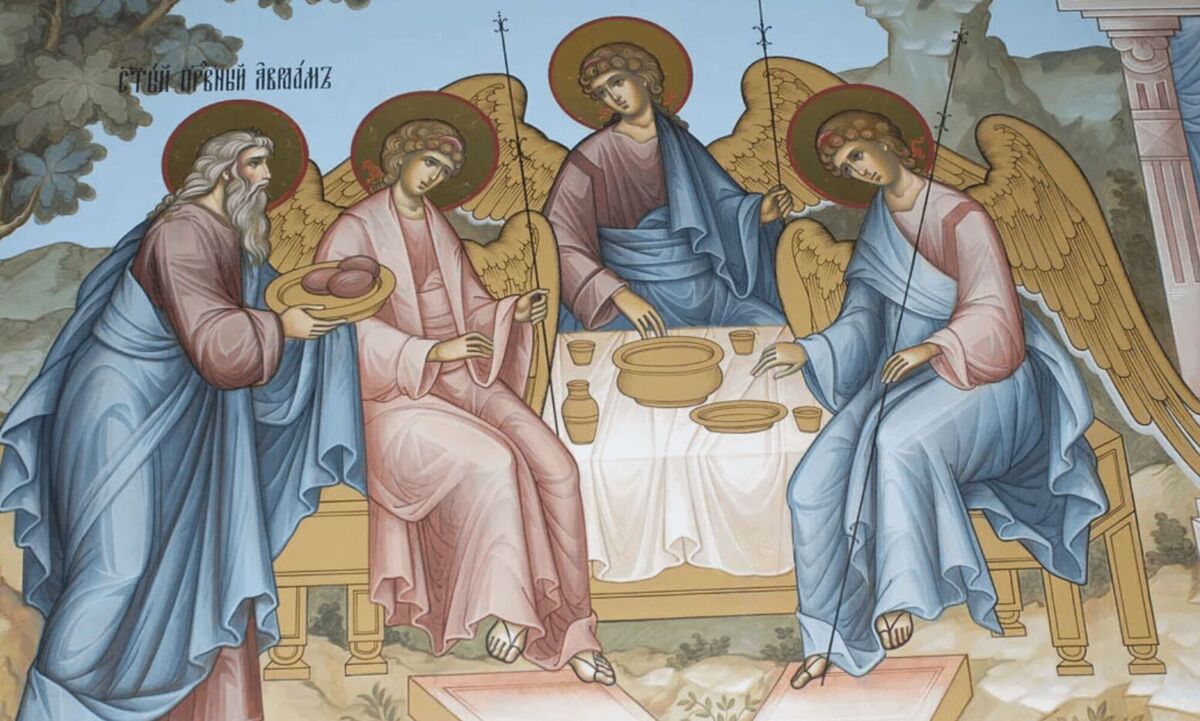
2nd century
St Justin Martyr, philosopher (c. 100–165)
God is consubstantial
… God begat before all creatures a Beginning, a certain rational power from Himself, who is called by the Holy Spirit, now the Glory of the Lord, now the Son, again Wisdom, again an Angel, then God, and then Lord and Logos; and on another occasion He calls Himself Captain, when He appeared in human form to Joshua the son of Nave (Nun). For He can be called by all those names, since He ministers to the Father’s will, and since He was begotten of the Father by an act of will; just as we see happening among ourselves: for when we give out some word, we beget the word; yet not by abscission, so as to lessen the word in us, when we give it out: and just as we see also happening in the case of a fire, which is not lessened when it has kindled another, but remains the same; and that which has been kindled by it likewise appears to exist by itself, not diminishing that from which it was kindled. The Word of Wisdom, who is Himself this God begotten of the Father of all things, and Word, and Wisdom, and Power, and the Glory of the Begetter, will bear evidence to me;
<…>
These are the words: “And God said, Behold, Adam has become as one of us, to know good and evil.” In saying, therefore, “as one of us,” Moses has declared that there is a certain number of persons associated with one another, and that they are at least two.
<…>
But this Offspring, which was truly brought forth from the Father, was with the Father before all the creatures
In God there is one will
He who is said to have appeared to Abraham, and to Jacob, and to Moses, and who is called God, is distinct from Him who made all things, — numerically, I mean, not distinct in will
God is triune
Our teacher of these things is Jesus Christ, who also was born for this purpose, and was crucified under Pontius Pilate, procurator of Judaea, in the times of Tiberius Caesar; and that we reasonably worship Him, having learned that He is the Son of the true God Himself, and holding Him in the second place, and the prophetic Spirit in the third.
The Son of God is not a God separate from the Father
this power was begotten from the Father, by His power and will, but not by abscission, as if the essence of the Father were divided; as all other things partitioned and divided are not the same after as before they were divided.
St Theophilus of Antioch, bishop (†183)
For the sun is a type of God, and the moon of man. And as the sun far surpasses the moon in power and glory, so far does God surpass man. And as the sun remains ever full, never becoming less, so does God always abide perfect, being full of all power, and understanding, and wisdom, and immortality, and all good. But the moon wanes monthly, and in a manner dies, being a type of man; then it is born again, and is crescent, for a pattern of the future resurrection. In like manner also the three days which were before the luminaries, are types of the Trinity, of God, and His Word, and His wisdom. And the fourth is the type of man, who needs light, that so there may be God, the Word, wisdom, man.
Athenagoras of Athens (c. 133–190)
The Holy Spirit Himself also, which operates in the prophets, we assert to be an effluence of God, flowing from Him, and returning back again like a beam of the sun. Who, then, would not be astonished to hear men who speak of God the Father, and of God the Son, and of the Holy Spirit, and who declare both their power in union and their distinction in order, called atheists?
(A Plea for the Christians, 10)
St Irenaeus of Lyons, hieromartyr († late 2nd c.)
The Church, though dispersed through the whole world, even to the ends of the earth, has received from the apostles and their disciples this faith: in one God, the Father Almighty, Maker of heaven, and earth, and the sea, and all things that are in them; and in one Christ Jesus, the Son of God, who became incarnate for our salvation, and in the Holy Spirit, who proclaimed through the prophets the dispensations of God, and the advents, and the birth from a virgin, and the passion, and the resurrection from the dead, and the ascension into heaven in the flesh of the beloved Christ Jesus, our Lord, and His manifestation from heaven in the glory of the Father
The rule of truth which we hold, is, that there is one God Almighty, who made all things by His Word, and fashioned and formed, out of that which had no existence, all things which exist. Thus saith the Scripture, to that effect “By the Word of the Lord were the heavens established, and all the might of them, by the spirit of His mouth” (Ps. 33:6)… For God needs none of all these things, but is He who, by His Word and Spirit, makes, and disposes, and governs all things, and commands all things into existence
(Against Heresies, Book I, 22.1)
For God did not stand in need of these beings, in order to the accomplishing of what He had Himself determined with Himself beforehand should be done, as if He did not possess His own hands. For with Him were always present the Word and Wisdom, the Son and the Spirit, by whom and in whom, freely and spontaneously, He made all things, to whom also He speaks, saying, “Let Us make man after Our image and likeness” (Gen. 1:26), He taking from Himself the substance of the creatures, and the pattern of things made, and the type of all the adornments in the world.
(Against Heresies, Book IV, 20.1)
But the path of those belonging to the Church circumscribes the whole world, as possessing the sure tradition from the apostles, and gives unto us to see that the faith of all is one and the same, since all receive one and the same God the Father, and believe in the same dispensation regarding the incarnation of the Son of God, and are cognizant of the same gift of the Spirit, and are conversant with the same commandments, and preserve the same form of ecclesiastical constitution
(Against Heresies, Book V, 20.1)
The presbyters, the disciples of the apostles, affirm that this is the gradation and arrangement of those who are saved, and that they advance through steps of this nature; also that they ascend through the Spirit to the Son, and through the Son to the Father, and that in due time the Son will yield up His work to the Father
(Against Heresies, Book V, 36.2)
3rd century
Tertullian (c. 155–220)
And especially in the case of this heresy, which supposes itself to possess the pure truth, in thinking that one cannot believe in One Only God in any other way than by saying that the Father, the Son, and the Holy Ghost are the very selfsame Person. As if in this way also one were not All, in that All are of One, by unity of substance; while the mystery of the dispensation is still guarded, which distributes the Unity into a Trinity, placing in their order the three Persons—the Father, the Son, and the Holy Ghost: three, however, not in condition, but in degree; not in substance, but in form; not in power, but in aspect. In fact, they are of one substance, and of one condition, and of one power, inasmuch as He is one God, from whom these degrees and forms and aspects are reckoned, under the name of the Father, and of the Son, and of the Holy Ghost. How they are susceptible of number without division, will be shown as our treatise proceeds.
<…>
At the same time, all the Scriptures attest the clear existence of, and distinction in the Trinity, and indeed furnish us with our Rule of faith, that He who speaks, and He of whom He speaks, and to whom He speaks, cannot possibly seem to be One and the Same.
<…>
And almost all the Psalms which prophesy of the person of Christ, represent the Son as conversing with the Father, that is, Christ with God. Observe also the Spirit speaking of the Father and the Son, in the character of a third Person: “The Lord said unto my Lord, Sit Thou on my right hand, until I make Thine enemies Thy footstool” (Ps. 110:1). Likewise in the words of Isaiah: “Thus saith the Lord to the Lord mine Anointed” (Isa. 45:1)
<…>
And since He had already His Son close at His side, as a second Person, His own Word, and a third Person also, the Spirit in the Word, He purposely adopted the plural phrase, “Let us make;” and, “in our image;” and, “become as one of us.”
<…>
And in general, everywhere I must hold one only substance in three coherent and inseparable Persons
St Peter of Alexandria, hieromartyr (2nd c.–311)
Therefore, from the holy Prophets and from all who, as I have said, dwelt equally piously and justly in the law of the Lord, and kept the Passover with all the people according to the ordinance and with reverence, the Master of all visible and invisible creation, the Only-begotten Son and Word, consubstantial with the Father and with the Holy Spirit in divinity, our Lord and God, Jesus Christ in the fullness of time, born after the flesh from the Holy Glorious Lady, our Mother of God and Ever-virgin and truly Mother of God Mary, visible on earth and consubstantial with men in human nature, truly remaining as a man, He Himself with the people in the years before His preaching lawfully and reverently kept the Passover and ate according to the ordinance of the lamb. For He came not to abolish the Law or (to do away with the teaching of) the Prophets, but to fulfil them, as the Saviour Himself said in the Gospel (see Matt. 5:17).
(On the Divinity) (PG 18, p. 518)
4th century
The First Ecumenical Council, Nicaea (325)
The holy, great and ecumenical council of the holy fathers gathered in Nicaea, through the blessed and holy Hosius, bishop of the city of Corduba in Spain, said: “The Godhead is not one person, as the Jews think, but three persons, distinguished among themselves not in name only but in hypostasis; and this is confirmed by many testimonies from the Old and New Testaments. The Old, reasoning still in a fleshly manner, presented the Word as if speaking, but the New called the Word God directly: In the beginning was the Word, and the Word was with God, and the Word was God (John 1:1), and a person, perfect from the Perfect. The Son is God, not a part, but perfect, just as the Father, of the same essence as the Father who begat Him in an unspeakable manner. Together with the Father and the Son there exists the Holy Spirit, who has the same essence and power as the Father and the Son. Therefore we must confess one will, one kingdom, one power, one dominion over all created beings, visible and intelligible, one Godhead and the same essence of the Father and the Son and the Holy Spirit. Not allowing confusion or division of the persons of the ineffable and blessed Trinity, we believe that the Father is always the true Father of the true Son, ever existing and abiding, and the Son — the true Son of the true Father, ever existing and abiding, and the Holy Spirit — the true Holy Spirit, ever existing and abiding, — a Trinity indivisible, ineffable; we believe that She truly cannot be comprehended by the mind or expressed in words, and has one Godhead and the same essence. Thus do we believe according to the true purity of the dogmas of the faith handed down to us from the beginning by the Lord Himself through His holy apostles and the ancient holy fathers of ours, who preserved this apostolic faith unchanged, and we are ready to confirm by numerous testimonies of the divine writings that thus one ought to believe”.
(Acts of the First Ecumenical Council, On how one ought to understand the three Persons in the one Godhead of the Father and the Son and the Holy Spirit)
St Athanasius the Great, bishop (c. 295–373)
“I am the door of the sheep.” The Lord fittingly called Himself a door, and not doors: because there is one Father, one Son, and one Holy Spirit: and not three Gods, but one, and one door of knowledge. And who bears witness to this? Paul, crying out thus: “one Lord, one faith, one baptism” (Eph. 4:5). So he (Paul) here does not say: two, three, four, five, but everywhere: one; since the one door — the one Lord — is the undivided Being;
(Homily on the man born blind)
Some, though they have departed from the Arians on account of their blasphemy against the Son of God, nevertheless think wrongly about the Holy Spirit, and assert that the Holy Spirit is not only a creature, but even one of the ministering spirits, and differs from the Angels only in degree. But this is only a feigned disagreement with the Arians, a real opposition to the pious faith. As the Arians, denying the Son, deny the Father also, so these, uttering blasphemy against the Holy Spirit, blaspheme the Son as well. Both have divided between themselves the lot of opposition to the truth, and for their wrong thinking — some about the Word, others about the Spirit — they are guilty of equal blasphemy against the Holy Trinity.
<…>
If, because of the unity of the Word with the Father, they do not agree to call the Son one of the created, but acknowledge Him (and rightly so) the Maker of creatures, then why do they call the Holy Spirit, who has the same unity with the Son as the Son has with the Father, a creature? Why did they not learn that, just as, not separating the Son from the Father, they preserve the unity of God, so, separating the Spirit from the Word, they no longer preserve the one Godhead in the Trinity, cutting it, mingling with it an alien and foreign nature, making it equal with creatures? This again shows that the Trinity is already not a unity, but a compound of two, and moreover (because of the other-essence of the Spirit which the heretics imagine) of different natures. And what kind of theology is this, compounded of the Creator and a creature? Or is the Godhead no longer triune but twofold, and moreover a creature? Or, if it is a Trinity (which it truly is), then why do they place the Spirit of the Trinity in one row with creatures, inferior to the Trinity? This again means dividing and decomposing the Trinity. Therefore those who think wrongly about the Holy Spirit do not think rightly about the Son either. And if they thought rightly about the Word, they would think healthily about the Spirit too, “who proceeds from the Father” (John 15:26)
<…>
Therefore it is madness to assert that the Spirit is a creature. If He were a creature, He would not be joined to the Trinity; because the whole Trinity is one God. And it is enough to know that the Spirit is not a creature and is not reckoned among creatures; because nothing alien is mingled with the Trinity; on the contrary, She is indivisible and like unto Herself… if God is triune (which He truly is), and it has been proved that He is an indivisible Trinity, unlike nothing in Himself; then it is necessary that the holiness of the Trinity be one, and Her eternity one, and Her nature immutable. For, as the faith in the Trinity handed down to us is one, and it unites us with God, whoever takes away anything from the Trinity, and is baptized in the one name of the Father, or in the one name of the Son, or in the Father and the Son without the Spirit, receives nothing, but both those being baptized, and he who thinks himself to be administering baptism, remain empty and unenlightened; because the initiation is performed in the name of the Trinity: so he who separates the Son from the Father, or brings down the Spirit to creatures, has neither the Son nor the Father, but is ungodly, worse than an unbeliever, and rather everything except a Christian. As there is one baptism administered in the Father and the Son and the Holy Spirit, and one faith in the Trinity, as the Apostle said (Eph. 4:5); so the Holy Trinity, identical with itself and abiding in unity, has nothing created in itself. Such is the indivisible unity of the Trinity, such is the one faith in Her.
(Letters to Serapion, bishop of Thmuis, Against those who slander that the Holy Spirit is a creature)
St Gregory the Theologian, bishop (c. 325–389)
I therefore write to your Reverence, what indeed you knew before, that I never have and never can honour anything above the Nicene Faith, that of the Holy Fathers who met there to destroy the Arian heresy; but am, and by God’s help ever will be, of that faith; completing in detail that which was incompletely said by them concerning the Holy Ghost; for that question had not then been mooted, namely, that we are to believe that the Father, Son, and Holy Ghost are of one Godhead, thus confessing the Spirit also to be God. Receive then to communion those who think and teach thus, as I also do; but those who are otherwise minded refuse, and hold them as strangers to God and the Catholic Church.
(Select Letters, To Cledonius the priest, against Apollinarius (Ep. 102))
5th century
Blessed Augustine of Hippo (354–430)
It is enough for the Christian to believe that the only cause of all created things, whether heavenly or earthly, whether visible or invisible, is the goodness of the Creator, the one true God; and that nothing exists but Himself that does not derive its existence from Him; and that He is the Trinity—to wit, the Father, and the Son begotten of the Father, and the Holy Spirit proceeding from the same Father, but one and the same Spirit of Father and Son.
By this Trinity, thus supremely and equally and unchangeably good, all things were created; and these are not supremely and equally and unchangeably good, but yet they are good, even taken separately. Taken as a whole, however, they are very good (Gen. 1:31), because their ensemble constitutes the universe in all its wonderful order and beauty.
(The Enchiridion on Faith, Hope, and Love)
19th century
St Theophan the Recluse, bishop (1815–1894)
“Believe in the Lord the Saviour” — one must contemplate Him thus, and hold Him thus in mind and heart, so that He stands in harmonious union with the mystery of the Most Holy Trinity. Otherwise it may happen that, while listening and speaking all about salvation only in the Lord Jesus, you so drive this truth into your attention that the thought of the Most Holy Trinity falls out of it altogether, and the Most Holy Trinity is quite overshadowed by the countenance of Christ the Saviour. And this would mean distorting the saving order of thoughts, or, as I would say, wrongly planting Christian consciousness in oneself and darkening it.
This is what I want to remind you of by this — that as the image of our salvation was fashioned by the Son of God, who became incarnate not without the Father and the Holy Spirit, so the salvation of each of us is wrought in the Lord Jesus Christ not without the participation of the Father and the Holy Spirit. And the salvation was wrought for us and each of us is saved by God, worshipped in the Trinity, the Father, the Son and the Holy Spirit. This must be planted in consciousness, and all who are being saved have it planted in their mind and heart.
(Selected letters on sects and heresies. Letter 8)