
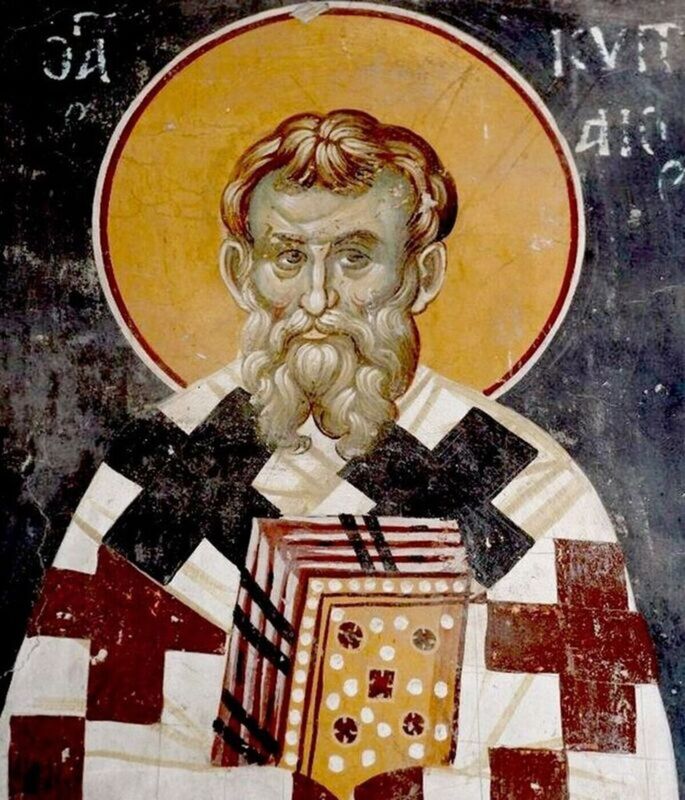
Biography
Commemoration Day: August 31 (September 13)
It is known that he was brought up in a pagan environment and made a career as a lawyer. The circumstances of his conversion are unknown. He was made bishop two years after his baptism and almost at once found himself in the persecution of Christians launched by the emperor Decius, and was drawn into difficult disputes about the repentance of apostates.
Under fear of torture many, including several bishops, renounced Christ, and after the persecution ended they decided to return to the Church. Cyprian insisted that only a bishop, or a presbyter appointed by him, could grant absolution of sins (and not the confessors — those who had not renounced their faith but for some reason had escaped death), and that the question of receiving a lapsed bishop could be decided only by a council of his former brethren. Any sacraments performed by a lapsed bishop before his reception by a council were invalid.
The disputes grew into a serious conflict with Pope Stephen, which did not escalate further only because of the latter's arrest and execution. Several years later Cyprian himself was arrested, sent into exile and then executed.
More on the history of the Church of Carthage (in Russian): https://azbyka.ru/otechnik/Lopuhin/pravoslavnaja-bogoslovskaja-entsiklopedija-ili-bogoslovskij-entsiklopedicheskij-slovar-tom-9-karmelity-koine/26
Faith
The endlessness of torments
But is glory given to God when the majesty and truth of God are so disregarded that the sacrilegious, while God proclaims His anger and indignation against those who sacrifice, while He threatens them with eternal punishments and endless torments...
(To Cornelius, Concerning Fortunatus and Felicissimus, or Against the Heretics)
Believe Him who deceives not at all. Believe Him who foretold that all these things should come to pass. Believe Him who will give to all that believe the reward of eternal life. Believe Him who will call down on them that believe not, eternal punishments in the fires of Gehenna. What will then be the glory of faith? what the punishment of faithlessness? When the day of judgment shall come, what joy of believers, what sorrow of unbelievers; that they should have been unwilling to believe here, and now that they should be unable to return that they might believe! An ever-burning Gehenna will burn up the condemned, and a punishment devouring with living flames; nor will there be any source whence at any time they may have either respite or end to their torments. Souls with their bodies will be reserved in infinite tortures for suffering. Thus the man will be for ever seen by us who here gazed upon us for a season; and the short joy of those cruel eyes in the persecutions that they made for us will be compensated by a perpetual spectacle, according to the truth of Holy Scripture, which says, "Their worm shall not die, and their fire shall not be quenched; and they shall be for a vision to all flesh" (Isa. 66:24).
<…>
The pain of punishment will then be without the fruit of penitence; weeping will be useless, and prayer ineffectual. Too late they will believe in eternal punishment who would not believe in eternal life.
Provide, therefore, while you may, for your safety and your life. We offer you the wholesome help of our mind and advice. And because we may not hate, and we please God more by rendering no return for wrong, we exhort you while you have the power, while there yet remains to you something of life, to make satisfaction to God, and to emerge from the abyss of darkling superstition into the bright light of true religion.
The Eucharist as a sacrifice
Cyprian to Cæcilius his brother, greeting. Although I know, dearest brother, that very many of the bishops who are set over the churches of the Lord by divine condescension, throughout the whole world, maintain the plan of evangelical truth, and of the tradition of the Lord, and do not by human and novel institution depart from that which Christ our Master both prescribed and did; yet since some, either by ignorance or simplicity in sanctifying the cup of the Lord, and in ministering to the people, do not do that which Jesus Christ, our Lord and God, the founder and teacher of this sacrifice, did and taught, I have thought it as well a religious as a necessary thing to write to you this letter <…> Know then that I have been admonished that, in offering the cup, the tradition of the Lord must be observed, and that nothing must be done by us but what the Lord first did on our behalf, as that the cup which is offered in remembrance of Him should be offered mingled with wine.
<…>
But how perverse and how contrary it is, that although the Lord at the marriage made wine of water, we should make water of wine, when even the sacrament of that thing ought to admonish and instruct us rather to offer wine in the sacrifices of the Lord!
(Epistle LXII, to Cæcilius, on the Sacrament of the Cup of the Lord)
Also in Exodus: "And let the priests which come near to the Lord God sanctify themselves, lest perchance the Lord forsake them." And again: "And when they come near to minister at the altar of the Holy One, they shall not bring sin upon them, lest they die." Those, therefore, who have brought grievous sins upon themselves, that is, who, by sacrificing to idols, have offered sacrilegious sacrifices, cannot claim to themselves the priesthood of God, nor make any prayer for their brethren in His sight.
(Epistle LXVII, to the Clergy and People Abiding in Spain, Concerning Basilides and Martial)
I, my colleagues and the whole brotherhood send you, dearest brother, this letter in our stead, and, expressing to you in writing our joy, we show the faithful devotion of our love, not ceasing here too, in the sacrifices and in our prayers, to give thanks to God the Father and to Christ His Son, our Lord.
(Epistle to Lucius, Bishop of Rome, Returned from Banishment)