
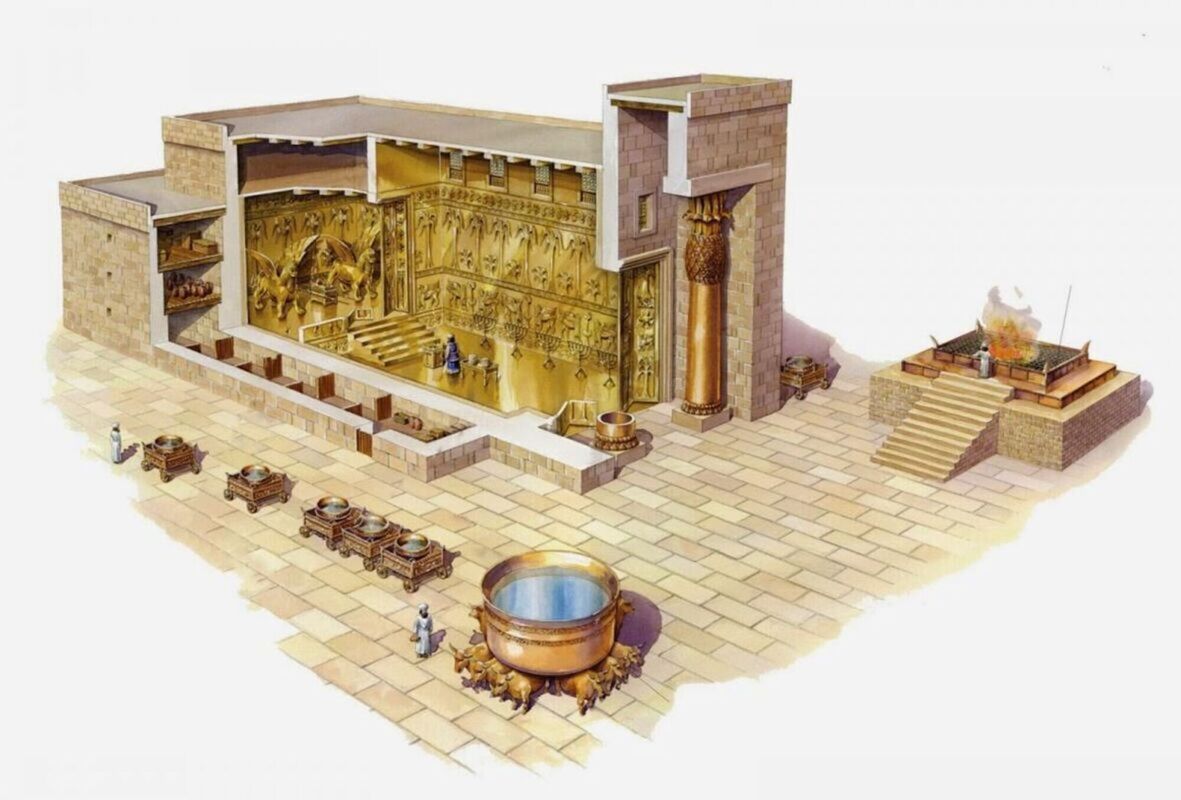
General Information
The Temple was built by Solomon on Mount Moriah (2 Chr. 3:1), on the site of the threshing floor (the place where wheat is gathered and cleaned) of Ornan the Jebusite (2 Chr. 3:1), where Solomon’s father (David) saw the angel striking the people, and which the prophet Gad also pointed out (2 Sam. 24:16-18). The building of the Temple began in the 480th year after the Jews came out of Egypt (according to the LXX, in the 440th year). It was the 4th year of Solomon’s reign, the month of Ziv (1 Kin. 6:37; 2 Chr. 3:2). The building was finished 7 years later, in the 11th year of Solomon’s reign, in the month of Bul (1 Kin. 6:38).
God’s Command to Make the Temple
“Then the LORD spoke to Moses, saying: ‘Speak to the children of Israel, that they bring Me an offering. <...> And let them make Me a sanctuary, that I may dwell among them. <...> And see to it that you make them according to the pattern which was shown you on the mountain’” (Ex. 25:1-2,8,40)
“Our fathers had the tabernacle of witness in the wilderness, as He appointed, instructing Moses to make it according to the pattern that he had seen” (Act. 7:44)
The earthly temple is arranged after the image of the heavenly reality:
“For Christ has not entered the holy places made with hands, which are copies of the true, but into heaven itself, now to appear in the presence of God for us” (Heb. 9:24)
The Structure of the Jerusalem Temple
The walls of the Temple were built of stone.
The dimensions below are given in cubits. To get meters roughly, divide the number of cubits by 2 (to get feet roughly, multiply by 1.5).
Dimensions of the Temple (1 Kin. 6:2; 2 Chr. 3:3)
60 cubits long (divided by a wall into 20 and 40 cubits),
20 cubits wide,
30 cubits high.
In meters: 31.5 x 10.5 x 15.75.
The Temple was divided into two parts (of 20 and 40 cubits) by a stone wall (1 Kin. 6:16-17):
the 20-cubit part is called the “Holy of Holies” (or the Debir, or “the inner sanctuary”);
the 40-cubit part is called the “Holy Place”.
The Temple had latticed windows with beveled frames (1 Kin. 6:4).
The Vestibule
In front of the Temple a vestibule (porch) was also built (it is not counted as part of the Temple). Its dimensions (1 Kin. 6:3):
20 cubits long;
10 cubits wide.
120 cubits high (2 Chr. 3:4)?
The Annex
Around the Temple a three-story annex was built (1 Kin. 6:5), not fastened into the walls of the Temple (1 Kin. 6:6). The width of the stories, starting from the lowest: 5, 6, 7 cubits.
Side Chambers
Around the Temple side chambers were also built, attached to the Temple with cedar beams (1 Kin. 6:10). Height of the chambers: 5 cubits.
The Walls of the Temple
The walls were built of hewn stone. Inside, the walls and ceiling of the Temple were paneled with cedar boards (1 Kin. 6:9,16). The floor of the Temple was covered with cypress planks (1 Kin. 6:15). Everything was covered with wood. No stone could be seen from inside (1 Kin. 6:18). The walls and floor of the Temple were also to some extent overlaid with gold (1 Kin. 6:22; 2 Chr. 3:5; 2 Chr. 3:7; 1 Kin. 6:30). As a rule, the carved images were overlaid with gold (1 Kin. 6:32). On the cedar boards (walls and ceiling) were carved cherubim, palm trees, open flowers (1 Kin. 6:29), and gourd-like ornaments (“ornamental buds”, 1 Kin. 6:18). They were carved in “both the inner and outer sanctuaries” (1 Kin. 6:29), that is, in the Holy of Holies (the inner part of the Temple) and in the Holy Place (the outer part). The Temple was adorned with precious stones (2 Chr. 3:6). Important: images of cherubim existed earlier as well, on the curtains (walls) of the Tabernacle (Ex. 26:1; 36:8).
The Holy of Holies
Dimensions: 20 x 20 x 20 cubits (1 Kin. 6:20; 2 Chr. 3:8), overlaid with pure gold. Golden chains were stretched across (1 Kin. 6:21).
The Entrance
The entrance to the Holy of Holies was through a door that in the Russian Synodal translation is called five-sided (1 Kin. 6:31, NKJV: “the lintel and doorposts were one-fifth of the wall”; 2 Chr. 4:22), made of olive wood. The door (like the walls) was adorned with carved figures of cherubim, palm trees, open flowers. The carvings were overlaid with gold (1 Kin. 6:32). Here also was a veil with embroidered figures of cherubim (2 Chr. 3:14; 1 Macc. 1:22), of blue, purple and crimson fabric, as in the Tabernacle (Ex. 26:31). Before the veil an unquenchable lamp always burned (Lev. 24:1-4)
Two Cherubim
Two large statues of cherubim made of olive wood were set up (1 Kin. 6:23). They were overlaid with gold (1 Kin. 6:28; 2 Chr. 3:10). The height and width of the cherubim were 10 cubits (1 Kin. 6:23), the width being measured from the tip of one wing to the tip of the other (1 Kin. 6:24-27; 2 Chr. 3:11). One wing of each cherub touched the wall, the other wing touched the wing of the neighboring cherub (2 Chr. 3:11-12). Their faces were turned toward the Temple (2 Chr. 3:13).
The Ark of the Covenant
In the middle, under the wings of the cherubim, stood the Ark of the Covenant (1 Kin. 6:19; 1 Kin. 8:6; 2 Chr. 5:7), together with the poles for carrying it (1 Kin. 8:7; 2 Chr. 5:9; Ex. 25:15). The dimensions of the Ark were 2.5×1.5×1.5 cubits (Ex. 25:10). The Ark was made of acacia (shittim) wood (Ex. 25:10), and was overlaid with gold inside and out (Ex. 25:11). At each corner of the base of the Ark there was a golden ring (Ex. 25:12) for wooden poles, also overlaid with gold (Ex. 25:13), which were needed to carry the Ark. In the Ark lay the 2 stone tablets of the Covenant, which the prophet Moses himself had put there (1 Kin. 8:9; 2 Chr. 5:10), the manna (Ex. 16:32-34) and Aaron’s blossoming almond rod (Num. 17:8-11). The Ark of the Covenant was closed on top with a lid (the mercy seat) of 2.5×1.5 cubits (Ex. 25:17). On the lid were two golden statues of cherubim, facing one another (Ex. 25:18-20). Their wings were raised and with them they covered the lid of the Ark. Above the lid of the Ark, between the two cherubim, God revealed Himself and spoke (Ex. 25:22).
The Holy Place
The Entrance
The entrance to the Holy Place was through a four-sided double door made of cypress (1 Kin. 6:34), with doorposts of olive wood (1 Kin. 6:33; NKJV: “one-fourth of the wall”). These doors too were adorned with carvings of cherubim, palm trees and open flowers overlaid with gold (1 Kin. 6:35).
The Altar
Before the door to the Holy of Holies stood the altar for burning incense. It was made of wood and overlaid with gold (1 Kin. 6:22; 1 Kin. 7:48).
The Table
Nearby was the golden table for the showbread (1 Kin. 7:48; 2 Chr. 4:8).
The Lampstands
On the left and right were golden lampstands (menorahs): 5 on the right and 5 on the left (1 Kin. 7:49). They were made entirely of pure gold, together with the lamps, censers, flowers, wick-trimmers, basins, bowls, ladles and door hinges — all of gold (1 Kin. 7:50; 2 Chr. 4:19-22).
The Vestibule
Overlaid inside with pure gold (2 Chr. 3:4)
The Pillars: Jachin and Boaz
Before the entrance to the Vestibule were set up two huge identical bronze pillars, which were given names: on the right — Jachin, on the left — Boaz (1 Kin. 7:21; 2 Chr. 3:17). The pillars were 18 cubits high (1 Kin. 7:15) (35 cubits — 2 Chr. 3:15). A line of 12 cubits measured their circumference (1 Kin. 7:15). On the pillars stood capitals, each 5 cubits high (1 Kin. 7:16). The capitals were adorned with lattice network and wreaths of chainwork (1 Kin. 7:16): 7 on each capital (1 Kin. 7:17). On the capitals were two rows of pomegranates (1 Kin. 7:18). Capitals of the pillars in the Vestibule in the shape of lilies, each of 4 cubits, are also mentioned (1 Kin. 7:19). All the bronze articles were burnished (1 Kin. 7:45).
The Courts
In front of the Temple an inner (priests’) court was made (1 Kin. 6:36; 2 Chr. 4:9). It was built (enclosed) with three rows of hewn stones and one row of cedar beams (1 Kin. 6:36) (1 Kin. 7:12). The great outer court was also enclosed (1 Kin. 7:12; 2 Chr. 4:9).
The Altar
Dimensions: 20 x 20 cubits and 10 cubits high (2 Chr. 4:1)
The Bronze Sea
A round vessel for the washing of the priests (2 Chr. 4:6). In the first (inner) court stood the round “Sea” cast of bronze. Dimensions: 10 cubits in diameter, 5 cubits high (1 Kin. 7:23; 2 Chr. 4:2), about a handbreadth thick (1 Kin. 7:26; 2 Chr. 4:5). A line of 30 cubits measured its circumference (1 Kin. 7:23). The rim of the vessel was adorned with two rows of gourds: 10 gourds to a cubit (1 Kin. 7:24). It contained 2000 baths (1 Kin. 7:26). It stood to the southeast of the Temple (1 Kin. 7:39; 2 Chr. 4:10).
12 Oxen
The Bronze Sea stood on 12 oxen (1 Kin. 7:25; 2 Chr. 4:3-4; 2 Chr. 4:15): 3 oxen looked toward the north, and 3 oxen likewise looked toward each of the other points of the compass.
10 Lavers
Vessels for washing the animal sacrifices before they were offered (2 Chr. 4:6). Each laver held [40] baths. They stood by the Temple: 5 on the left and 5 on the right (1 Kin. 7:39). Each of them had a movable stand on wheels.
10 Stands
10 movable square bronze stands (carts) (1 Kin. 7:27; 1 Kin. 7:31): 4 by 4 cubits, and 3 cubits high. On the panels of the stands were depicted lions, oxen and cherubim, and on top were wreaths (1 Kin. 7:28-29). The stands moved on 4 bronze wheels (1 Kin. 7:30). The height of the wheels was 1.5 cubits (1 Kin. 7:32). They were all identical (1 Kin. 7:37).
Singers, Trumpeters
At the consecration of the Temple the Levites sang and played musical instruments (cymbals, stringed instruments and harps), and the priests sounded trumpets (2 Chr. 5:12). The musical instruments were made specially for the Temple (2 Chr. 7:6).
Images
Carved images of cherubim were on the walls of the Temple (1 Kin. 6:32), on the entrance door (1 Kin. 6:32; 1 Kin. 6:35), and on the veil before the entrance to the Holy of Holies (2 Chr. 3:14; 1 Macc. 1:22). In the Holy of Holies stood two large gilded wooden statues of cherubim (1 Kin. 6:23). On the lid of the Ark of the Covenant two statues of cherubim were made (Ex. 25:18-20). In the court of the Temple, on the large stands for the lavers, lions, oxen and cherubim were depicted (1 Kin. 7:28-29).
Prayer
The prayer of King Solomon at the consecration of the Temple: 1 Kin. 8:22-53; 2 Chr. 6:14-42
God’s answer to Solomon’s prayer: 2 Chr. 7:12-22