
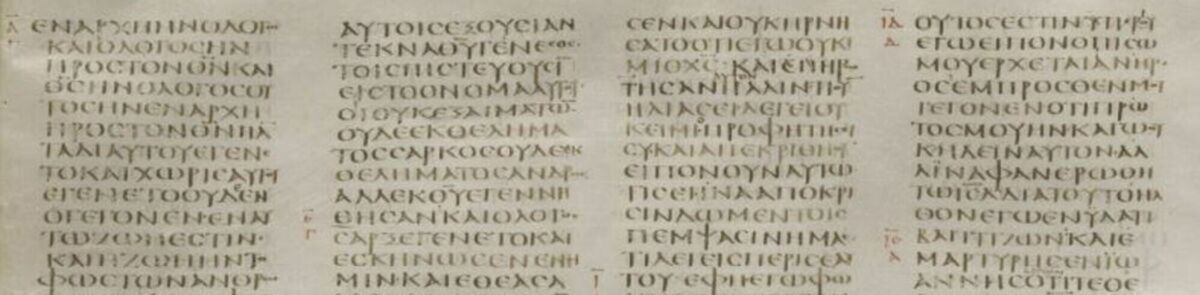
On the site there is a collection of biblical quotations in defense of the teaching of the Orthodox Church, with translations into various languages. The collection is intended to show the teaching of the Orthodox Church from the Bible alone. Not because the Orthodox Church supposedly holds the opinion that faith must be built “by Scripture alone” (it does not hold this opinion, and it is not in Scripture). But in order to show that the Orthodox faith fully corresponds to Scripture and can be expressed even in this way — by Scripture alone, which the Orthodox Church herself once received from the apostles, preserved, and gathered into the list of books known as the New Testament of the Bible.
The collection is founded on the assertion that every society that claims its faith corresponds to Holy Scripture in fact offers the listener only an interpretation of Scripture. And this interpretation will always proceed from the faith of that society: as the faith is, so is the interpretation.
This was exactly the case with the creator of the idea “Sola Scriptura” (Scripture Alone) — Martin Luther (16th century), who expressed his faith through explaining the lines of Scripture. But when his faith came into insurmountable contradiction with Scripture (James 2:24: “not by faith only”), this part of Scripture was recognized by Luther as not apostolic. Why so? Because faith is primary. Faith is always primary, and the interpretation of Scripture is a consequence of faith. And the main question is only this — where did this or that faith come from, where did the interpreter of Scripture take his faith from: did he invent it himself or receive it from someone, and if he received it — from whom, where is the beginning?
The biblical epistle of the apostle James sharply contradicted another postulate of Luther — Sola Fide (by faith alone):
“Do you see that a man is justified by works, and not by faith only?” (James 2:24)
And so Martin Luther, a little man with the titles of master, bachelor, and doctor of theology, comes to the conclusion that the text of the epistle of the apostle James, which for centuries was recognized as apostolic, in fact does not belong to the apostles. At first he will write less strictly, gently rejecting the apostolic authority:
1522: “I highly value the Epistle of James and consider it valuable, despite the fact that in antiquity it was rejected.” It does not set forth human doctrines, but pays great attention to God’s law. [...] I do not consider that it was written by the apostles” [1]
And then he will write more and more strictly, finally making nothing of this epistle:
The Gospel of John and his first Epistle, the Epistles of St. Paul, especially to the Romans, Galatians, Ephesians, and the Epistle of St. Peter — these are the books that show you Christ and teach everything that is necessary and blessed for you to know, even if you had never seen or heard any other book of teaching. Thus, the Epistle of James, compared with them, is a right strawy epistle, since there is nothing evangelical in it” [2]
1530s–1540s: “Someday I will use James to kindle my stove” [3]
in 1542: “We have thrown the Epistle of James out of this school (Wittenberg), because it has no value... I consider that it was written by some Jew” [4]
This act of the creator of the idea “Scripture Alone” clearly shows that a person’s faith is primary. It determines the attitude to texts and their interpretation. When a person refuses to accept the transmitted faith, then, starting from himself, he simply becomes the initiator of a new faith (a new interpretation) and a new chain of transmission of his faith.
A huge number of modern Christian societies now claim, following Luther, that they believe “by Scripture alone.” At the same time, today it is not difficult to find a Protestant society with any faith in God, with any understanding of His actions in the world and any understanding of salvation — and all of them offer their different doctrines as the teaching “by Scripture alone.”
The gathering of one’s own separate societies after Christ has already once gathered His own (the Church of Christ) requires of the separated societies first of all to prove the fall of the society gathered by Christ. Because if the society of Christ has not fallen, then, obviously, it is precisely to it that one must join in order to be with Christ in unity, peace and obedience (more).
The method of building one’s own societies “by Scripture alone,” accordingly, leads people to search for accusations against the Church of Christ of departing from Scripture, of not corresponding to Scripture. For this reason, in the section of biblical quotations proofs are offered of the truth of the Orthodox faith by Scripture alone, for people who are seeking the true Church of Christ, which was once created by Him and, as Christ Himself promised, never disappeared and did not fall away (Matt. 16:18). Along the way, an answer is given to the most well-known criticism.