
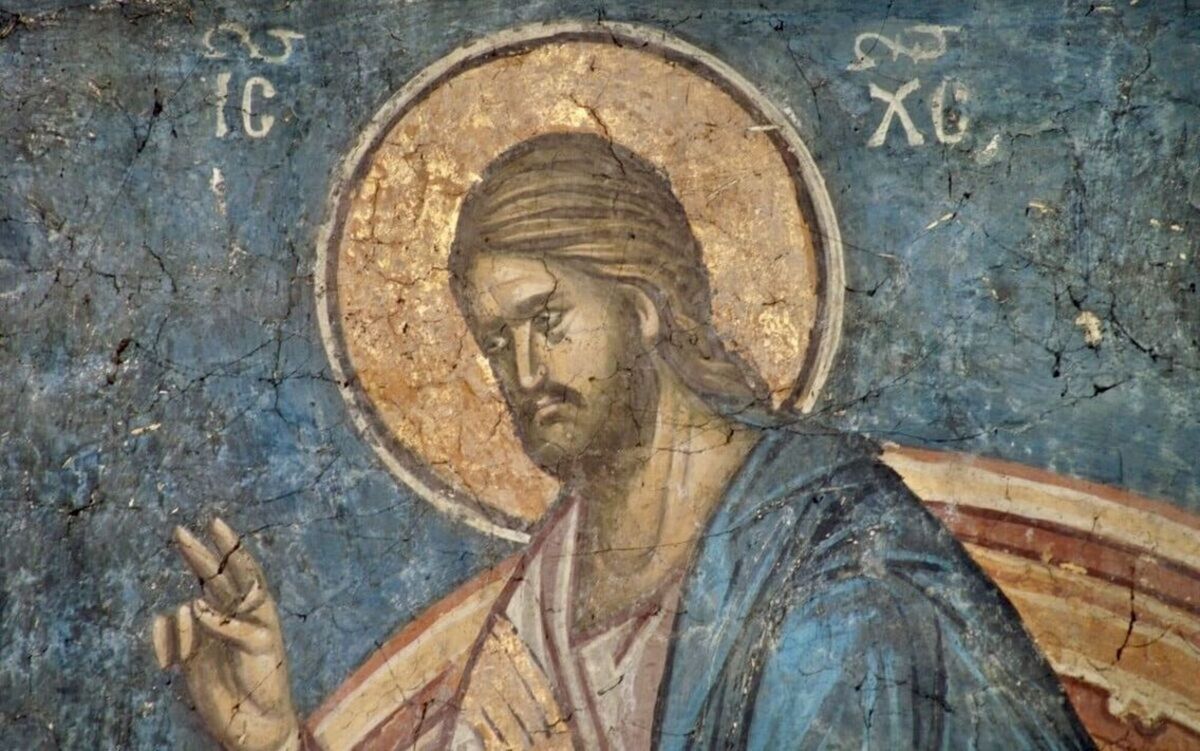
1st century
St Ignatius the God-bearer, hieromartyr (c. 35–107)
“For them there is only one Physician who is possessed both of flesh and spirit; both made and not made; God existing in flesh, true life in death, both of Mary and of God; first possible and then impossible, even Jesus Christ our Lord” (To the Ephesians, ch. 7)
“For our God, Jesus Christ, was, according to the appointment of God, conceived in the womb by Mary, of the seed of David, but by the Holy Ghost” (To the Ephesians, ch. 18)
“Hence every kind of magic was destroyed, and every bond of wickedness disappeared; ignorance was removed, and the old kingdom abolished, God Himself being manifested in human form for the renewal of eternal life” (To the Ephesians, ch. 19)
2nd century
St Justin Martyr, philosopher (c. 100–165)
it is declared that He would come forth from the highest heavens, and again return to the same places, in order that you may recognise Him as God coming forth from above, and man, living among men; and that He will again appear, and they who pierced Him shall see Him, and shall bewail Him.
by Reason (or the Word, the Logos) Himself, who took shape, and became man, and was called Jesus Christ.
<…>
the Father of the universe has a Son; who also, being the first-begotten Word of God, is even God. And of old He appeared in the shape of fire and in the likeness of an angel to Moses and to the other prophets; but now in the times of your reign, as we before said, become Man by a virgin, according to the counsel of the Father, for the salvation of those who believe on Him, He endured both to be set at nought and to suffer, that by dying and rising again He might conquer death.
For next to God, we worship and love the Word who is from the unbegotten and ineffable God, since also He became man for our sakes, that, becoming a partaker of our sufferings, He might also bring us healing.
Tertullian (c. 155–220)
Besides, the flesh is not God, so that it could not have been said concerning it, “That Holy Thing shall be called the Son of God,” but only that Divine Being who was born in the flesh, of whom the psalm also says, “Since God became Man in the midst of it, and established it by the will of the Father” (Ps. 87:5). Now what Divine Person was born in it? The Word, and the Spirit which became incarnate with the Word by the will of the Father. The Word, therefore, is incarnate; and this must be the point of our inquiry: How the Word became flesh,—whether it was by having been transfigured, as it were, in the flesh, or by having really clothed Himself in flesh. Certainly it was by a real clothing of Himself in flesh. For the rest, we must needs believe God to be unchangeable, and incapable of form, as being eternal. But transfiguration is the destruction of that which previously existed. For whatsoever is transfigured into some other thing ceases to be that which it had been, and begins to be that which it previously was not. But God, however, neither ceases to be what He was, nor can He be any other thing than what He is. The Word is God, and “the Word of the Lord remaineth for ever” (Ps. 117:2),—even by holding on unchangeably in His own proper form. Now, if He admits not of being transfigured, it must follow that He be understood in this sense to have become flesh, when He comes to be in the flesh, and is manifested, and is seen, and is handled by means of the flesh; since all the other points likewise require to be thus understood. For if the Word became flesh by a transfiguration and change of substance, it follows at once that Jesus must be a substance compounded of two substances—of flesh and spirit,—a kind of mixture, like electrum, composed of gold and silver; and it begins to be neither gold (that is to say, spirit) nor silver (that is to say, flesh),—the one being changed by the other, and a third substance produced. Jesus, therefore, cannot at this rate be God for He has ceased to be the Word, which was made flesh; nor can He be Man incarnate for He is not properly flesh, and it was flesh which the Word became. Being compounded, therefore, of both, He actually is neither; He is rather some third substance, very different from either. But the truth is, we find that He is expressly set forth as both God and Man; the very psalm which we have quoted intimating (of the flesh), that “God became Man in the midst of it, He therefore established it by the will of the Father,”—certainly in all respects as the Son of God and the Son of Man, being God and Man, differing no doubt according to each substance in its own especial property, inasmuch as the Word is nothing else but God, and the flesh nothing else but Man. Thus does the apostle also teach respecting His two substances, saying, “who was made of the seed of David;” (Rom. 1:3) in which words He will be Man and Son of Man. “Who was declared to be the Son of God, according to the Spirit;” (Rom. 1:4) in which words He will be God, and the Word—the Son of God. We see plainly the twofold state, which is not confounded, but conjoined in One Person—Jesus, God and Man.
3rd century
St Peter of Alexandria, hieromartyr (2nd c.–311)
Therefore, from the holy Prophets and from all who, as I have said, dwelt equally piously and justly in the law of the Lord, and kept the Passover with all the people according to the ordinance and with reverence, the Master of all visible and invisible creation, the Only-begotten Son and Word, consubstantial with the Father and with the Holy Spirit in divinity, our Lord and God, Jesus Christ in the fullness of time, born after the flesh from the Holy Glorious Lady, our Mother of God and Ever-virgin and truly Mother of God Mary, visible on earth and consubstantial with men in human nature, truly remaining as a man, He Himself with the people in the years before His preaching lawfully and reverently kept the Passover and ate according to the ordinance of the lamb. For He came not to abolish the Law or (to do away with the teaching of) the Prophets, but to fulfil them, as the Saviour Himself said in the Gospel (see Matt. 5:17).
(On the Divinity) (PG 18, p. 518)
All the signs, as many as He gave, and the manifestations of power show that He was God made man; and both show that He was God by nature and became Man by nature
(On the Divinity)
4th century
St Athanasius the Great, bishop (c. 295–373)
For this cause He was both born and appeared as Man, and died, and rose again, dulling and casting into the shade the works of all men of old time, that whatsoever they had been inclined to hold might be withdrawn from them, and that men might know the true Father of His Father, as He Himself says: “I came forth… to seek and to save that which was lost” (Matt. 18:11; Luke 19:10).
For seeing that men had once fallen to the sensible, the Word willingly made Himself visible through a body, that, becoming man, He might draw men’s attention to Himself, withdraw their senses to Himself, and when they should see Him as man, persuade them by the works He wrought that He is not only man, but God, the Word and Wisdom of the true God.
<…>
And as, while abiding in the whole creation, though He is outside all by essence, He is present in all by His own powers, ordering all things, extending His providence to all and in all, quickening each creature and all creatures together, embracing the whole universe and not being embraced by it, but abiding wholly in His Father alone; so also in the human body, while He quickened it, He quickened beyond all doubt also the universe, abode in all creatures, and was outside the universe, making Himself known in the body by His works, and never ceasing to manifest Himself in His actions toward the universe.
<…>
…the Word of God in the man. It was not bound by the body; on the contrary, it possessed it wholly; therefore, it was in the body, and was in all creatures, and was outside created things, and rested in the Father alone. And, what is most marvellous, it lived as a man, quickened all things as the Word, and abode with the Father as the Son.
<…>
Therefore, when theologians of the Word say that it ate, and drank, and was born, know that the body, as body, was born, and sustained with food corresponding to its nature, while God, the Word Himself, Who was united with the body, while ordering all things, also by the works He did in the body showed Himself to be not man, but God the Word. But these things are said of Him, because the actual body which ate, was born, and suffered, belonged to none other but to the Lord. And because the Lord became man, it was fitting to say of Him this also, as of a man, that it might be evident that He truly, and not in appearance, has a body.
(On the Incarnation of the Word)
He made even the creation break silence: in that even at His death, marvellous to relate, or rather at His actual trophy over death – the Cross I mean – all creation was confessing that He that was made manifest and suffered in the body was not man merely, but the Son of God and Saviour of all.
<…>
Again, these, even where they suffered, were men resembling all in their common nature; but he that is declared in Scripture to suffer on behalf of all is called not merely man, but the Life of all, albeit He was in fact like men in nature. For you shall see, it says, your Life hanging before your eyes (Deut. 28:66); and “who shall declare his generation?” (Isa. 53:8; cf. Acts 8:33) For one can ascertain the genealogy of all the saints, and declare it from the beginning, and of whom each was born; but the generation of Him that is the Life the Scriptures refer to as not to be declared. Who then is he of whom the Divine Scriptures say this? Or who is so great that even the prophets predict of him such great things?
None else, now, is found in the Scriptures but the common Saviour of all, the Word of God, our Lord Jesus Christ. For He it is that proceeded from a virgin and appeared as man on the earth, and whose generation after the flesh cannot be declared; because there is none that can tell His father after the flesh, His body not being of a man, but of a virgin alone.
(On the Incarnation of the Word)
St Ephrem the Syrian, monk (c. 306–373)
For there is one God who appeared in the world in a body. His glory proclaimed the divine nature which is from the Father, and His body proclaimed the human nature which is from Mary; both natures met and were joined in one hypostasis. The Only-begotten of the Father is the only-begotten of Mary. And whoever divides the natures in Him will be cut off from His Kingdom, and whoever blends them will be deprived of His life. Whoever denies that Mary bore God will not behold the glory of His Godhead, and whoever denies that He bore sinless flesh will not receive the salvation and life given through His body. The very deeds bear witness, and His divine powers teach the discerning that He is the True God. And His sufferings show that He is a true man. I confess One and the Same as perfect God and perfect man, in two natures, united hypostatically or personally, known indivisibly, unconfusedly and immutably, clothed in flesh animated by a rational and understanding soul, and become like unto us in all things except sin alone. One and the Same is earthly and Heavenly, temporal and Eternal, subject to principle and Without principle, Timeless and subject to time, created and Uncreated, passible and Immortal, God and man, perfect in both, One in two natures, and in the two One. The Godhead and the flesh abide in one hypostasis and in one Person indivisibly and unconfusedly.
(On the Transfiguration of our Lord God and Saviour Jesus Christ)
And the speech of the Archangel confirms that the Godhead overshadowed the Virgin for nothing else than that a Man might be born, for the Lord could have appeared instantly over the whole earth, had He not purposed to dwell with men, truly joined with man.
Look upon the pearl, and you will find an indication of two natures: in its brightness an indication of the Godhead, in its whiteness of the assumed [that is, the Manhood].
(On the Heretics)
Who before Thy honoured Cross doubted ever so little
Of Thy Manhood, and before Thy majesty
Did not receive faith in Thy Godhead? I two natures
Have confessed in Thee: Thou art man and God consubstantially.
(On the Resurrection, Death, and Satan)
St Basil the Great, bishop (c. 329–379)
So we have to consider what measure of truth can be reflected in this discourse, even if the mind cannot draw near to the nature of the incomprehensible, and speech finds it hard to express a nature corresponding to what is somehow accessible to thought. God [appeared] on earth, God [dwelt] among men, conversing with them no longer from “fire” (Exod. 3:2), nor in “a trumpet’s voice” (Exod. 19:19), nor on “the smoking mountain” (Exod. 19:18), nor in “darkness” (Exod. 20:21), nor in “the storm” (Heb. 12:18) that terrifies the souls of the hearers of the lawgiver, but through a body, gently and tenderly, as with kin. God [appeared] in the flesh, acting no longer from a distance, as with the prophets, but having made human nature grown together and united with Himself and thus, raising all humanity to Himself through His flesh that is akin to us. But one may say, how through one Source of light did He come to all? Or in what way was the Godhead [present] in the flesh? Thus, as fire in iron: not changing its place, but imparting its power. Indeed, fire does not pass over to where the iron is, remaining in its former place, but imparts to it its own power, so that it is itself not diminished by this imparting, and yet wholly fills what becomes partaker of it. Thus also God the Word both did not depart from Himself and “dwelt among us” (John 1:14), underwent no change, “and the Word became flesh” (John 1:14). And heaven was not emptied of Him that contains it, and earth received into its bosom the Heavenly One. Do not imagine here any descent of the Godhead, for it is not His nature to pass from place to place, like bodies. And do not imagine that the Godhead changed and became flesh, for that which is immortal is unchangeable. But one may ask, why did not God the Word become filled with bodily infirmity? To this we answer: just as fire does not take on the properties of iron. Iron is black and cold; nevertheless, when it is heated, it takes on the form of fire, itself becoming light-bearing, but not making the fire black, becoming aflame, but not cooling the flame.
So also the human flesh of the Lord itself became partaker of the Godhead, but did not impart to the Godhead its own infirmity. On the other hand, one should not think that the Godhead acts exactly like this sensible fire. But thou imaginest some suffering in the Impassible, arising from human infirmity, and art perplexed how the corruptible nature remains untouched through its participation in God? Learn then the Mystery. So also the human flesh of the Lord itself became partaker of the Godhead, but did not impart to the Godhead its own infirmity. The corruptible nature remains untouched because of its participation in God. God [appeared] in the flesh in order to mortify the death dwelling in it. For as a healing medicine, taken into the body, overcomes deadly poisons, or as the darkness reigning in a room is scattered when light is brought in, so the death that reigned over the human nature was destroyed by the presence of the Godhead. And as ice in water, all the while night and shadow last, subdues the watery nature, but melts under the rays when the sun warms it, so death reigned until the coming of Christ. But when “the grace of God that bringeth salvation” (Tit. 2:11) shone forth, and the “Sun of righteousness” (Mal. 4:2) arose, then “death was swallowed up in victory” (1 Cor. 15:54), not enduring the approach of the True Life.
<…>
the magi, following the prophecy, brought [to Christ] gold as to a king, myrrh as to a mortal man, and frankincense as to God.
(Homily on the Nativity of Christ)
St John Chrysostom, archbishop of Constantinople (c. 347–407)
I behold a strange and extraordinary mystery: shepherds resound in my ears, not with some idle song, but chanting the heavenly hymn. Angels sing, archangels chant, Cherubim cry out, Seraphim glorify, all rejoice, beholding God on earth and man in heaven: the Most High below, by His economy, and the lowly above, by (God’s) love for mankind. Today Bethlehem has become like heaven, receiving instead of stars the singing angels, and instead of the sun ineffably containing the Sun of righteousness. Do not inquire how this is: where God wills, the order of nature is overcome. He willed, He was able, He descended, He saved; all obeys God. Today is born the Existing One, and the Existing One becomes what He was not; being God, He becomes man, without ceasing to be God; without losing the Godhead, He became man, and, on the other hand, not through gradual advance from man did He become God, but, being the Word, He became flesh, so that His nature remained unchanged in its impassibility.
(Homily on the Nativity of our Saviour Jesus Christ)
By this name death has been destroyed, devils have been bound, heaven opened, the gates of paradise unlocked, the Spirit sent down, slaves made free, enemies made sons, strangers made heirs, men made angels. What do I say — angels? God became man, and man God; heaven received the earthly nature, and earth received Him who sits on the Cherubim among the angelic hosts; the middle wall has been taken away, the fence destroyed, the divided joined, the darkness dispersed, the light has shone, death swallowed.
(Homilies on the Psalms, Homily 6, on Psalm 8)
If they wrote some things, as to place and time, somewhat differently, this does no harm to the truth of their narrative — which we shall endeavour, with God’s help, to prove later. Now we ask you to notice that in the main thing, which contains the foundation of our life and constitutes the essence of the preaching, they nowhere disagree with one another in the least. In what, then? In that God became man, worked miracles, was crucified, was buried, rose, ascended into heaven and will come to judge; that He gave saving commandments, introduced a law not contrary to the Old Testament; that He is the Son, the only-begotten, true, consubstantial with the Father, and the like. In all this we find in the evangelists complete agreement.
(Homilies on the Gospel of Matthew, Homily 1)
for the mediation of the blessing there was need of a high priest, by nature descended from the seed of Abraham, but by dignity greater than the prophets, sinless and meek, able to endure sufferings, and in dangers able to cry to God: “not what I will, but what Thou wilt” (Mark 14:36). For this Christ is born, assuming not the angelic nature, since God promised men the blessing not of the seed of angels, but of the seed of Abraham, like those who received the promise.
(Supplements to the Homilies)
The same must be said of the Only-begotten. When we see the curtains of heaven lifted up, and the King of Angels descending from there, surrounded by the heavenly hosts, then vision will present this wonder to us in a greater form; and what, consider, to see that our [human] nature is borne upon the Cherubim and surrounded by all the angelic might!
(Homilies on the Impotence of the Devil, Homily 1)
St Gregory the Theologian, bishop (c. 325–389)
Do not let the men deceive themselves and others with the assertion that the “Man of the Lord,” as they call Him, Who is rather our Lord and God, is without human mind. For we do not sever the Man from the Godhead, but we lay down as a dogma the Unity and Identity of Person, Who of old was not Man but God, and the Only Son before all ages, unmingled with body or anything corporeal; but Who in these last days has assumed Manhood also for our salvation; passible in His Flesh, impassible in His Godhead; circumscript in the body, uncircumscript in the Spirit; at once earthly and heavenly, tangible and intangible, comprehensible and incomprehensible; that by One and the Same Person, Who was perfect Man and also God, the entire humanity fallen through sin might be created anew.
If anyone does not believe that Holy Mary is the Mother of God, he is severed from the Godhead. If anyone should assert that He passed through the Virgin as through a channel, and was not at once divinely and humanly formed in her (divinely, because without the intervention of a man; humanly, because in accordance with the laws of gestation), he is in like manner godless. If any assert that the Manhood was formed and afterward was clothed with the Godhead, he too is to be condemned. For this were not a Generation of God, but a shirking of generation. If any introduce the notion of Two Sons, one of God the Father, the other of the Mother, and discredits the Unity and Identity, may he lose his part in the adoption promised to those who believe aright. For God and Man are two natures, as also soul and body are; but there are not two Sons or two Gods (as neither are there here two manhoods, though Paul speaks in some such language of the inner and outer man (2 Cor. 4:16)). And (if I am to speak concisely) the Saviour is made of elements which are distinct from one another (for the invisible is not the same with the visible, nor the timeless with that which is subject to time), yet He is not two Persons. God forbid! For both natures are one by the combination, and the Deity being made Man, and the Manhood deified, or however one should express it. And I say different Elements, because it is the reverse of what is the case in the Trinity; for There we acknowledge different Persons so as not to confound the persons; but not different Elements, for the Three are One and the same in Godhead.
If any should say that the Deity worked in Christ, as in a Prophet, by grace, but was not united with Him in Essence and does not remain united — let him be empty of the Higher Energy, or rather full of the opposite. If any worship not the Crucified, let him be Anathema and be numbered among the Deicides. If any assert that He was made perfect by works, or that after His Baptism, or after His Resurrection from the dead, He was counted worthy of an adoptive Sonship, like those whom the Greeks interpolate as added to the ranks of the gods, let him be anathema: for that which has a beginning or a progress or is made perfect, is not God, although the expressions may be used of His gradual manifestation (Luke 2:52). If any assert that He has now put off His holy flesh, and that His Godhead is stripped of the body, and deny that He is now with His body and will come again with it, let him not see the glory of His Coming. For where is His body now, if not with Him Who assumed it? It is not laid by in the sun, according to the babble of the Manichæans, that it should be honoured by a dishonour; it was not poured forth into the air and dissolved, as is the nature of a voice, or the flow of an odour, or the course of a lightning flash that never stands. How else to explain that He was handled after the Resurrection (John 20:27), and will hereafter be seen by them that pierced Him (John 19:37)? The Godhead is in its nature invisible. But, as I think, He will come with His body — so I have learnt — such as He was seen by His Disciples in the Mount, or as He showed Himself for a moment, when His Godhead overpowered the carnality And as we say this to disarm suspicion, so we write the other to correct the novel teaching.
If anyone assert that His flesh came down from heaven, and is not from hence, nor of us though above us, let him be anathema. For the words, The Second Man is the Lord from Heaven, (1 Cor. 15:47-48) and, As is the Heavenly, such are they that are Heavenly; and, No man hath ascended up into Heaven save He which came down from Heaven, even the Son of Man which is in Heaven (John 3:13), and the like, are to be understood as said on account of the Union with the heavenly; just as that All Things were made by Christ (1 Cor. 8:6) and that Christ dwelleth in your hearts (Eph. 3:17) is said, not of the visible nature which belongs to God, but of what is perceived by the mind, the names being mingled like the natures, and flowing into one another, according to the law of their intimate union.
If anyone has put his trust in Him as a Man without a human mind, he is really bereft of mind, and quite unworthy of salvation; for that which He has not assumed He has not healed; but that which is united to His Godhead is also saved. If only half Adam fell, then that which Christ assumes and saves may be half also. But if the whole of his nature fell, it must be united to the whole nature of Him that was begotten, and so be saved as a whole. Let them not, then, begrudge us our complete salvation, and let them not clothe the Saviour only with bones and nerves and the portraiture of humanity. If His Manhood is without soul, even the Arians admit this, that they may attribute His Passion to the Godhead, as that which gives motion to the body is also that which suffers. But if He has a soul, and yet is without a mind, how is He man, for man is not a mindless animal. And this would necessarily involve that, while His form and tabernacle was human, His soul should be that of a horse or an ox, or some other of the brute creation. And such would be what He saves. And so I have been deceived by the Truth, and led to boast of an honour which had been bestowed upon another. But if His Manhood is intellectual and not without mind, let them cease to be thus really mindless.
But, it may be said, the Godhead took the place of the human mind. How does this touch me? For Godhead joined to flesh alone is not man, nor to soul alone, nor to both apart from mind, which is the most essential part of man. keep then the whole man, and mingle Godhead therewith, that you may benefit me in my completeness. But, he asserts, He could not contain Two perfect Natures. Not if you only look at Him in a bodily fashion. A bushel measure will not hold two bushels, nor will the space of one body hold two or more bodies. But if you will look at what is mental and incorporeal, remember that I in my one personality can contain soul and reason and mind and the Holy Spirit; and before me this world, by which I mean the system of things visible and invisible, contained Father, Son, and Holy Ghost. For such is the nature of intellectual Existences, that they can mingle with one another and with bodies, incorporeally and invisibly. And many sounds are comprehended by one ear; and the eyes of many are occupied by the same visible objects, and the smell by odours; nor are the senses narrowed by each other, or crowded out, nor the objects of sense diminished by the multitude of the perceptions.
But where is there mind of man or angel so perfect in comparison of the Godhead that the presence of the greater must crowd out the other? The light is nothing compared with the sun, nor a little damp compared with a river, that we must first do away with the lesser, and take the light from a house, or the moisture from the earth, to enable it to contain the greater and more perfect. For how shall one thing contain two completenesses, either the house, the sunbeam and the sun, or the earth, the moisture and the river? Here is matter for inquiry; for indeed the question is worthy of much consideration. Do they not know, then, that what is perfect by comparison with one thing may be imperfect by comparison with another, as a hill compared with a mountain, or a grain of mustard seed with a bean or any other of the larger seeds, although it may be called larger than any of the same kind? Or, if you like, an Angel compared with God, or a man with an Angel. So our mind is perfect and commanding, but only in respect of soul and body; not absolutely perfect; and a servant and a subject of God, not a sharer of His Princedom and honour. And Moses was a god to Pharaoh and a servant of God, as it is written (Exod. 7:1; Num. 12:7). And the stars which illumine the night are hidden by the Sun, so much that you could not even know of their existence by daylight. And a little torch brought near a great blaze is neither destroyed, nor seen, nor extinguished; but is all one blaze, the bigger one prevailing over the other.
But, it may be said, our mind is subject to condemnation. What then of our flesh? Is that not subject to condemnation? You must therefore either set aside the latter on account of sin, or admit the former on account of salvation. If He assumed the worse that He might sanctify it by His incarnation, may He not assume the better that it may be sanctified by His becoming Man? If the clay was leavened and has become a new lump, O ye wise men, shall not the Image be leavened and mingled with God, being deified by His Godhead? And I will add this also: if the mind was utterly rejected, as prone to sin and subject to damnation, and for this reason He assumed a body but left out the mind, then there is an excuse for them who sin with the mind; for the witness of God — according to you — has shown the impossibility of healing it. Let me state the greater results. You, my good sir, dishonour my mind (you a Sarcolater, if I am an Anthropolater) that you may tie God down to the Flesh, since He cannot be otherwise tied; and therefore you take away the wall of partition. But what is my theory, who am but an ignorant man, and no Philosopher? Mind is mingled with mind, as nearer and more closely related, and through it with flesh, being a Mediator between God and carnality.
Further let us see what is their account of the assumption of Manhood, or the assumption of Flesh, as they call it. If it was in order that God, otherwise incomprehensible, might be comprehended, and might converse with men through His Flesh as through a veil, their mask and the drama which they represent is a pretty one. Not to say that it was open to Him to converse with us in other ways, as of old, in the burning bush and in the appearance of a man. But if it was that He might destroy the condemnation by sanctifying like by like, then as He needed flesh for the sake of the flesh which had incurred condemnation, and soul for the sake of our soul, so, too, He needed mind for the sake of mind, which not only fell in Adam, but was the first to be affected, as the doctors say of illnesses. For that which received the command was that which failed to keep the command; and that which failed to keep it was that also which dared to transgress; and that which transgressed was that which stood most in need of salvation; and that which needed salvation was that which also He took upon Him. Therefore, Mind was taken upon Him.
This has now been demonstrated, whether they like it or no, by, to use their own expression, geometrical and necessary proofs. But you are acting as if, when a man’s eye had been injured and his foot had been injured in consequence, you were to attend to the foot and leave the eye uncared for; or as if, when a painter had drawn something badly, you were to alter the picture, but to pass over the artist as if he had succeeded. But if they, overwhelmed by these arguments, take refuge in the proposition that it is possible for God to save man even apart from mind, then say: certainly it would be possible for Him to do so also apart from flesh by a mere act of will, just as He works all other things, and has wrought them without body. Take away, then, the flesh as well as the mind, that your monstrous folly may be complete. But they are deceived by the latter, and, therefore, they run to the flesh, because they do not know the custom of Scripture. We will teach them this also. That everywhere in Scripture He is called Man, and the Son of Man, need one say it to those who know?
(Letter to Cledonius the priest, against Apollinarius (Ep. 101))
that the Word of God Himself, Who is before all worlds, the Invisible, the Incomprehensible, the Bodiless, the Beginning of beginning, the Light of Light, the Source of Life and Immortality, the Image of the Archetype, the Immovable Seal, the Unchangeable Image, the Father’s Definition and Word, came to His own Image, and took on Him Flesh for the sake of our flesh, and mingled Himself with an intelligent soul for my soul’s sake, purifying like by like; and in all points except sin was made Man; conceived by the Virgin, who first in body and soul was purified by the Holy Ghost, for it was needful both That Child-bearing should be honoured and that Virginity should receive a higher honour. He came forth then, as God, with That which He had assumed (the human nature); one Person in two natures, flesh and Spirit, of which the latter deified the former.
(Oration 38, on the Epiphany, or the Nativity of the Saviour)
for our Lord was of two Natures; so that one expression is used properly, the other improperly in each of the two cases; but exactly the opposite way to their use in respect of us. For with respect to us God is properly our God, but not properly our Father. And this is the cause of the error of the Heretics, namely the joining of these two Names, which are interchanged because of the Union of the Natures. And an indication of this is found in the fact that wherever the Natures are distinguished in our thoughts, the Names are also distinguished.
(Oration 30, the Fourth Theological Oration, on God the Son)
St Sylvester I, bishop of Rome (314–335)
And such is our Lord Jesus Christ, born not according to the custom and law of nature, but from a pure and holy virginal womb, as Adam came from earth unstained by sin. And as Adam was quickened by a divine breath, so He became incarnate under the action of the Holy Spirit descending upon the Most Holy Virgin, and became perfect God and perfect man — in all things except sin, having two natures, the divine and the human, but in one person; and therefore the human nature suffered for us, while the Godhead remained impassible.
When a tree, illumined by the rays of the sun, is cut down with an axe, the ray of the sun is not cut with the tree that is being cut. So the manhood of Christ, joined to the Godhead, if it endured sufferings, these sufferings did not touch the Godhead.
(Discourse with the Jews)
St Hilary of Poitiers, bishop (315–367)
“He who knoweth not Jesus the Christ as very God and as very man, knoweth not in reality his own life, for we incur the same peril if we deny Christ Jesus or God the spirit, or the flesh of our own body. ‘Whosoever therefore shall confess me before men him will I confess also before my Father which is in Heaven, but whosoever shall deny me before men him will I also deny before my Father which is in Heaven.’ (Matt. 10:32-33) These things spoke the Word made flesh; these things the man Christ Jesus, Lord of Glory, taught, being made Mediator for the salvation of the Church in the very mystery whereby He mediated between God and men. He was one and the same through either nature, but so that in both He fell short in neither, lest haply by being born as man He should cease to be God, or by remaining God should not be man. Therefore this is the blessedness of the true faith among men to preach both God and man, to confess both word and flesh, and to recognise that God was also man, and not to be ignorant that the flesh is also Word.”
yet remember that He who died and rose again to life was one, Christ Jesus. For He is one Person — God and man. For He, being two natures united [in one Person] for this Mediation, is the full reality of each nature, remaining in each.
I have had to dwell on this briefly, that we may not forget that our Lord Jesus Christ is regarded as one Person of two natures, since He, abiding in the form of God, took the form of a servant, in which He was obedient even unto death.
(On the Trinity, Book II)
St Gregory of Nyssa, bishop (331–394)
That which is consubstantial acquires identity; that which is of different substance, the contrary. And although by an ineffable union both are one, yet not by nature, on account of the unconfusedness. Therefore Christ is two existing natures (Χριστὸς δύο ὑπάρχων φύσεις), but one truly known in them, having the one face of sonship.
(PG 46, col. 1112C / Letter to the monk Philipus)
If in the opposite properties the nature of both is observed, I mean [the nature] of flesh and of Godhead, how then are the two natures one? (πῶς μία αἱ δύο φύσεις εἰσίν )
(Against Apollinaris / GNO. Vol. 3. Pt. 1. P. 196. 3-5)
St Ambrose of Milan, bishop (339–397)
What is the purpose of the mystic gifts in the humble cave, if not for our knowledge of the distinction of the flesh and the Godhead in Christ? He is seen as man and worshipped as Lord; He lies in swaddling clothes, but shines in the stars; the cradle points to the birth, the stars to lordship; the flesh is swaddled, while angels serve the Lordship. The dignity of natural majesty is not lost, and the truth of the assumed flesh is affirmed.
<…>
He added: My God and your God, although the Son and the Father are one (John 10:30) and the Father is the Son’s by property of nature, but to us God became Father through the Son not by the law of nature, but of grace. Evidently two natures in Christ are here pointed out — divine and fleshly: the Godhead from the Father, the flesh from the mother; one existing before all, the other from the Virgin. He called Him first Father as Son, and then God as man.
<…>
Although we read: They crucified the Lord of glory (1 Cor. 2:8), let us not think that He was crucified in His glory, but because He is both God and Man — God by the divine nature, Man by the assumed flesh, Jesus Christ — it is said that the Lord of glory was crucified, for He has part in both natures, that is, the divine and the human. By the human nature He endured suffering, so as to be equally called the Lord of glory, who suffered, and the Son of Man, who came down from heaven (John 3:13)
<…>
Both are true; both are full of meaning: the one below does not fear, and the One above feels human fear. For the one as man knows not the weight of death, while the other as God reveals the frailty of the flesh, being in the body, to prevent the impiety of those who deny the mystery of the incarnation. He said this, but Manichaeus did not believe it, Valentinus rejected it, and Marcion took it for a vision.
<…>
Let us therefore keep the distinction of the divine nature and the flesh. One Son of God speaks in both natures, because in Him are two natures. Though it is always One and the Same who speaks, yet each time in a different manner. Attend now either to His divine glory, then to His human sufferings. As God He speaks of the divine, because He is the Word of God; and as man — of the human, because He speaks according to my [human] nature.
<…>
Isaiah saw this beginning and therefore said: Unto us a Child is born, unto us a Son is given (Isa. 9:6). The magi also saw, and at the sight of the Infant in the manger worshipped Him with the words: A Child is born; and when they noticed the star, they cried out: A Son is given. One is the gift of the earth, the other the gift of heaven, and both are One, perfect in both, without change of the divine nature and without diminution of the human nature. To the One they bowed and brought gifts, the magi, to show that He whom they see in the manger is Himself the Lord of heaven.
(On the Faith, Books I-II)
St Epiphanius of Cyprus, bishop (315–403)
But nevertheless He does not separate His manhood from the Godhead. For the Godhead was not outside His manhood when it willed to suffer, and in the very suffering the human nature was not abandoned by the Word. The impassible Word did not suffer suffering, though present in the suffering flesh. For the true name is one for the two natures, for the Godhead and for the manhood. Christ signifies the very incarnation of the Word, Christ also signifies the Lord come in the flesh. But He suffered in the flesh, as Peter said: Christ having suffered for us in the flesh (1 Pet. 4:1) . By this it is indicated that the Godhead itself did not suffer. And he says further: being put to death in the flesh, but quickened in the spirit (1 Pet. 3:18). So the words: this Jesus, whom ye crucified, show that His holy fleshly nature was not abandoned by the impassible and uncreated Word, but was joined to the uncreated Word from above. Therefore God made Lord and Christ that which was born of Mary, joined to the Godhead: for Mary was not God. Therefore He then adds: made.
(Panarion, or Medicine-chest against eighty heresies, Book II)
5th century
Blessed Augustine of Hippo (354–430)
Thus Christ Jesus, the Son of God, is both God and man. God before all worlds; man in our world: God, because the Word of God (for “the Word was God” (John 1:1); and man, because in His one person the Word was joined with a body and a rational soul. Wherefore, so far as He is God, He and the Father are one (John 10:30); so far as He is man, the Father is greater than He (John 14:28). For when He was the only Son of God, not by grace, but by nature, that He might be also full of grace, He became the Son of man: and He Himself unites both natures in His own identity, and both natures constitute one Christ. “Being in the form of God, He thought it not robbery to be,” what He was by nature, “equal with God… But He made Himself of no reputation, and took upon Himself the form of a servant” (Phil. 2:6-7), not losing or lessening the form of God. And, accordingly, He was both made less and remained equal, being both in one, as has been said: but He was one of these as Word, and the other as man: as Word, He is equal with the Father; as man, less than the Father. One Son of God, and at the same time Son of man; one Son of man, and at the same time Son of God; not two Sons of God, God and man, but one Son of God: God without beginning; man with a beginning, our Lord Jesus Christ.
<…>
As we confess: our Lord Jesus Christ, who of God is God, and as man was born of the Holy Ghost and of the Virgin Mary, having both natures, the divine and the human, is the only Son of God the Father Almighty, from whom proceedeth the Holy Spirit.
(The Enchiridion on Faith, Hope, and Love)
Certain heretics, through a perverse enthusiasm and exaltation of His power, refused wholly to acknowledge the reality of His human nature
<…>
He appeared as Mediator between God and man, uniting the Two Natures in one Person, and He raised what was ordinary by what was extraordinary, and tempered what was extraordinary by what was ordinary in Himself.
(On the Trinity, Book II)
The one Christ is Man and God; as one man is soul and body: but God and Man are not two persons. For in Christ there are truly two natures, God and Man; but one Person, that the Trinity may remain, and that a Quaternity may not be introduced by the addition of the human nature.
(On the Trinity, Book V)
St Cyril of Alexandria, bishop (376–444)
Him who was born of the Holy Virgin we confess to be perfect God and perfect man, endowed with a rational soul. Therefore we call the Holy Virgin the Mother of God and say that God the Word dwelt in her substantially — not in thought only, but in truth — and that He, when He was two or three months old, is the Son of God and at the same time Son of man. The properties ascribed by the Divine Scriptures sometimes to His human nature, sometimes to His divine power, are, in our conviction, united in Him into one person. He was one and the same when He slept and when He calmed the sea and the winds by His might; one and the same when He was weary on the way and when He walked upon the sea and crossed the desert by His power. Therefore, without any doubt, He was God and at the same time man. For what would be wonderful if some man like us, endowed with power, worked miracles? The Divine Scripture shows us that God the Word did not diminish Himself in imagination or by a seeming appearance, but in reality. Through the prophets and apostles it clearly announced to us that He is God and at the same time man. Therefore in reality there were: the conception of God from the Virgin, His birth, His likeness to us in all things, His suffering, His preaching to those in darkness and the shadow, His Resurrection, and finally His ascension into heaven. The Uncircumscribed, taking flesh from Mary, consents to be enclosed in a virginal womb. The Boundless is contained in flesh. The Unchangeable assumes the human image. The Impassible suffers in His flesh for us and for our sake. He who is ever inseparable from God and the Father “on earth”, according to the Scripture, “was seen and dwelt with men” (Bar. 3:38). The Untouched is pierced by a spear by the impious. The Impassible voluntarily endures the cross for us. The Immortal Light submits to death on the cross. Being in the bosom of the Father, He does not refuse to ascend with His flesh into heaven. Those who say that God the Word assumed some man like us, without being hypostatically with him an active and living Son, and dwelling non-humanly for the sake of the economy, the holy council held in Ephesus rejects.
(On the Incarnation of God the Word)
In the first chapter he says the following: “the child that is born is called Emmanuel — and God, not separated from the human nature, and man, not alien to the Godhead.” He ought to have made a careful and exact exposition of these matters. Nevertheless this must be noted; for here he calls God inseparable from the human nature, clearly expressing the unity, and even acknowledges that Christ is both God and man; for he knows that He is one by the providential union (οικονομικην).
So, whereas Nestorius everywhere destroys the bodily birth of God the Word, assuring us of a unity of dignities alone, and says that the man honoured with the twofold name of sonship is joined to God, we say that the union is hypostatic, refuting his words with the expression “hypostatic”, an expression meaning nothing else than that the nature of the Word, or hypostasis (which means the Word itself), truly united itself with the human nature without any transformation or change, as we have said very often, and is conceived and is the one Christ — God and man. And this, as I think, Theodoret himself allows, as soon as he says that God is not separated from the human nature and that the manhood is not conceived without the Godhead. Therefore we do not say that the union of the form of God and the form of a servant excludes the hypostasis, nor that an ordinary man, honoured with an equality of dignities, was joined to the Word by indwelling; but we say that the only-begotten Son of God Himself, by the assumption, as I said, of one flesh animated by a rational soul, became a true man, while remaining God.
<…>
Therefore one should not say that Emmanuel is God and Lord of Himself, since He is at one and the same time God and man, from the moment when the Word of God was made flesh and became man. When someone doubts that the Godhead is one thing by its nature and something else the manhood by its nature — nevertheless both natures, the Godhead and the manhood, compose one Christ by the providential union.
(Against those who corrupt the good confession)
Therefore, not blending the natures nor confusing them with one another, as our opponents say, we declare that a natural union (of them) took place; but everywhere we affirm, that of two natures not identical, of Godhead and manhood, there came to be one Christ, and Son, and Lord. Obviously we have nothing in common with the opinions of Apollinaris; for those once condemned as perverters of the truth must be shunned.
(Against the Easterns)
The Word, having joined to itself in the unity of person a body, animated by a rational soul, ineffably and incomprehensibly to our mind, became man, became the Son of man not by will alone and good pleasure, not by the assumption of a person alone; but we say that the natures, truly united with one another, though different, yet in the union of both these natures are one Christ and Son. We do not present this so as to say that in this union the difference of natures was abolished, but the Godhead and the manhood, at the ineffable and inexplicable union, remained perfect, showing to us one Lord Jesus Christ and Son.
(To Nestorius, Book I)
Though He, it says, became man, nevertheless we must not on this account suppose two in Him: for the Word, as before the manifestation was God, so having become man and become Mediator in the human nature, is again one. Therefore he called Him the Mediator of God and men, as One Being of both essences; for that which mediates between any two things certainly has their properties in itself. Thus He is Mediator of God, by reason of the identity of essence with the Father; He is Mediator of men, by reason of the full participation of the human nature, sin excepted. Consequently, when he calls Christ Jesus a man, let no one be scandalized, but let him understand that One and the Same is called both Lord and God, together with the name again of Christ and Jesus.
<…>
but we confess Christ Lord and God; for the Word of God became man for our sake, and, participating in the human nature, was born of the holy and ever-virgin Virgin with it by ineffable love for mankind. For this very reason He is called man and is called God, being one and the Same Christ in both names.
(Against those who do not wish to confess the holy Virgin as the Mother of God)
Moreover, we do not divide the sayings of our Saviour in the Gospels into two hypostases or persons, for the one and single Christ is not twofold, though He is conceived of as being of two and different natures (πραγμάτων) united into an inseparable unity, just as man indeed consists of soul and body, yet is not twofold, but on the contrary one out of two. But we think rightly when we affirm that the sayings both human and divine (proper to the human and the divine natures) are spoken by One. Thus, when He says of Himself what belongs to the Godhead: “I and the Father are one,” we understand here His divine and ineffable nature, by which He is one with His Father through the identity of essence, as the image and the reflex and the radiance of His glory. And when, not neglecting the measure of His manhood, He says to the Jews: “Now ye seek to kill Me — a man, who told you the truth” (John 8:37), again at His human limitation we acknowledge Him, nevertheless, not in the least less (abiding) in equality with the Father. For if we believe that, being God by nature, He became man, or as a man animated by a rational soul, what ground shall we have to be ashamed of those sayings of His which corresponded to His manhood? If He refused the words proper to a man, who compelled Him to become a man like us? Having humbled Himself for our sake to voluntary humiliation, for what reason would He refuse the words proper to that state of humiliation? Therefore all the sayings in the Gospels must be referred to one person (πϱοσώπῳ), to the one hypostasis (ὑποτάσει) of the incarnate Word, for one is the Lord Jesus Christ in these sayings.
(Commentary on the Gospel of John, Book VII)
But I know that the nature of God is impassible, immutable, unchangeable, even if it coexists with the human nature, and that Christ is one in both (natures) and of two (natures).
(PG 77, col. 288 / Letter of Cyril to Pope Sixtus)
Paul of Emesa, bishop (†444)
Whoever speaks, thinks, reasons otherwise, let him be cut off from the Church. — The Mother of God Mary bore to us Emmanuel, that is, God made man. For God the Word, born of the Father before the ages in a mystic and incomprehensible manner, in the last times was born of a Woman. Having assumed our whole nature, uniting Himself with the manhood at the very moment of conception and making our flesh a temple for Himself, He came forth from the Mother of God perfect God and at the same time perfect man; for the union of the two natures, of Godhead and manhood, formed one Son, one Christ, one Lord.
Peter said: Thou art the Christ, the Son of the living God (Matt. 16:13-16). Thou art the Christ, that is, Thou who hast united in Thyself two natures, who hast become man. Thou art the Christ, — he did not say — sons, but — the Son of the living God, for he knew the unity of the Person. — Let us pray then to the Father (in heaven) to send down upon us the usual banquet — the most perfect and manifold gifts of the Holy Spirit, to fill the cup of teaching, to fill us with that joy which is the mother of chastity. Let us say: Let God arise, let my glory arise, let the psaltery and the harp arise (Ps. 56:9) of the Holy Spirit, to whom be glory and dominion for ever and ever. Amen.
(Homily on the Nativity of Christ)
Thus the most holy Mary bore Emmanuel, who is, as we said, consubstantial with the Father in Godhead, consubstantial with us in manhood — impassible in Godhead, subject to sufferings in manhood. For although God the Word appropriated to Himself the sufferings of His flesh and acknowledged them as His own, He Himself nevertheless remained within impassibility. And although thou hearest Him say: I gave my back to the smiters and my cheeks to them that plucked off the hair; I hid not my face from shame and spitting (Isa. 50:6), do not think for all that that He endured anything by His own nature, but rather take care to appropriate to thyself the sufferings of His flesh, for God the Word remained impassible.
<…>
Behold also how John speaks of two natures and of one Son. One is his habitation, and another that which dwelt; one a temple, and another the God who dwelt in the temple. Consider what is said. He did not say: one and another, as it would naturally be said of two persons, or of two Christs, or of two sons; but said: one and another, as it is fitting to say of two natures. After this, having said: and dwelt among us, and by this indicating the duality of natures, the evangelist continues: and we beheld his glory, the glory as of the Only-begotten of the Father. He did not say: the glory of two sons, but said: the glory of the Only-begotten. Thus Isaiah calls him Emmanuel, that is, God made man. Peter says: Thou art the Christ, the Son of the living God (Matt. 16:16), confessing the duality of natures and the unity of persons. And John the theologian says: and dwelt among us (John 1:14), pointing to two natures and the one person of the Only-begotten.
(Acts of the Third Ecumenical Council)
St Proclus of Constantinople, bishop (†446)
The divine nature is uncreated, the reception from me is genuine; and there is one Son: not two natures divided into two hypostases, but the dread economy joins two natures in one hypostasis
(On the Great Fast / PG 65, col. 885, I)
He was called to the marriage — the One in two natures: He ate and drank according to the human nature, as man, and He according to the divine nature turned water into wine. He slept in the ship — the Only-begotten Son in two natures: the sleep belonged to the human nature, while the calming of the sea and the winds belonged to the divine. He walked upon the waters — one Christ in two natures: one visible, the other invisible. He wept over Lazarus and said: “I was not there for him”, and asked: “Where have ye laid him?” — according to the human nature; and raised him from the dead — according to the divine. They are not two, and not two Christs — God forbid! — but one and the same God, the Son in two natures, entered and reclined at the table in the house of Simon the leper, — one hypostasis in two natures.
(Homilies)
I marvel at the madness of men who are paving for themselves new paths of error. For, being piously taught and instructed that there is one Son, I confess the one hypostasis of the incarnate God the Word. If one and the same both suffers the passions and works miracles, why then, keeping silence about the divine, do they mock at that which is below the Godhead? That they might be assured that He, being God and Word, and remaining what He was, became flesh, and an infant, and a man, and that the mystery was not broken by any transformation, He both worked miracles and suffered. By signs He gave to know that He is what He was; and by the passions He assured that He became what He created. And so we confess one and the same Son both eternal and incarnate in the last days, introducing nothing counterfeit into His nature;
(Letter to the Armenians on the Faith)
St John Cassian, monk (4th–5th c.)
God forbid that we should imagine that the two natures being in a way moulded together should become one substance. For a mixture of this sort is destructive of both parts.
<…>
And again a little later on: “But because the Word of God vouchsafed to come down upon manhood by assuming manhood, and manhood was taken up into the Word by being assumed by God, God the Word in His completeness became complete man. For it was not God the Father who was made man, nor the Holy Ghost, but the Only Begotten of the Father; and so we must hold that there is one Person of the Flesh and the Word: so as faithfully and without any doubt to believe that one and the same Son of God, who can never be divided, existing in two natures (who was also spoken of as a “giant”) in the days of His Flesh truly took upon Him all that belongs to man, and ever truly had as His own what belongs to God: since even though He was crucified in weakness, yet He liveth by the power of God” (2 Cor. 13:4).
And a little later on: “Therefore the God-man, Jesus Christ, the Son of God, is truly born for us of the Holy Ghost and the ever-virgin Mary. And so in the two natures the Word and Flesh become one, so that while each substance continues naturally perfect in itself, what is Divine imparteth without suffering any loss, to the humanity, and what is human participates in the Divine. Nor is there one person God, and another person man, but the same person is God who is also man: and again the man who is also God is called and indeed is Jesus Christ the only Son of God.
(On the Incarnation of the Lord, against Nestorius)
St Vincent of Lérins, monk (†445)
Apollinaris, affecting to agree with the Church as to the unity of the Trinity, though not this even with entire soundness of belief, as to the Incarnation of the Lord, blasphemes openly. For he says that the flesh of our Saviour was either altogether devoid of a human soul, or, at all events, was devoid of a rational soul. Moreover, he says that this same flesh of the Lord was not received from the flesh of the holy Virgin Mary, but came down from heaven into the Virgin; and, ever wavering and undecided, he preaches one while that it was co-eternal with God the Word, another that it was made of the divine nature of the Word. For, denying that there are two substances in Christ, one divine, the other human, one from the Father, the other from his mother, he holds that the very nature of the Word was divided, as though one part of it remained in God, the other was converted into flesh, so that, whereas the truth says that of two substances there is one Christ — he, an opponent of the truth, affirms, contrary to the truth, that of the one divinity of Christ there have become two substances. This, then, is the doctrine of Apollinaris. But Nestorius is afflicted with a disease the opposite of Apollinaris’s. Pretending, as though he distinguished in Christ two substances, he suddenly introduces two persons, and with unheard-of wickedness allows two Sons of God, two Christs — one God, and the other man, one born of the Father, and the other born of his mother. On this account he asserts that the holy Mary is to be called not the Mother of God, but the Mother of Christ, because from her was born, as he would have it, not Christ-God, but Christ-man.
<…>
In these ways then do these rabid dogs, Nestorius, Apollinaris, and Photinus, bark against the Catholic faith: Photinus, by denying the Trinity; Apollinaris, by teaching that the nature of the Word is mutable, refusing to acknowledge that there are two substances in Christ, denying moreover either that Christ had a soul at all, or, at all events, that he had a rational soul, and asserting that instead of the rational soul was the Word of God; Nestorius, by affirming that there were always or at any rate that once there were two Christs. But the Catholic Church, holding the right faith both concerning God and concerning our Saviour, is guilty of blasphemy neither in the mystery of the Trinity, nor in that of the Incarnation of Christ. For she worships both one Godhead in the plenitude of the Trinity, and the equality of the Trinity in one and the same majesty, and she confesses one Christ Jesus, not two; the same both God and man, the one as truly as the other. One Person indeed she believes in Him, but two substances; two substances but one Person: Two substances, because the Word of God is not mutable, so as to be convertible into flesh; one Person, lest by acknowledging two sons she should seem to worship not a Trinity, but a Quaternity. But it will be well to unfold this same doctrine more distinctly and explicitly again and again. In God there is one substance, but three Persons; in Christ two substances, but one Person. In the Trinity, another and another Person, not another and another substance (distinct Persons, not distinct substances); in the Saviour another and another substance, not another and another Person, (distinct substances, not distinct Persons). How in the Trinity another and another Person (distinct Persons) not another and another substance (distinct substances)?
Because there is one Person of the Father, another of the Son, another of the Holy Ghost; but yet there is not another and another nature (distinct natures) but one and the same nature. How in the Saviour another and another substance, not another and another Person (two distinct substances, not two distinct Persons)? Because there is one substance of the Godhead, another of the manhood. But yet the Godhead and the manhood are not another and another Person (two distinct Persons), but one and the same Son of God, and one and the same Person of one and the same Christ and Son of God, in like manner as in man the flesh is one thing and the soul another, but one and the same man, both soul and flesh. In Peter and Paul the soul is one thing, the flesh another; yet there are not two Peters – one soul, the other flesh, or two Pauls, one soul, the other flesh – but one and the same Peter, and one and the same Paul, consisting each of two diverse natures, soul and body. Thus, then, in one and the same Christ there are two substances, one divine, the other human; one of (ex) God the Father, the other of (ex) the Virgin Mother, one co-eternal with and co-equal with the Father, the other temporal and inferior to the Father; one consubstantial with his Father, the other, consubstantial with his Mother, but one and the same Christ in both substances.
Blessed, I say, be the Church, which believes that in Christ there are two true and perfect substances but one Person, so that neither does the distinction of natures divide the unity of Person, nor the unity of Person confound the distinction of substances. Blessed, I say, be the Church, which, in order to show that Christ always is and was one, confesses that man was joined to God not at His birth but already in the very womb of His mother. Blessed, I say, be the Church, which acknowledges that God became Man not by conversion of nature, but by reason of a Person, but of a Person not feigned and transient, but substantial and permanent. Blessed, I say, be the Church, which declares this unity of Person to be so real and effectual, that because of it, in a marvellous and ineffable mystery, she ascribes divine attributes to man, and human to God; because of it, on the one hand, she does not deny that Man, as God, came down from heaven, on the other, she believes that God, as Man, was created, suffered, and was crucified on earth; because of it, finally, she confesses Man the Son of God, and God the Son of the Virgin.
(For the Antiquity and Universality of the Catholic Faith)
19th century
St Ignatius (Brianchaninov), bishop (1807–1867)
The Pre-eternal Word — the Son of God — by the power of His creativity composed for Himself flesh in the womb of the Virgin: the God-man was conceived and the God-man was born. The Son by the divine nature became a son also by the human nature. Jesus Christ was born of the Virgin, one Person in two undivided and unconfused natures — the divine and the human. The divine nature, despite its boundlessness, did not destroy the human nature, and the human nature, despite its unconfused existence, in no way constrained the boundlessness of the divine nature. Such a wondrous union, received by faith and the spiritual reason born of it, incomprehensible for the reason that is fleshly and soulish, was wrought by the omnipotence of the Godhead.
The incarnate Lord had all the properties of man: spirit, soul, and body. By the name of spirit is designated the rational part of man: his mind, his thought, his verbal heart-felt sensations, alien to the nature of beasts and cattle, common to the nature of man and of angels. Strictly the soul is expressed in the vital force; to the soul belong desire or will and energy or natural wrath, not passing into irritability. These properties we see also in animals. The human spirit of Christ exercised itself in prayer and in setting forth in human words the words of God; the soul of Christ expressed joy, sorrow, wrath, longing; the body of Christ was conceived, born, fed, grew, wearied, felt hunger and thirst, rested with sleep, suffered, was crucified and buried, rose again. By the inseparability of the natures, in every case when the human nature was manifested as if acting exclusively, the divine nature assisted it indivisibly and inseparably, though unconfusedly, acting according to itself. Thus, although a man was conceived in the womb of the Virgin, he was already God at the very conception; although a man was born of the Virgin, God was born together with him; he grew, tasted food, was wearied by the way, was bound in the garden of Gethsemane, struck on the cheeks, struck on the head with a reed, crowned with thorns, crucified as man, but together as God. Thus the apostles were witnesses, disciples, envoys of God (Luke 1:2); Judas Iscariot betrayed God; the Jewish chief priests and Pilate are deicides; the Ever-virgin is the Mother of God. By the inseparability of the natures, in one Person that which took place with respect to one nature inevitably pertained also to the other.
(Ascetic Homilies)