
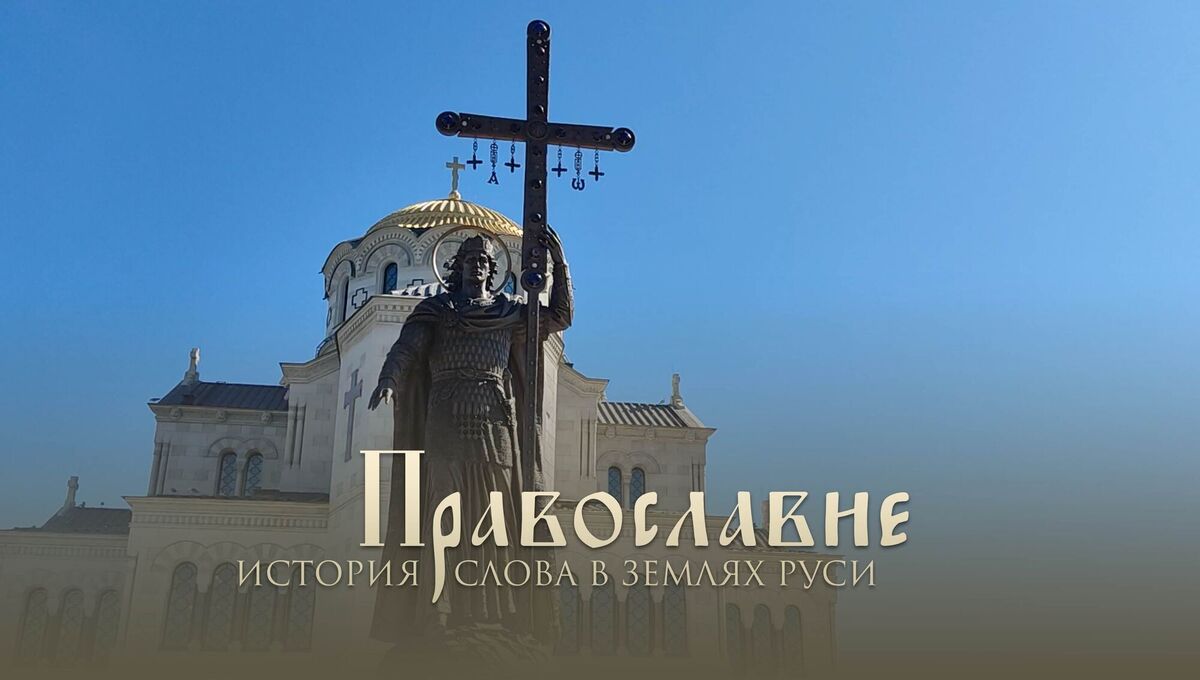
10th century — the coming of Orthodoxy to Rus’
At the end of the 10th century (the year 988) Rus’ received from the Byzantine Empire the Christian faith, which from the 2nd century had been called in Greek ὀρθοδοξία [orthodoxia] (detailed analysis). This name is rendered in the Slavonic language as “pravoslavie” (Orthodoxy), which is a calque (a literal translation) of the Greek word ὀρθοδοξία (ὀρθός — straight, correct; δόξα — glory). In this article the history of the word “Orthodoxy” in the lands of Rus’ is examined in the quotations.
11th century
St Theodosius of the Caves, monk (c. 1008–1074)
And the holy fathers, having written this venerable Orthodox teaching, handed it on to Christians for the continuation of this life and for the partaking of eternal life, so that whoever fulfills this rule of the holy fathers, and lives his years doing the will of God, shall inherit eternal life, but whoever does not heed these books shall be condemned with the devil to eternal torment.
(Instruction on the punishments of God)
Lord, bless! I have a word for you, O God-loving Prince. I am Theodosius, a lowly servant of the Most Holy Trinity, of the Father and of the Son and of the Holy Spirit, born in the pure and Orthodox faith and raised in good instruction by Orthodox father and mother. Beware, my child, of the crooked-believers and of all their conversations, for our land too has been filled with them.
If anyone saves his soul, it is only by living in the Orthodox faith, for there is no faith better than our pure, Holy, Orthodox one. Living in this Faith you will not only be delivered from sins and eternal torment, but will become a partaker of eternal life and will rejoice without end with the Saints. But those who live in another faith shall not see eternal life.
It is not fitting, my child, to praise a foreign faith. Whoever praises a foreign faith is the same as one who blasphemes his own. If anyone praises both his own and a foreign one, he is a man of two faiths, close to heresy. Therefore, my child, beware of them and always stand for your Faith.
<…>
My child! If you must die for your holy Faith, go boldly to death. So did the saints die for the Faith, and now they live in Christ. If you see, my child, men of another faith arguing with an Orthodox man and wishing to tear him away from the Orthodox Church – help the Orthodox man. By this you will deliver the lamb from the lion’s mouth. But if you keep silent and leave him without help, it is the same as if you had taken the redeemed soul away from Christ and sold it to Satan. If anyone says to you: “Your faith and ours are from God”, then you, my child, answer him thus: “You of crooked faith, do you consider God also of two faiths? Do you not hear what the Scripture says: ‘One God, one Faith, one baptism’ (Eph. 4:5)? Do you not hear the Apostle Paul teaching: ‘Though we... an angel from heaven preach any other gospel unto you than that which we preached unto you, ... let him be accursed’ (Gal. 1:8). Those of another faith have rejected the apostolic preaching and the decrees of the holy fathers and have accepted an unrighteous and corrupt faith, full of all perdition, and therefore have been rejected by us. They are dead and offer a dead sacrifice. But we offer to the Living God a Living Sacrifice, pure and undefiled, that we may find eternal life in Christ Jesus our Lord. To Him be glory. Amen.
(Testament to the Kiev prince Izyaslav on the Orthodox Christian faith)
(*According to the opinion of a number of researchers, the epistle was written in the mid-12th century by Theodosius the Greek.)
Nestor the Chronicler, monk (c. 1056–1114)
by all such deeds our Orthodox faith is tested, that it is firm and strong, abiding near to the Lord and not carried away by the devil
(The Tale of Bygone Years)
According to the Hypatian codex (c. 1420):
таковыми вещьми искушатися нашея православныя вѣры, аще тверда есть и искрь пребывающи Господеви
(Chronicle according to the Hypatian codex, edition of the Archaeographic Commission, St Petersburg, 1871, p. 25)
12th century
Kirik of Novgorod, hieromonk (c. 1110–1156)
If a Latin wishes Orthodox baptism (fol. 276a). If there is any man in the faith and baptism of the Latins and wishes to come over to us, let him go to church for 7 days.
(The Questions of Kirik to Archbishop Niphont)
St Cyril of Turov, bishop (c. 1130–1182)
Cover me with Thy protection, O Hope of all the ends of the earth, O Most Holy Lady Virgin Mother of God, the great wonder of Angels, the lofty preaching of prophets, the praise of Apostles, the firm confirmation of martyrs, the excellent adornment of hierarchs, the unconquerable stronghold of tsars Orthodox and of princes, the precious adornment of churches
(Prayers for Wednesday)
15th century
Epiphanius the Wise, monk (c. 1375–1443)
Every day he served the Divine Liturgy, zealously performed the morning and evening prayers – for the peace of the whole world, for the good estate of the Holy Churches, for Orthodox tsars and princes, and for all Orthodox Christians.
<…>
not wishing to submit to the Latin authority, and therefore endured from Isidore for the Orthodox faith great sorrows and torments in prisons, in fetters and chains.
<…>
Who could tell of all the misfortunes and the great sorrow that then fell upon the Orthodox Christians?
<…>
The instruction given to you by St Mark preach everywhere you go, to all the Orthodox, who keep the traditions of the holy apostles and the commandments of the holy fathers of the seven Councils.
<…>
During the siege of the mother of cities, Moscow, many of the Orthodox saw how, from the eastern gates, where men usually entered the city
<…>
Not only did the Orthodox marvel at the virtuous life of the Monk, but many of the unbelievers also marvelled at his blessed life
<…>
In those times, when near the monastery of the saint Orthodox Christians suffered devastation from the pagan Lithuanians
<…>
from the godless Tatars, Germans, Lithuanians and other peoples who do not honour in truth God, our Lord Jesus Christ, and who desire to destroy Orthodox Christianity.
<…>
The Monk appeared in the Latin and German lands and praised St Mark of Ephesus, calling him equal-to-the-apostles and long-suffering, and by his appearance preserved from the pagans, on the way back, the priest Simeon and others, commanding that the rightness of the Orthodox faith be preached in Rus’.
<…>
they bravely armed themselves against the godless, for they saw that the Orthodox faith was being trampled and Christians were being beaten down by the godless
<…>
Those who had trampled the Christian faith and sided with the Poles and Lithuanians, ravaging Orthodox Christians, he besought to depart from the heretics and to join themselves anew to the Orthodox.
<…>
many men of past generations bravely stood for the Orthodox faith, did not spare their heads and endured a martyric death, and now the Church of God glorifies their sufferings and sings praise to them in her services.
(The Life and Miracles of St Sergius, abbot of Radonezh)
As once in Israel Bezaleel, He filled him with wisdom, understanding and skill. Filled with this, he was kindled with the warmth of the faith of Christ and with a strong desire, and wished to go to the land of Perm and teach them the Orthodox faith of Christ.
<…>
“Holy is the church of thee and wondrous in righteousness”. Wondrous, because of the many praises of her, with many praises do I boast of her. Not because she is painted with human skills or masterly devices and designs and inventions, but because she is adorned with the glory of God, arrayed in virtue, embellished with divine doxologies, coloured with the salvation of man, and clothed in the beauty of Orthodoxy.
<…>
And after the appointed short time, having prayed for them abundantly and taught them the Orthodox Christian faith, with their wives and children he baptized them in the name of the Father and of the Son and of the Holy Spirit, and taught them the Perm letters, which he had by that time created.
<…>
For a difficult labour lies before me, and I strive with joy to accomplish it and to suffer. And not only this, but I am ready even to die for the holy Orthodox faith
<…>
he flourished well, abounding in the fruit of virtue; thus the order of the Church of Christ was duly strengthened, and Orthodoxy flourished.
<…>
Shall I call thee father or teacher of the Permians, for in Christ Jesus, by the holy Gospel, thou hast begotten the Permians and taught them the Orthodox faith
(A discourse on the life of St Stephen, former bishop of Perm)
St Joseph of Volokolamsk (Sanin), monk (1439–1515)
all rejoiced that you showed zeal for the most pious and Orthodox Christian faith, as the former holy Orthodox Christian tsars
<…>
For God’s sake, O sovereign, and of the Most Pure Mother of God, be pleased to care for and provide for the divine churches and for the Orthodox faith of Christians and for us, thy poor and needy ones, for thou, O sovereign, art appointed by the right hand of the Most High God an autocrat and sovereign of all Rus’.
<…>
Those dark and foul heretics of Novgorod and apostates and followers of Jewish wisdom thou hast utterly cast down with their blasphemic teachings, while the Orthodox and true and undefiled Christian faith, shaken and weakened by the heretic and Jewish teachings, thou hast again established
<…>
If now thou, O sovereign, dost not take care and dost not bestir thyself in these things, dost not extinguish the foul heretics and their dark heretic teaching, then, O sovereign, the whole of Orthodox Christianity will perish from the heretic teachings, as in former times many kingdoms perished in this way: the great kingdom of Ethiopia, and Armenia, and Rome, which for many years abode in the Orthodox faith of Christians, and so perished.
<…>
So too the great Russian land, which for five hundred years had abode in the Orthodox Christian faith
(Epistles of Joseph of Volokolamsk)
16th century
St Maxim the Greek (Trivolis), monk (1470–1556)
“This is the prophetic faith, this is the apostolic faith, this is the patristic faith, this is the Orthodox faith, this faith established the universe”. This is the faith of thy ancient forefathers, from which those have vainly departed who teach contrary to the saying of the Lord and transgress the institution of the blessed fathers
<…>
But the Latins, when the Orthodox ask them why they invented the addition concerning the procession of the Holy Spirit “and from the Son”, answer that they do this prudently.
<…>
The Latins, who in their pride are presumptuous in all things, not only dreamed that they had the authority to change the word of the Master, but also renounced the agreed definition of the ecumenical councils, by which our pious Orthodox Christian faith was taught by experience and received establishment in the truth.
<…>
And since we have spoken briefly about the confession of the Orthodox faith, there now lies before us the second labour
<…>
The use of unleavened bread at the sacrifice is a Jewish thing, and none of the Orthodox Churches or holy patriarchates – neither Constantinople, nor Alexandria, nor Antioch, nor Jerusalem – allow unleavened bread at the service. Unleavened bread is used only by the Jews and the accursed Armenians, from whom the Latins afterwards accepted it, imitating them.
(An answer to Nicholas the Latin)
How else can this be corrected by us, if not by the true-believing and Orthodox faith
<…>
by the grace of the true God our Jesus Christ I am a true-believing Christian in all things, and a well-wisher and most diligent prayer-maker for the God-kept Russian realm. I beseech every pious Orthodox priest and prince to hear my answer
<…>
Having enlightened your minds with the customary Orthodox tranquillity of sacred love and meekness, take care, wherever anything departs from the Orthodox faith, whether through unreason, or forgetfulness, or the lack of instruction of the mind and understanding
<…>
which the eyewitnesses and servants of God the Word handed down to us, and after them all the ecumenical councils of the God-inspired fathers, adding nothing to them at all, nor smoothing over, nor changing one iota or a single stroke, but the whole Orthodox faith and their theology I keep in my heart whole and unaltered.
<…>
Further to this I confess and proclaim for myself and for every believer the Most Blessed Lady my Mother of God to be the intercessor and protectress of all Orthodox Christians, to be throughout all holy and most pure and undefiled and Ever-virgin
<…>
Judge whether it is righteous for me to suffer thus from you and to hear this, being not guilty, that is, as far as the Orthodox faith is concerned.
<…>
But if the zeal for the truth which is after God, and the boldness with which we dare in God, trusting in your and our Orthodox faith and love, are displeasing to you
(The confession of the Orthodox faith by Maxim, a monk of the Holy Mountain)
We could offer you, for your assurance, many other powerful testimonies and indications from the books of Moses and the prophets, in proof that the only true, infallible and God-pleasing faith is – the gospel and apostolic faith, which the Orthodox Christians hold.
(Answers of Christians against the Hagarenes, who blaspheme our Orthodox Christian faith)
17th century
St Peter (Mohyla), metropolitan of Kiev (1596–1647)
The Orthodox, Catholic and Apostolic Faith consists in believing with the heart and confessing with the mouth the one Trihypostatic God, according to the teaching of the same Paul: “with the heart man believeth unto righteousness; and with the mouth confession is made unto salvation” (Rom. 10:10). Besides this, the Orthodox Christian must accept as certain and undoubted (VI Council, rule 28) that all the articles of the faith of the Catholic and Orthodox Church were handed down to her by our Lord Jesus Christ through His Apostles, expounded and established by the Ecumenical Councils
<…>
so they received from the Holy Apostles; so, and not otherwise, taught, handed down and established the Ecumenical and Local Councils and the teachers of the Church. The same does our Orthodox and Catholic Church contain.
<…>
And so it is enough for us firmly to hold and to believe what Christ taught us, in what the Eastern Catholic and Orthodox Church believes
<…>
that they may be the signs of the true sons of God, or of the Orthodox Catholic and Apostolic Church.
<…>
“In the name of the Father, and of the Son, and of the Holy Spirit. Amen” – he will pronounce exactly and unchangeably, according to the understanding of the Catholic and Orthodox Church.
<…>
For the reception of the dread Mysteries one must prepare according to the order of our Orthodox Church.
(The Orthodox Confession of the Catholic and Apostolic Eastern Church)
St Dmitry of Rostov (Tuptalo), hierarch (1651–1709)
What is greater: whether the catholic Orthodox Apostolic Church which is throughout the universe, or your Bryn? The catholic Orthodox Apostolic Church, (I speak not of walls and buildings, but of the multitude of the true-believing) not only in the Russian state, but in the Greek, and Arabian, and Syrian, and Egyptian lands, and in the Serbian, and Bulgarian, and in Dalmatia, and in Moldavia, and simply put, throughout the universe: your Bryn, however, is in only one corner of the Russian state, and it is as great against the whole catholic Orthodox Apostolic church, as a single handful of water is great against the great sea.
(The Search into the schismatic Bryansk faith, part 2, ch. 7)
18th century
St Stephen (Yavorsky), metropolitan (1658–1722)
The same does our Holy Orthodox Church divinely teach about the holy icons, and teaches us, her children, the same theology.
<…>
Understand and divinely teach the same about the holy icons, according to the common teaching and establishment of the holy fathers, the Ecumenical Councils and the whole Orthodox Church.
<…>
Do you see, sons of the Orthodox Church, the nets of the adversaries, woven by wiles, and consider, what truth is in them?
<…>
I answer. Arius, and Nestorius, and the other heretics did not contradict the Orthodox Church in everything, yet they were heretics, and you call them so.
<…>
But you, sons of the Orthodox Church, stand firm in the faith which you have successively received from Christ and from the apostles
<…>But if you enter into the iconoclastic temples, and especially into the Calvinist kirches, you will find in them such a difference from the Orthodox churches as there is between a stable, or a stall for cattle, and a royal palace.
<…>
All that has been said above I conclude with this: that the Orthodox Church acts rightly and justly when she completely refuses to listen to the institutions of your iconoclastic tsars about the casting out of the holy icons and departs from them as from utter perdition.
<…>
Understand all this perfectly, son of the Orthodox Church, and doubt not at all in the holy icons
(The Stone of Faith of the Orthodox-Catholic Eastern Church)
The Holy Orthodox Church has full authority to establish laws about the holy fasts, adapting them to the needs of the time, and to incite true Christians to keep them according to conscience.
<…>
does not the Holy Church have a similar and even greater authority to impose a fast upon Orthodox Christians by her own discretion and good judgment? And if the Old Testament people obeyed their teachers, then we all the more
<…>
From this it is evident that the Church of Christ (that is, the Ecumenical and Local Councils and the whole order of pastors and churchly teachers – successors of the apostles, Orthodoxly and unanimously confessing the holy Orthodox faith) has the authority to establish laws.
<…>
all the more is there a need for churchly laws for the spiritual governance of the Orthodox people, that they may live according to the spirit and not according to the flesh, and may subdue their passions to the spirit.
(Fasting is the commandment of God, the teaching of the Orthodox Church on the holy fasts)
19th century
St Philaret (Drozdov), metropolitan of Moscow (1782–1867)
272. Why is our Church called “Apostolic”?
The Church is called Apostolic because she unceasingly and unchangeably keeps from the apostles both the teaching and the succession of the gifts of the Holy Spirit through sacred ordination. In the same sense the Church is also called Orthodox, or True-believing.
(The Longer Catechism of the Orthodox Catholic Eastern Church, part 1)
St Gregory (Postnikov), metropolitan (1784–1860)
For by the clear word of God and by the firm teaching of the whole truly Orthodox Church of Christ, the true Church of Christ must be with Bishops until the very second coming of Christ.
<…>
To think, to admit, and all the more to strive with special effort to prove that in our time the Church of Christ consists only of simple Christians not consecrated by any ordination, means to think, to admit, or yet with special effort to strive to prove an opinion directly contrary to the clear word of God and contrary to the ever-constant common and firm teaching of the whole Orthodox Church
<…>
But to think, to admit and yet with special effort to strive to prove anything directly contrary to the clear word of God and to the ever-constant common and firm teaching of the whole Orthodox Church
<…>
men who reject not only the teaching of the Orthodox Church, but Christianity itself
<…>
one or the other, by the clear word of God and by the ever-constant common and firm teaching of the whole Orthodox Church, which must continue until the very second coming of the Lord
<…>
the common and firm voice of the whole Orthodox Church
<…>
The answer of the Orthodox Church dominant in the Russian State, with its foundation.
The Orthodox Church says: “The Church created by the Son of God and God Jesus Christ, the Saviour of the world, is precisely she”, and in proof of her words presents that she has and holds everything that the Church created by the Lord must have and hold, both according to the word of God and according to the rules of the holy Councils and holy Fathers
(The truly ancient and truly Orthodox Church of Christ, set forth in relation to the so-called Old Belief)
20th century
St Arkady (Ostalsky), hieromartyr (1889–1937)
Do you wish to test the words and counsels of the holy Orthodox Church – walk the path of Christian life
<…>
The solution of this question by the experience of the Orthodox Church of Christ.
<…>
Of what do they accuse the Orthodox Church?
<…>
Let us consider, then, whether the Orthodox Church is truly hostile to popular education.
II. The Orthodox Church is not only not an enemy of popular education, but she was the first to take it up and carried it until the latest times.
<…>
Thus the Orthodox Church is the protectress and the source of true teaching and upbringing, giving to parents good, obedient and caring children, to the fatherland honest, industrious and patient sons, to the world true men, and to heaven angel-like citizens and companions of the saints.
(“We must not fear any sufferings...”. Works, vol. I)