
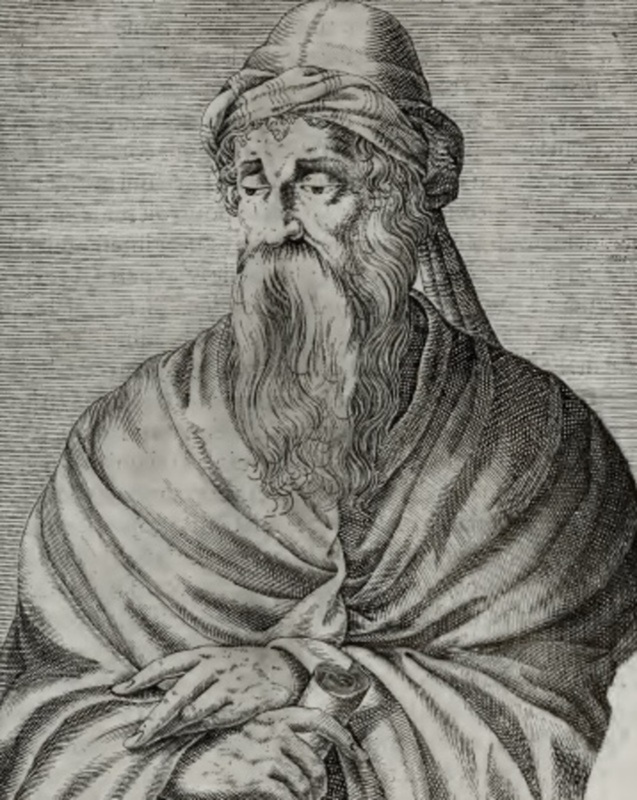
Biography
Childhood and youth. First steps in monastic life
Theodoret of Cyrus was born in 393 in Antioch, one of the most prominent cultural, economic and political centres of the ancient world.
His parents were believing, wealthy, respected and pious people. The name Theodoret, "given by God", was given to the future bishop of Cyrus because he was born after long waiting, thanks to the prayers of two venerable ascetics, Macedonius and Peter: Theodoret's mother had for a long time been unable to conceive. Moreover, the name is connected with his parents' earlier promise, later fulfilled, to dedicate their future son to the service of God.
In the eighth year of his life, in fulfilment of the sacred vow, Theodoret was given to be brought up in one of the monasteries in the vicinity of Antioch. Under the guidance of experienced Syrian ascetics he grew in spiritual stature, and then made the main choice of his life: he renounced the bustle of the world and entered upon the monastic path.
At about the age of twenty Theodoret was ordained a reader at one of the churches of Antioch. Some time later (by then his parents had already died) he withdrew to a monastery near Apamea and devoted himself to monastic struggles.
Further details of the biography of Blessed Theodoret, up to the time of his elevation to the episcopal see of Cyrus, are unknown to us.
Episcopal ministry
In 423, at the age of 30, Theodoret was raised to the episcopal see of Cyrus. According to his own recollections, he accepted ordination reluctantly: on the one hand, he was attracted by the solitary contemplative life; on the other hand, like many outstanding ascetics of his time, out of humility of heart he did not consider himself worthy of the episcopal rank and vestments.
Cyrus, entrusted to his pastoral care, was known as a poor provincial town. It lay far from the main roads, two days' journey from Antioch. The population of the town was small. The inhabitants, as far as they could, tried to move to economically more developed regions of the country.
Theodoret had been accustomed from childhood to a simple life, and material difficulties did not frighten him. In general, during his activity as a hierarch he was known as a good and unselfish pastor. In daily life he was content with the bare necessities and sought neither money nor valuable gifts from the inhabitants. The clergy under his authority tried to imitate him.
Moreover, Theodoret himself donated from the church treasury for the improvement of the town and the living conditions of its citizens. Through his personal efforts two bridges over the river were built in Cyrus, aqueducts were laid, galleries were erected and the public baths were restored.
Caring for the townspeople, the blessed one more than once petitioned the imperial authorities to grant the town legal privileges, and invited artists, skilled craftsmen and doctors to his region.
It goes without saying that the administrative and economic activity connected with the transformation of the social life of the people of Cyrus occupied, though not the last, yet not the first place in the list of the main tasks that faced Theodoret as a ruling hierarch.
As bishop he cared for the improvement of the work of the parish clergy and for the moral state of the faithful, and engaged in educational and missionary work.
By the time his episcopate began, along with true believers there lived in the town a large number of pagans and heretics. Much effort was required to change the situation for the better. And he, with God's help, succeeded.
It is noted that during his governance of the see there were about 800 churches in the diocese. Through Theodoret's efforts the number of venerated holy objects in the diocese increased, in particular holy relics.
The fiery zeal, high sense of responsibility, irreproachable life and learning of Blessed Theodoret led to his becoming known in time throughout the whole Orthodox East.
At this stage of his earthly life he also became famous as a church writer. The range of his writings included commentaries on various Books of Holy Scripture, refutations of heresies and paganism, and answers to dogmatic questions.
The disputes over the heresy of Nestorius
Soon after Nestorius, a representative of the Church of Antioch, ascended the Patriarchal throne of Constantinople, he declared a struggle against heresies. However, instead of faithfully carrying out this task, he himself departed from the purity of faith and became the founder of a heresy.
The essence of his error was the claim that the Mother of God cannot be called Theotokos ("Birth-giver of God"), but only Christotokos ("Birth-giver of Christ"), since the Virgin, being a creature of God, could not give birth to God, Who existed before the Virgin Herself and is Her Creator.
In reality, the Church never taught that the Most Pure Virgin gave birth to God according to His Divinity. But neither did it teach that the Theotokos gave birth to a mere man, and not to God made man.
At first some Antiochene pastors treated the ideas of Nestorius warily but with restraint, one might say indulgently, not suspecting how far he might go in his error. Nestorius, however, possessed the gift of eloquence and could easily draw masses of uneducated believers into his nets.
The sharpest opposition to the heretical patriarch came from the clergy of the local Church of Alexandria. Among them St. Cyril of Alexandria particularly stood out. Seeing that Nestorius blasphemed both the Theotokos and Her Divine Son, the hierarch urgently composed a number of special works. In one of them he set out the so-called twelve anathematisms — twelve detailed propositions that exposed the deception and condemned the new false teaching.
But however much his brothers in Christ urged Nestorius to come to his senses, he stood his ground. Blessed Theodoret, wishing to calm the unrest growing in the Church, sought to defend that part of the teaching of Nestorius which, in his understanding, corresponded to the spirit of the Gospel. At the same time he wished to persuade him to renounce those seductive ideas that contradicted Tradition.
Meanwhile the disputes only flared up. It became necessary to convene another Ecumenical Council.
The Third Ecumenical Council, which met in Ephesus, condemned the heresy of Nestorius and deposed the heresiarch himself. The Fathers of the Council confirmed the veneration of the Virgin Mary as Theotokos.
However, the Christological disputes (concerning the manner of the union of the two natures in Christ) did not subside. Soon after the end of the Council, Theodoret of Cyrus came out against Cyril of Alexandria, whose position on this question seemed suspicious to him. It took time, much patience and effort to reach common agreement and mutual understanding.
Condemnation and vindication
After the death of Cyril of Alexandria (444), the orphaned see was occupied by Dioscorus. When a new Christological heresy (Monophysitism), opposite in content to Nestorianism, spread in Constantinople, Dioscorus joined the camp of the heretics.
Being an admirer of St. Cyril, Dioscorus, knowing of his disputes with Theodoret and seeing in him a dangerous opponent, began to accuse him of departing from the decisions of the Ecumenical Council, while presenting himself as a zealous defender of Orthodoxy.
In 449, through the efforts and intrigues of Dioscorus, another council was held in Ephesus, at which Theodoret was deprived of his episcopal rank and condemned in absentia. Other zealots of the faith were also condemned at this council. It later received the name of the "Robber Council".
Theodoret, confined in a monastery, was forced to remain there without means of subsistence, but he did not despair and trusted in Divine Providence. And he was not deceived.
The Fourth Ecumenical Council, which met in Chalcedon in 451, condemned Dioscorus and his like-minded associate, the heretic Eutyches, and vindicated the Orthodox defenders. Theodoret was rehabilitated with the personal assistance of the emperor, to whom he had previously appealed with a petition to review his case. The Egyptian bishops did not wish to see Theodoret among the participating fathers, but this wish was not granted.
The last years of his earthly life
After his solemn vindication Blessed Theodoret returned to his diocese, to Cyrus.
He spent most of his time in a monastery near Cyrus, devoting much time to scholarly work and prayer, while not ceasing to govern the affairs of the diocese.
In 457 he quietly departed to the Lord, dying at peace with the Church.
At the Fifth Ecumenical Council, held several decades after his death, which condemned Origenism, some writings of Theodoret composed in polemic with Cyril of Alexandria were also condemned.
However, Theodoret himself was not condemned. He is venerated by the Church in the rank of a blessed father and is rightly recognized as an outstanding Christian writer and teacher.