
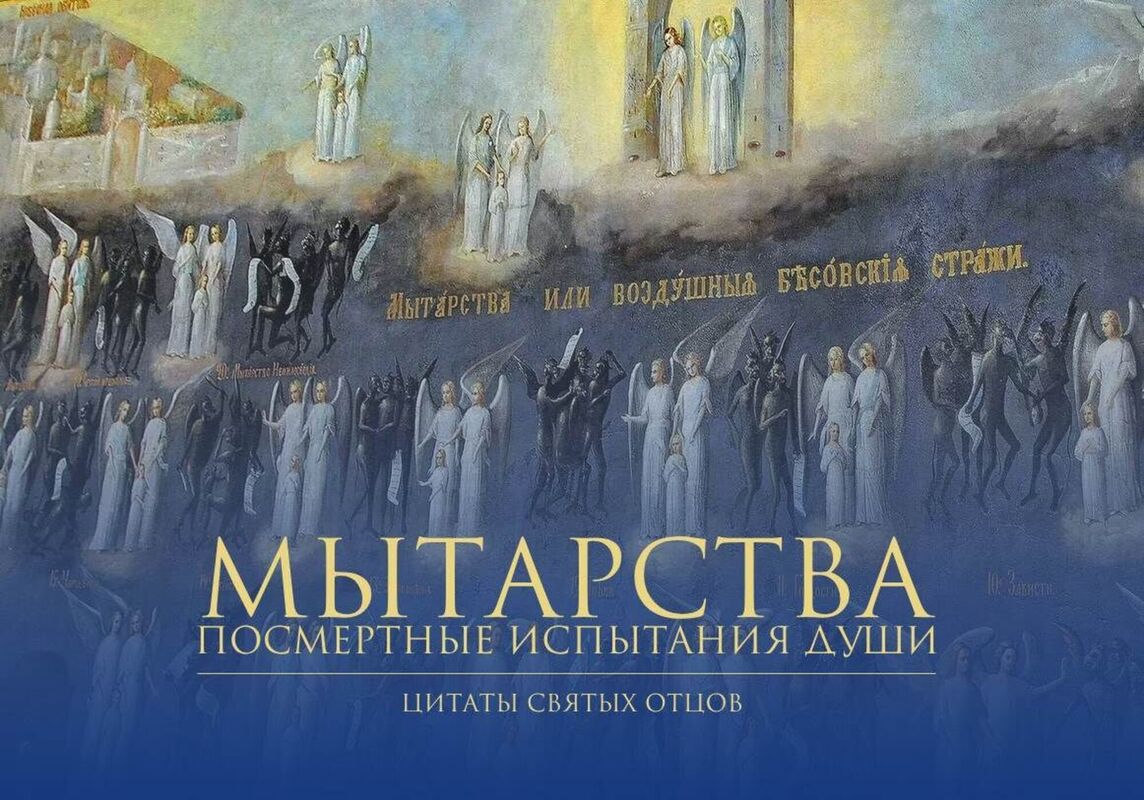
Briefly about the toll houses
The toll houses are the teaching of the Orthodox Church that after a person’s death the fallen angels try to take possession of his soul. Thus the soul undergoes terrible trials, in which the angels of God strive to protect righteous souls and lead them to God. This teaching is expressed symbolically, figuratively, as certain stations, at each of which the soul is tested for one or another passion. The angels in this case are instruments of the accomplishment of God’s justice.
2nd century
St Justin the Philosopher, martyr (c. 100–165)
…And the prayer that His soul should be saved from the sword, and lion’s mouth, and hand of the dog, was a prayer that no one should take possession of His soul: so that, when we arrive at the end of life, we may ask the same petition from God, who is able to turn away every shameless evil angel from taking our souls. And that the souls survive, I have shown to you from the fact that the soul of Samuel was called up by the witch, as Saul demanded. And it appears also, that all the souls of similar righteous men and prophets fell under the dominion of such powers, as is indeed to be inferred from the very facts in the case of that witch.
Hence also God by His Son teaches us for whose sake these things seem to have been done, always to strive earnestly, and at death to pray that our souls may not fall into the hands of any such power.
4th century
St Athanasius the Great, archbishop of Alexandria (c. 295–373)
For once, when about to eat, having risen up to pray about the ninth hour, he perceived that he was caught up in the spirit, and, wonderful to tell, he stood and saw himself, as it were, from outside himself, and that he was led in the air by certain ones. Next certain bitter and terrible beings stood in the air and wished to hinder him from passing through. But when his conductors opposed them, they demanded whether he was not accountable to them. And when they wished to sum up the account from his birth, Antony’s conductors stopped them, saying, ‘The Lord has wiped out the sins from his birth, but from the time he became a monk, and devoted himself to God, it is permitted you to make a reckoning.’ Then when they accused him and could not convict him, his way was free and unhindered. And immediately he saw himself, as it were, coming and standing by himself, and again he was Antony as before. Then forgetful of eating, he remained the rest of the day and through the whole of the night groaning and praying. For he was astonished when he saw against what mighty opponents our wrestling is, and by what labours we have to pass through the air. And he remembered that this is what the Apostle said, ‘according to the prince of the power of the air Ephesians 2:2.’ For in it the enemy has power to fight and to attempt to hinder those who pass through. Wherefore most earnestly he exhorted, ‘Take up the whole armour of God, that you may be able to withstand in the evil day Ephesians 6:13,’ that the enemy, ‘having no evil thing to say against us, may be ashamed Titus 2:8.’ And we who have learned this, let us be mindful of the Apostle when he says, ‘whether in the body I know not, or whether out of the body I know not; God knows 2Corinthians 12:2.’ But Paul was caught up unto the third heaven, and having heard things unspeakable he came down; while Antony saw that he had come to the air, and contended until he was free.
66. And he had also this favour granted him. For as he was sitting alone on the mountain, if ever he was in perplexity in his meditations, this was revealed to him by Providence in prayer. And the happy man, as it is written, was taught of God. After this, when he once had a discussion with certain men who had come to him concerning the state of the soul and of what nature its place will be after this life, the following night one from above called him, saying, ‘Antony, rise, go out and look.’ Having gone out therefore (for he knew whom he ought to obey) looking up, he beheld one standing and reaching to the clouds, tall, hideous, and fearful, and others ascending as though they were winged. And the figure stretched forth his hands, and some of those who were ascending were stayed by him, while others flew above, and having escaped heaven-ward, were borne aloft free from care. At such, therefore, the giant gnashed his teeth, but rejoiced over those who fell back. And immediately a voice came to Antony, ‘Do you understand what you see?’ And his understanding was opened, and he understood that it was the passing of souls, and that the tall being who stood was the enemy who envies the faithful. And those whom he caught and stopped from passing through are accountable to him, while those whom he was unable to hold as they passed upwards had not been subservient to him. So having seen this, and as it were being reminded, he struggled the more daily to advance towards those things which were before.
St Macarius the Great of Egypt, monk (c. 300–391)
But you, hearing that there are rivers of serpents and mouths of lions, and the dark powers under heaven, and a flaming fire seething in the members, such as is not on earth, do you know that, if at your departure from the body you do not receive the pledge of the Holy Spirit, they will hold back your soul, not allowing you to ascend to the heavens? Likewise, hearing also of the dignity of the soul, of how precious this rational essence is, do you understand that it was not of the Angels, but of human nature, that God said: ‘Let us make man in Our image and likeness’ (Gen. 1:26)
(Spiritual Homilies, Homily 16. That spiritual people are subject to temptations and sorrows arising from the first sin)
When the human soul leaves the body, then a great mystery is accomplished. For if it is guilty of sins, then crowds of demons come, and evil angels and dark powers take that soul and carry it into their own domain. And no one should marvel at this; for if the soul in this life, while in this age, was subject and obedient to them and was their slave, then all the more is it held by them and remains in their power when it departs from the world. But as for the good part, you must imagine that it happens thus. With the holy servants of God even now Angels abide, and holy spirits surround and guard them. And when they depart from the body, choirs of Angels receive their souls into their own domain, into the pure age, and thus lead them to the Lord.
(Spiritual Homilies, Homily 22. On the twofold state of those departing from this life)
St Ephrem the Syrian, monk (c. 306–373)
The day will come, brethren, it will surely come, and the day will not pass us by in which a man will leave everything and everyone, and will go alone, forsaken by all, humbled, put to shame, stripped, helpless, having neither defender nor companion, unprepared, without an answer, if only that day finds him in negligence — ‘in the day when he does not expect it, and in the hour when he does not know’ (Matt. 24:50), while he is merry, gathers treasures, lives in luxury, and gives himself over to negligence. For suddenly one hour will come — and everything is at an end; a slight fever — and all will turn to vanity and emptiness; one deep, dark, and painful night — and a man will go, like a defendant, where those who seize him lead him. Much then, O man, you will need guides, many helpers, many prayers, many co-workers in that hour of the separation of the soul from the body. Great then is the fear, great the trembling, great the mystery, great the upheaval for the body when it passes into the world beyond. For if even on earth, when passing from one country to another, we need some guides and leaders, how much more will they be needed when we pass into the boundlessness of the age, from which no one has returned? Again I repeat: many helpers will you need in that hour. This hour is ours, not some other; our path, our hour, and a fearful hour; this is our bridge, and there is no passage over it; this is the common end for all, common, and fearful for all; a hard path, but all must pass along it; a narrow and strait way, but we shall all enter it; a bitter and terrible cup, but we shall all drink it, and not another; great and hidden is the mystery of death, and no one can explain it. Terrible and dreadful is what the soul then experiences, but none of us knows it except those who have gone before us there, except those who have learned it by experience.
<…>
When the Master’s Powers draw near, when the terrible hosts come, when the divine seizers command the soul to depart from the body, when, drawing us away by force, they lead us to the inevitable tribunal
<…>
Pray that his soul may depart in peace, ask that a place of rest be given to him; fall down in supplication that he may have merciful Angels; fall down in supplication that he may find the Judge indulgent; offer up fragrant incense, because he sees the angelic vision; pray, because he is now in a great struggle. Watch over this yourselves, and pray. Look carefully and do not forget this mystery; strain your eyes, and take thought for that hour yourselves.
<…>
What is man? Nothing. What is man? A worm. What is man? Ashes. What is man? A dream. What is man? A shadow. Behold, he has lived out his span; behold, he is gone; behold, he lies motionless, breathless, silent; behold, he is dead; that great and invincible lion, the tormentor, mighty, exalted, a ruler terrible to all, lies there and has become gentle as a sheep. He has left us; he appeared and vanished, was born — and as though he had not been born; he towered above many — and as though he had never been! The sovereign now himself heeds commands; he who imposed chains is bound; and behold, he must go where those who seize him lead him. On that day, as soon as the divine seizers come and take the soul, they ascend through the air, where the Principalities and Powers stand, and the world-rulers of the opposing powers. These are our evil accusers, the terrible tax-gatherers, recorders, and exactors; they meet us on the way, they write down, examine, and reckon the sins and the handwriting of this man, the sins of youth and old age, voluntary and involuntary, committed by deed, word, and thought. Great is the fear there, great the trembling of the poor soul, indescribable the need which it will then endure from the countless multitude of darkness, from the enemies surrounding it, slandering it so as not to let it ascend to heaven, to dwell in the light of the living, to enter the land of life.
But the holy Angels, taking the soul, lead it away.
(Sermon on the Brethren Who Have Fallen Asleep in Christ)
5th century
Abba Isaiah of Scetis, monk and hermit (4th–5th c.)
And if one who performs worldly works rejoices when he sees success in them, with what joy must that soul be filled which has given itself to the service of God and carefully fulfills this service. It, at its departure from this life, will see the Angels meeting it and rejoicing at its deliverance from the powers of darkness. For when the soul goes out of the body, the Angels accompany it. Then all the powers of darkness come out to meet it and search whether there is anything belonging to them, for which they might hold it back. Then the Angels defend it, and incomparably more its own deeds, by which it is guarded and fenced from the attack of the opposing powers, so that they cannot touch it. If its good deeds prevail, the Angels accompany it with singing until it stands before God with gladness. At that time it forgets all the works of this world and all the labors it has endured. Therefore let us labor diligently in this brief course of life, keeping our deeds pure and blameless from all evil, that we may be delivered from the hands of our enemies, who are immeasurably wicked and merciless.
2. Blessed is he in whom those opposing powers find nothing of their own: for his joy, and gladness, and rest, and crown are ineffable.
(Ascetical Discourses, Word 17. On the joy of the soul that works for God)
Every day keep death before your eyes and carefully consider how you must go out of the body, pass by the powers of darkness that meet us in the air, and stand blameless before God, stretching your gaze also toward the terrible day of His last judgment and the recompense to each one for deeds, words, and thoughts. For all things are naked and open before the eyes of Him to whom we must give an answer (Heb. 4:13).
(Chapters on Asceticism and Silence, Word 1. The commandments of Abba Isaiah to the brethren who lived with him)
St Cyril of Alexandria, archbishop (376–444)
Do you imagine, O my soul, what fear and horror will seize you on that day when you see the terrible, wild, cruel, merciless, and shameless demons standing before you like dark Ethiopians? The mere sight of them is more terrible than any torments. Looking at them, the soul is troubled, falls into agitation, is in turmoil, tries to hide so as not to see them, running to the Angels of God.
The soul, upheld and raised up by the Angels, as it passes through the airy spaces, meets on its way the toll houses — as it were, separate companies of spirits who watch over the ascent of souls, hold them back, and hinder those who ascend. Each toll house, as a separate division of spirits, presents to the soul its own particular sins.
The first toll house is that of the spirits of slander and of gluttonous frenzy. There the spirits present the sins which the soul committed by word…
(On the Departure of the Soul and the Last Judgment) (Spuria) (the content of the text is recognized by the Church)
St John of Karpathos, monk (5th c.)
51.1 With threats and abuse the devil boldly attacks the soul that has just left the body, appearing as a bitter and terrible accuser of its falls. But one may also see how a soul that loves God and is faithful to Him, although it has been wounded many times before by sins, does not fear his attacks and threats, but becomes ever stronger in the Lord, is winged with joy, is inspired with wisdom, seeing the heavenly powers that accompany it; and, as it were, walled about by the light of faith, with great boldness it cries out against the wicked devil: “What have we to do with you, you stranger to God? What have we to do with you, you evil servant cast down from Heaven? You have no power over us. Christ, the Son of God, has power over us and over all things in the world; we have sinned against Him, and to Him we shall give an answer, having as our pledge His mercy toward us and the precious cross of our salvation in Him. But flee far from us, you wretched one!”
(Instructions)
7th century
John Climacus, monk (c. 579–649)
Others said dolefully: ‘Will our soul pass through the impassable water of the spirits of the air?’ (Ps. 124:5) — not having complete confidence, but looking to see what would happen in that rendering of accounts.
(The Ladder of Divine Ascent, Step 5)
St Maximus the Confessor, monk (580–662)
The memory of death preserves it, together with the constant and sharpest suffering of the soul because of the future departure. The uninterrupted imagination keeps it completely unquenchable: the coming terrible and strict examination awaiting the soul, which the spirits of evil will set up in the air. Who, beloved, among those stained with transgressions like mine, does not fear the power of the holy angels, who at the end of this present life, by the sentence of God, will violently and wrathfully tear the soul from the body against its will? Who, having a defiled conscience, does not fear the fierce and wild attack of the evil demons, each of whom, after the departure from the body, ruthlessly drags to himself the unhappy soul seized with suffering, and puts it to shame by exposing what it has done, and deprives it of every hope of future blessings? This sorrow is savingly nourished by the exact depiction of the state of souls in hell, where they come after being examined by the spirits of evil in the air: how they remain in deep darkness and oppressive silence, feeding only on the bitterest groans and tears, and moreover on despondency, and all the time expecting nothing else but the just condemnation by the judgment of God
(Letters, IV. To the Same, on Godly Sorrow)
18th century
St Nicodemus of the Holy Mountain (Kallivourtsis), monk (1749–1809)
For the demons who fell from heaven: some remained in the air above the earth, that is, in the air under heaven; others in the air surrounding the earth; and others fell down into the subterranean air (into the nether world). Those of them who are in the air under heaven hinder the ascent of souls after death and deceive with various imaginings and allurements the mind of those who strive to contemplate spiritual things.
(Commentary on the Canon of the Exaltation of the Precious and Life-giving Cross, Ode 5, Troparion 2)
19th century
St Seraphim of Sarov, monk and wonderworker (1754–1833)
A soul filled with the love of God, at the time of its departure from the body, will not fear the prince of the air, but will fly up with the Angels, as it were from a foreign land to its homeland.
(Conversation of St Seraphim with N. A. Motovilov. On the aim of the Christian life; On the love of God)
St Ignatius (Brianchaninov), bishop (1807–1867)
The justice of God carries out judgment over Christian souls that have gone out of their bodies by means of Angels, both holy and evil. The former, during a man’s earthly life, note all his good deeds, and the latter note all his transgressions. When a Christian soul begins to ascend to heaven, guided by the holy Angels, the dark spirits accuse it of sins not blotted out by repentance, as sacrifices to Satan, as pledges of communion and of the same eternal lot with him.
For the trial of souls passing through the airy space, separate tribunals and watches have been established by the dark powers in a remarkable order. Along the layers of the region under heaven, from the earth to heaven itself, stand the watchful regiments of fallen spirits. Each division is in charge of a particular kind of sin, and tries the soul in it when the soul reaches that division. The aerial demonic watches and tribunals are called in the writings of the Fathers toll houses, and the spirits serving in them, tax-gatherers.
A tax-gatherer in the time of Christ and in the first centuries of the Christian Church was a collector of state dues. Since this duty, in the simplicity of ancient customs, was entrusted to a person without any definite responsibility or accountability, the tax-gatherers allowed themselves every means of violence, all kinds of cunning, quibbles, countless abuses, and inhuman plunder. They usually stood at the city gates, in the markets, and in other public places, so that no one could escape their watchful eye. The conduct of the tax-gatherers made them a terror to the people. In the people’s understanding, the name of tax-gatherer meant a man without feeling, without principles, capable of every crime and every degrading act, breathing and living by them — a man rejected. In this sense the Lord compared the stubborn and desperate despiser of the Church to a heathen and a tax-gatherer (Matt. 18:17). For the Old Testament worshippers of the true God nothing was more abominable than an idol’s servant: the tax-gatherer was equally hateful to them. The name of tax-gatherers passed from men to the demons who guard the ascent from earth to heaven, by the similarity of the office and its performance. As sons and companions of lies, the demons convict human souls not only of the sins they have committed, but also of such as they never were guilty of. They resort to inventions and deceits, joining slander with shamelessness and insolence, in order to snatch the soul from the hands of the angels and to increase by it the countless multitude of hell’s prisoners (Ps. 27:12); so speaks the Holy Spirit in the person of the human soul, describing its invisible struggle with invisible enemies.
The teaching on the toll houses is the teaching of the Church. It is certain that the holy apostle Paul speaks of them when he declares that Christians face a struggle against the spirits of wickedness under heaven. We find this teaching in the most ancient church tradition and in the church’s prayers.
<…>
Further he says that the Angels receive the undefiled and righteous soul with love, bless it, and bear it up with singing, repelling the power of the enemies and rising above the toll houses of the ascent. On the contrary, the sinful soul is not allowed to rise into the country higher than the air: the devil has grounds to accuse it. He contends with the Angels who carry it, presenting its sins, on account of which it must belong to him, and presenting its deficiency in that degree of virtue which is necessary for salvation and for a free passage through the air
(The Word on Death)
St Theophan the Recluse, bishop (1815–1894)
The Church is the living union of all believers, who, being joined into one under one head — Christ the Lord — constitute one body. It is made up of believers, both living and departed. Unbelievers, both living and departed, are outside it and outside the Lord Savior, its head. Unbelievers here are called, and if they take advantage of this here and enter the Church, then there too they will be the same, that is, children of the Church. The Savior says: “He who believes and is baptized will be saved; but he who does not believe will be condemned” (Mark 16:16). And again, “whoever is not baptized with water and the Spirit will not enter the kingdom of God” (John 3:5)! And this must be accomplished on earth. And again, in heaven only that will be loosed which is loosed on earth. There have been such cases, when one of those worthy of the kingdom died with some sin unloosed, and the Lord judged him to return to earth to finish what was unfinished. Those who die outside the faith and the Church are like suicides… The Church does not pray for suicides, for they die in a mortal sin unloosed — not cleansed by repentance… It is bitter for your love to hear this about your parents… but to them one may apply what is appointed for infants who die without baptism.
The latter are given over to the boundless mercy of God. Do you also give over to God the fate of your parents, and pray for them in your private prayer, that He may deal with them according to this mercy and according to your faith in this mercy.
Where are the souls of sinners who did not manage to justify themselves here? In some place appointed for them by the Righteous Judge. After death there is a particular judgment, at which the fate of sinners is determined… But the final decision of their fate will follow at the universal Last Judgment. Until then they only await that fearful moment… and are horrified and suffer from it. — What is purgatory? — Purgatory is an article of the Catholic faith. It is a place where sinners not yet purified are purified here. Purification is accomplished by torments, according to sins. All those in whom there is any sinful impurity enter it. — In the Orthodox Church there is no such teaching (about purgatory — note), but there is the belief that those who died with repentance and communion, but did not manage to perform corrective labors or penances, make this up by the prayers of the Church for them and by alms for them, and of course by their own prayers there. They live in hope and do not suffer, they are not in torments. This is similar to purgatory, but not the same.
What are the toll houses? — They are an image of the particular judgment after death, at which the whole life of the dying person is reviewed with all its sins and good deeds. Sins are recognized as blotted out by opposite good deeds or by corresponding repentance.
Find the “Cheti-Minei for the month of March.” There, under the 26th, the passing of the toll houses by St Theodora the Elder is described. — All who die as sinners unjustified in life pass through the toll houses. Only perfect Christians are not detained at the toll houses, but ascend straight to heaven in a bright band.
(Letters, No. 489–91–92–93–94, Letter 479, issue 3, p. 163)
It has come to my mind to suggest the following to you! Obtain the Cheti-Minei for the month of March and read there the account of Blessed Theodora about how she passed through the toll houses. It is placed in the Life of Basil the New under March 26. The Life of the Elder itself is long. Begin directly with Theodora’s account, and where it begins you can learn from the notes in the margins.
<…>
What Blessed Theodora met, every soul meets. The Apostle called the demons the powers of the air. Will these evil and importunate beings let any soul pass when it is to ascend to the throne of God, without attempting, if not to seize it, then to trouble it with their terrors? What is to be done? To our great consolation, tears of repentance together with repentant labors, and especially together with almsgiving, blot out all sins. How many times Blessed Theodora saw how the demons, having brought scrolls on which her sins were written and unrolled them to convict her, found nothing there. The Angels who accompanied her, when she asked them the reason for this, explained to her that whoever sincerely repents of his sins, fasts, prays, and gives alms, his sins are blotted out.
Do not indulge in vain speculation, but take this account to heart and, following its guidance, deal with all your failings.
(What Is Spiritual Life and How to Attune Oneself to It, 36. Perfect preparation for the sacrament of repentance and communion. The feelings necessary for the penitent. A useful reminder of Blessed Theodora and her passing through the toll houses)
The second moment of not being put to shame is the time of death and of passing through the toll houses. However wild the thought of the toll houses may seem to the clever, there is no avoiding passing through them. What do these tax-gatherers seek in those who pass? — Whether they have any of their goods. And what are their goods? — The passions. Therefore, where the heart is pure and estranged from the passions, they can find nothing to which they might cling; on the contrary, the goodness opposite to them will smite them like lightning arrows. To this one of no little learning expressed yet another thought: the toll houses seem something terrible; but it is very possible that the demons, instead of something terrible, present something alluring (flattering, cunning). By every kind of passion, they present to the passing soul one alluring thing after another. When the passions have been driven out of the heart during the earthly life and the opposite virtues planted in their place, then whatever alluring thing is presented, the soul that has no sympathy for it passes by, turning away from it with loathing. But when the heart is not purified, then the soul rushes there toward whatever passion it has most sympathy for. The demons take it as friends, and afterwards they know where to put it. So it is very doubtful that a soul, while there still remain in it sympathies for the objects of any passions, will not be put to shame at the toll houses. The shame here consists in this, that the soul itself rushes into hell.
(Selected Psalms Interpreted by St Theophan the Recluse, verses 73–80, Ps. 119:80. “Let my heart be blameless regarding Your statutes, That I may not be ashamed”)
St Anthony (Amfiteatrov), archbishop of Kazan and Sviyazhsk (1815–1879)
The particular judgment of God over souls, after their separation from the body, is preceded, according to the teaching of the Orthodox Church, by their trial at the so-called toll houses, through which they, ascending from the earth accompanied by angels, pass through the airy space, and at which the evil spirits detain them and expose all the sins they have committed in life. This teaching is partly confirmed also by Holy Scripture, when it calls the air precisely the domain of the evil spirits (Eph. 6:12), and their prince the prince of the power of the air (Eph. 2:2). And if it is certain that the evil spirits take a great part in our affairs and try in every way to harm us here, then of course they cannot leave us in peace in a time so convenient for them — when the soul passes through what is, as it were, their own domain. But the teaching on the toll houses proper is set forth in many church prayers and is found in many Fathers of the Church, certainly on the basis of Holy Tradition
(Dogmatic Theology of the Orthodox Catholic Eastern Church, § 341. The manner of the particular judgment)
20th century
St Seraphim (Sobolev), archbishop (1881–1950)
Having in mind such a wondrous intercession of the Most Pure Mother of God, the holy Church always prays that the Mother of God may appear to us in the most terrible hour of our life — the hour of our death. The Church believes that the Mother of God shows us Her protection also in that time which is terrible for us, when our soul, after separation from the body, passes through the aerial toll houses.
(Sermon for the Feast of the Protection of the Most Holy Theotokos. On the special intercession of the Most Pure Mother of God in our great calamities)
Let us never blame our neighbors for them, but blame and condemn only ourselves, and then the words of Christ will be fulfilled in us: “he who humbles himself will be exalted” (Matt. 23:12; Luke 14:11). The Lord will exalt us for our humility to joyful communion with Himself, will free us from demonic power even in our earthly life, and also at the aerial toll houses after death, and will make us partakers of His Kingdom with all its ineffable blessedness.
(Sermon on the 23rd Sunday after Pentecost. On the activity of demonic power in our life)
May the Lord help us, my beloved children in Christ, to have this great love for our neighbors, this condescension to their shortcomings. As the holy apostle Paul testifies, in attaining this love we shall fulfill the whole law of Christ, all His saving commandments. Then the Lord will send us a wondrous, peaceful, Christian end. Then the angels will fence our souls, at least from the demons — during our passing through the aerial toll houses, and will settle us in the heavenly dwellings for eternal heavenly blessedness
(Sermon for the Day of the Commemoration of St Seraphim of Sarov the Wonderworker)
St John (Maximovitch), archbishop of Shanghai and San Francisco (1896–1966)
Our earthly life is a preparation for the future, and that preparation ends with our death. “It is appointed for men to die once, but after this the judgment.” Then a man leaves all his earthly cares, the body dissolves, to rise again in the general resurrection. But his soul continues to live and does not cease its existence for a single moment. By many appearances of the departed we are given to know in part what happens to the soul when it leaves the body. When its sight through bodily eyes ceases, then its spiritual sight opens. Often it begins in the dying even before death, and they, still seeing those around them and even talking with them, see what others do not see. Having gone out of the body, the soul finds itself among other spirits, good and evil. Usually it strives toward those who are more akin to it in spirit; and if, while in the body, it was under the influence of some, it remains dependent on them after leaving the body, however unpleasant they may prove at the meeting.
For two days the soul enjoys relative freedom and may visit places on earth that it loved, and on the third day it sets out for other spaces. At that it passes through hosts of evil spirits who block its path and accuse it of various sins to which they themselves tempted it. According to the revelations, there are twenty such barriers, the so-called toll houses, at each of which one or another kind of sin is tested; having passed through one, the soul comes to the next, and only after safely passing through all can the soul continue its path, and not be cast into hell at once. How terrible those demons and their toll houses are is shown by the fact that the Mother of God Herself, informed by the archangel Gabriel of her approaching death, besought Her Son to deliver Her from those demons, and, fulfilling Her prayer, the Lord Jesus Christ Himself came from Heaven to receive the soul of His Most Pure Mother and bear it up to heaven.
(I await the resurrection of the dead and the life of the age to come)
John (Krestyankin), archimandrite (1910–2006)
O great Archistrategos of God, Archangel Gabriel! You announced to the Most Pure Virgin Mary the conception of the Son of God. Announce also to me, a sinner, the terrible day of my death, and entreat the Lord God for my sinful soul, that the Lord may forgive my sins, and that the devils may not hold me back at the toll houses for my sins. O great Archangel Gabriel, preserve me from all misfortunes and from grievous illness, always, now and ever and unto the ages of ages. Amen.
(Prayer to the Holy Archangel Gabriel)
But woe to us if by our actions we force him to turn from our defender into our accuser. According to the teaching of the Church, the Guardian Angel will stand before each of us and at the mysterious, terrible, sacred, and inevitable moment of our death.
Then indeed we shall ask and entreat him not to depart from us. Not to leave us during the passing through the toll houses, because it will be very terrible for us without him. And how deeply we shall regret then that in our life we ourselves withdrew from him, forgot to pray to him, especially in moments of danger.
And how blessed will those of us be who have accustomed themselves in life to turn to him in prayer: “My Guardian Angel! When the hour of my death comes, hasten to my help at the separation of the soul from the body; be my comforter in the struggle with death; take me under your protection when I pass into the realm of eternity, when I go out of this world and enter the world unknown to me; encourage me by your presence… May I see you standing at my right hand, radiant, gentle, my defender…” If a man’s soul proves worthy, the Guardian Angel will accompany it in the worship of God on the 3rd, 9th, and 40th day after death, and will not abandon it even in the life beyond the grave.
(Homily on the Heavenly Angelic Host)