
Biography
General Information
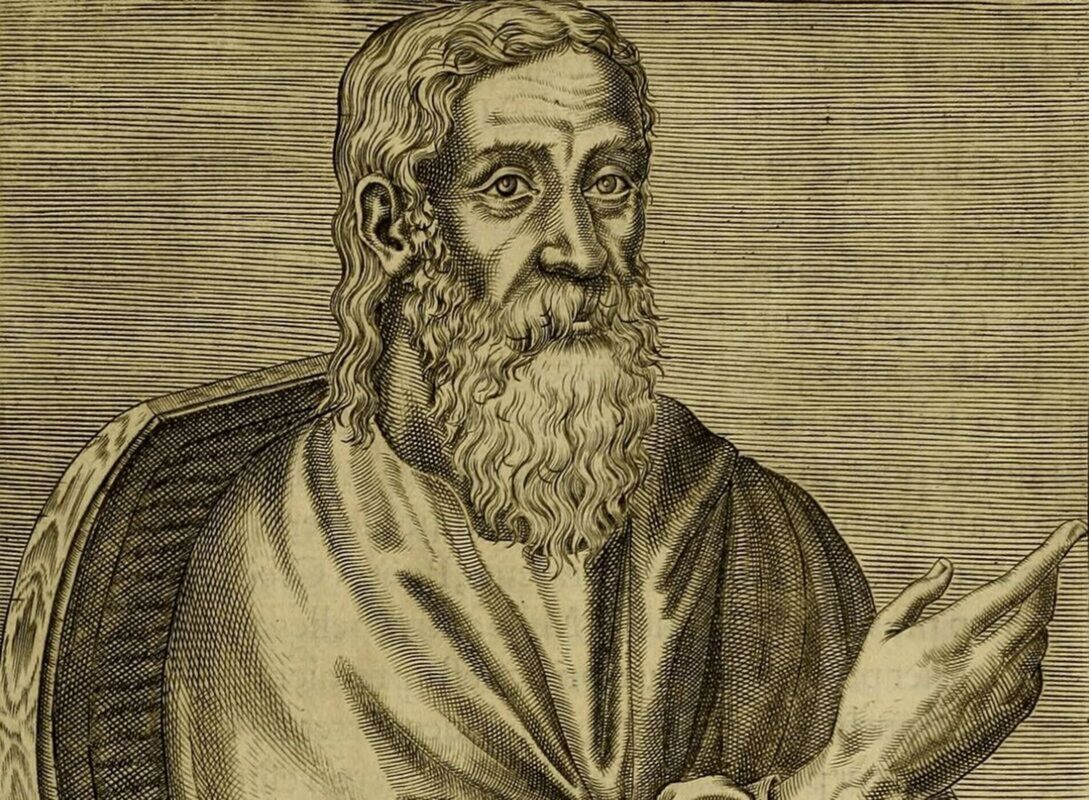
Titus Flavius Clement of Alexandria (~150-215) is venerated by the Church as a Christian philosopher, teacher of the faith, and witness of Tradition.
The exact date of Clement's birth, and the chronology of his childhood and youth, are unknown to us.
It is asserted that he was born in the second half of the second century. Depending on the source, Clement of Alexandria's homeland is considered to be either Alexandria or Athens.
There is reason to believe that his parents belonged to the pagan nobility.
The literary works composed by Clement testify to his high level of education. It is evident that Clement was skilled in philosophy, the art of speech, knew ancient mythology, and was well-versed in the intricacies of pagan mysteries.
It is noteworthy that today, on a whole range of questions concerning pagan rites, Clement's writings are virtually the only primary source.
Christian Life
Detailed circumstances of Clement's conversion to Christ have not reached us.
There is an opinion that initially he developed an interest in Christianity not so much from a desire to follow Christ, but rather for the acquisition of additional knowledge. However, having become more familiar with Christian teaching, he acknowledged its truth and its indisputable superiority over pagan beliefs and pagan philosophy.
Seeking to increase his level of education, Clement undertook journeys to various countries of the West and the East (to Lower Italy, Palestine, Syria), until he finally found peace of spirit in Egypt.
During his travels, he met many praiseworthy people, including those who had received the faith directly from the disciples of the apostles.
Around 180 AD, shortly after his arrival in Egypt, he became acquainted with Pantenus, the head of the catechetical school in Alexandria. The role of this school in the development of theological science and the spread of the faith was so significant that it is compared, in its importance, to the outstanding role played by the Platonic Academy for philosophy.
Being a zealous and educated Christian, Pantenus managed to confirm Clement in the faith.
While residing in Alexandria, Clement became acquainted not only with Christianity but also with the teachings of the Gnostics and with Hellenistic-Jewish literature. The works of the renowned thinker Philo of Alexandria had a great influence on him. Nevertheless, as a Christian, he adhered to the framework of the Church's Tradition.
Around 189 AD, he was honored with the position of teacher at the Alexandrian School, becoming an assistant and associate of Pantenus.
Around 190 AD, after Pantenus left Alexandria, Clement was ordained to the priesthood and took the place of head of the school.
Soon he achieved wide renown and recognition as a church writer and an authoritative theologian.
He was among the first to attempt to systematize the dogmas of the faith and to give theology a scientific form, insisting that thorough, profound knowledge of the faith is necessary for spiritual development. Clement viewed other sciences and philosophy as a means conducive to the development and transformation of the person. He considered philosophy to be a "tutor to Christ".
In his works, he zealously defended the truth of the Christian religion, explained the content of the dogmas, and refuted the reality of the pagan gods.
Engaging in literary activity, he displayed considerable erudition. His immortal works contain many excerpts not only from Holy Scripture but also from early Christian literature, such works as the "Didache", the Epistle of Clement of Rome, the "Shepherd" of Hermas, and the Epistle of Barnabas.
Clement's treatises—"Protrepticus", "Paedagogus", "Stromata", and others—are inscribed in Church History as some of the finest works of Christian thought.
Departure from Alexandria
In 202, during another persecution of Christians, launched under the reign of Septimius Severus, Clement was forced to leave his beloved Alexandria.
His subsequent place of residence is unknown. It is believed that from Alexandria he withdrew to one of his disciples, probably Alexander, who, by God's Providence, became the Bishop of Caesarea in Cappadocia, and later the Bishop of Jerusalem.
In 211, Alexander, while in prison, sent a letter to the Church of Antioch through Clement. At that time, he described him as a blessed, tested, and virtuous man. There is reason to believe that in Alexander's absence, Clement cared for his flock, enlightening and strengthening the orphaned community.
Information about the last years of his life is extremely scarce. The time of Clement of Alexandria's death is considered to be the period between 215 and 217.