Commemoration Day: June 15(28)
Biography
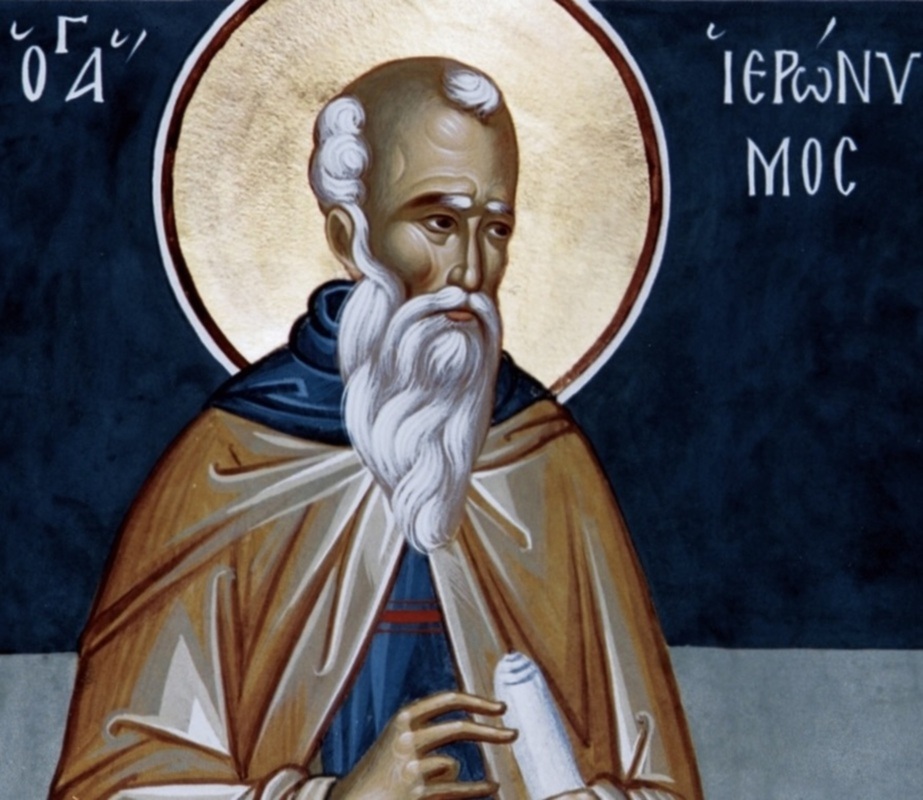
Little is known about the early years of the life of Blessed Jerome of Stridon. Time has obscured both the exact date of his birth and even his secular name (although there is reason to believe that he was named Eusebius). Jerome's place of birth was Stridon (a small town located near the borders of two regions: Dalmatia and Pannonia). Jerome's parents were Christians. There is a version that by their social status they belonged to the well-off freedmen.
Jerome received his initial education at home under the guidance of a teacher. Then, by the will of his parents, he went to Rome, where he continued his studies. Among other educational disciplines, he studied philosophy and rhetoric. During his stay in Rome, he faced many temptations, which he did not always overcome. Despite all this, he managed to preserve that spark of faith which his mother and father had kindled in his heart back in his childhood. On Sundays, for example, he loved to visit the tombs of Christian martyrs, the impression of which touched his soul so deeply that, by his own admission, it seemed to him as if he himself, alive, was descending into the grave.
While in Rome, Jerome decided to change his life. It is believed that during this period he was baptized. After leaving the Eternal City, while traveling in Gaul, he seriously considered monasticism. Returning to his native Stridon in 372, Jerome no longer found his parents alive. The necessity of caring for his sister and younger brother, as well as for his parental inheritance, forced him to postpone his plans for hermitage. For some time he lived in Aquileia, communicating with friends from a "semi-monastic" circle. Then he undertook a journey to the East, intending to visit Jerusalem, Syria, and Egypt. However, upon reaching Antioch, he fell seriously ill.
After his recovery, he settled in the Syrian Thebaid; it is believed, in a local monastery. There he lived, in ascetic labors and prayer, for about five years. At this time he also studied the Holy Scriptures and the Hebrew language. In Antioch, he joined the community of Bishop Paulinus and was ordained a priest. After a short time, he moved to Constantinople, where he communicated with two great hierarchs: Gregory the Theologian and Gregory of Nyssa. Leaving Constantinople in 381, he went to Rome. At that time, a Council was held there, organized on the occasion of the Meletian schism. In Rome, the blessed father was honored with the position of secretary under Pope Damasus.
Not everyone accepted the highly spiritual life of Father Jerome: for many, he served as a reproof. Intrigues began against the saint. Slanders were spread. To all other accusations was added the accusation of sympathy for Origen.
After the death of Pope Damasus in 384, the pressure on Father Jerome only increased: the new pope, Siricius, disliked him. Then the blessed one, taking his brother Paulinian with him, left Rome and went to the Holy Land. Having venerated the holy places, he undertook a pilgrimage to Egypt. Here he was fortunate to listen to Didymus the Blind and converse with the Nitrian desert dwellers.
In 386, Jerome became the head of a monastic monastery in Bethlehem. In addition to managing the monastery and ascetic exercises, he was engaged in literary work.
The contribution of Blessed Jerome to ecclesiastical literature is difficult to overestimate. He left behind an extensive literary heritage. One of his most important achievements is considered to be the translation of the Books of Holy Scripture into Latin. On September 30, 420, the saint passed away to the Lord.