
Irenaeus of Lyons on Images – The Gnostic Use of Icons
This note examines a quotation from St. Irenaeus of Lyons (2nd century) concerning images:
They style themselves Gnostics. They also possess images, some of them painted, and others formed from different kinds of material; while they maintain that a likeness of Christ was made by Pilate at that time when Jesus lived among them. They crown these images, and set them up along with the images of the philosophers of the world that is to say, with the images of Pythagoras, and Plato, and Aristotle, and the rest. They have also other modes of honouring these images, after the same manner of the Gentiles.
This quotation is used by those who advocate for the establishment of their own churches in order to accuse the Church—the community once gathered personally by Christ—of apostasy from God. In this context, the division-makers seek to justify the necessity of creating new communities, which requires them to argue that the Church has lost grace, and they do so, among other things, by searching for pagan roots in her traditions.
The Orthodox practice of venerating the prototype through the image existed even in the Old Testament and is comprehensively addressed in the article on icon veneration. Here, through textual analysis, we will demonstrate that the Church's practice does not derive from Gnostic or pagan practices, since it is entirely different in both form and content.
St. Irenaeus of Lyons was a Greek-speaking writer, so let us turn to an analysis of the Greek text, so we will analyze the quotation by comparing the Greek and Latin versions.
External Differences in the Use of Images between the Church and the Gnostics
1. Three-Dimensional Images
The Gnostics used three-dimensional figures—busts or statuettes, or relief images produced by stamping or casting. Let us examine the expressions in the text that directly or indirectly indicate this.
Direct Indication of Three-Dimensionality
The three-dimensional nature of the images is unequivocally indicated by the Greek word ἐκτυπώματα (ektypōmata) —a noun derived from the verb ἐκτυπόω (to beat out, imprint, press out, mold, or make in relief). It means a relief, impression, bas-relief, bust, or even a statuette. Ektypoma implies volume, convexity, or a form obtained by casting or embossing.
Here is how the passage in question can be translated from the Greek (all necessary sources and details will be provided at the end of this work):
"They have images painted with colors, as well as [images] made of gold, silver, and other materials, which, they say, are three-dimensional impressions (ἐκτυπώματα) of Jesus, and that they were made under Pontius Pilate—that is, three-dimensional impressions (ἐκτυπώματα) of Jesus himself, when He dwelt among the human race."
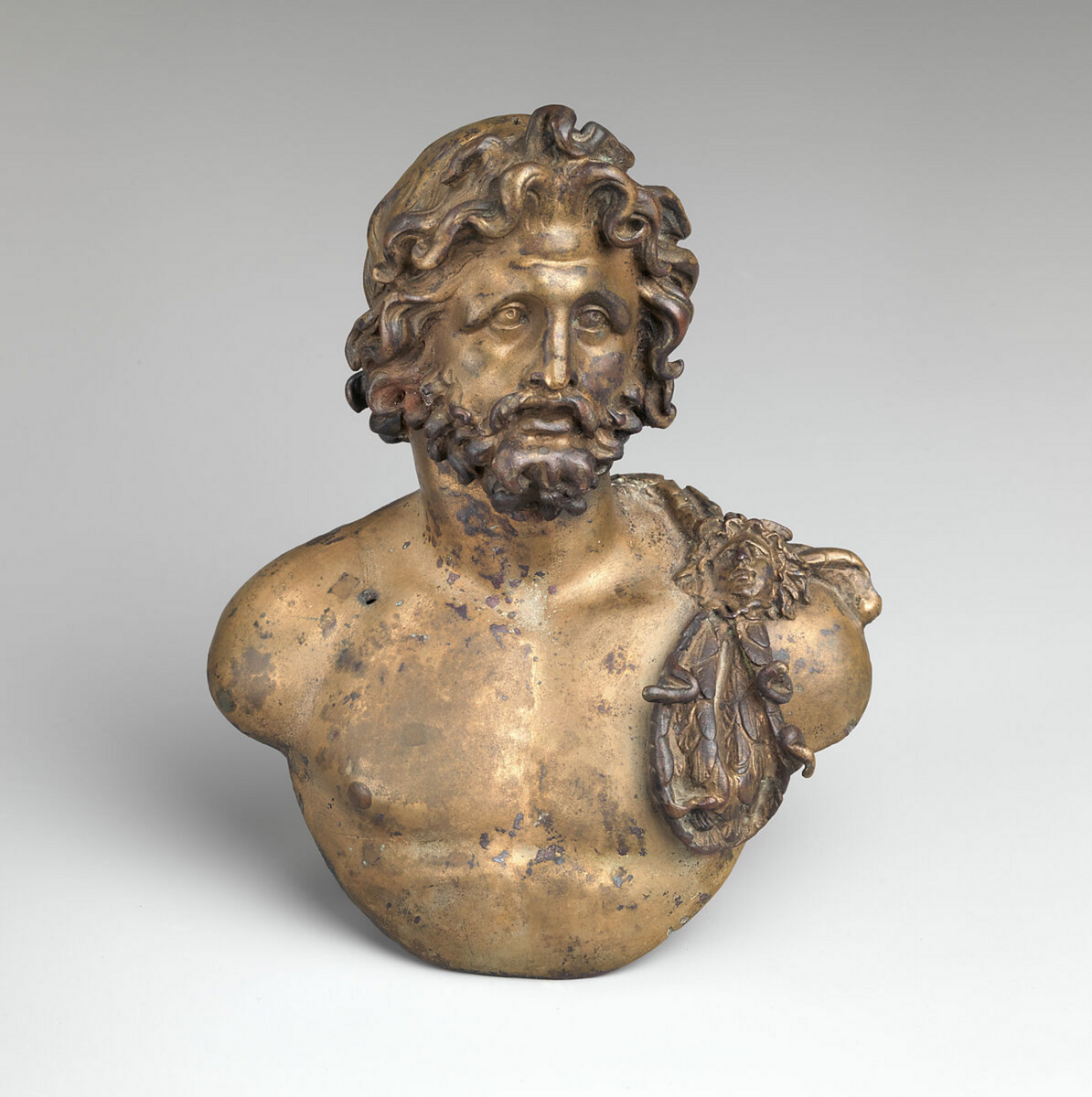
Most likely, the Gnostics used busts of the type already widespread among pagans for domestic worship. Such items were in demand, could easily be found for sale, and one could readily commission a craftsman to produce them.
Examples:
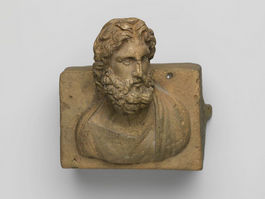
[1st–2nd century AD, bronze bust of Neptune, Metropolitan Museum, USA] [large version] [source]
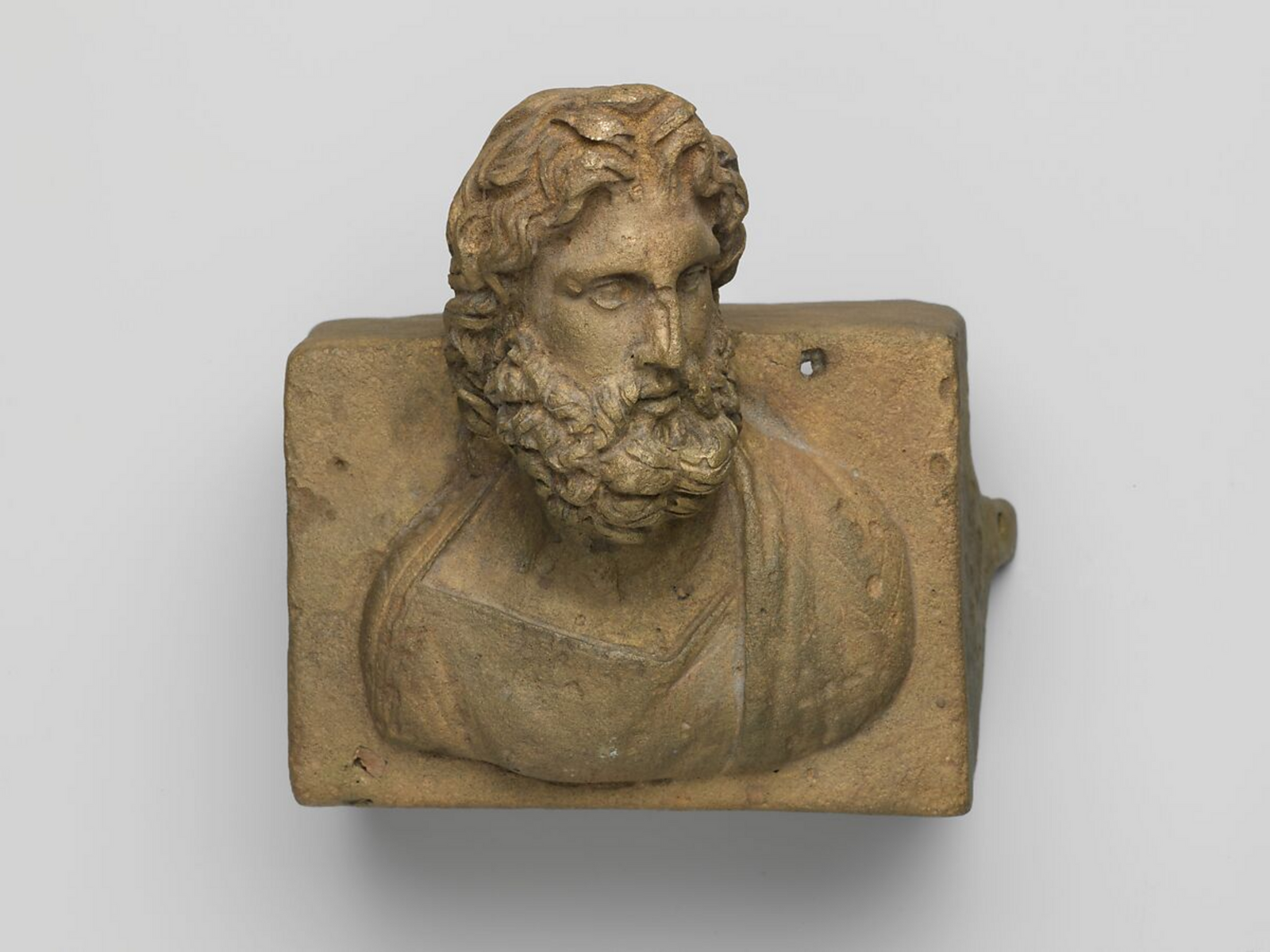
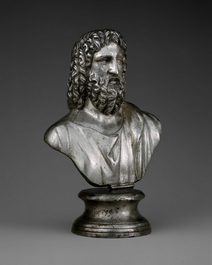
[2nd century AD, silver bust of the pagan deity Serapis, Metropolitan Museum, USA] [large version] [source]
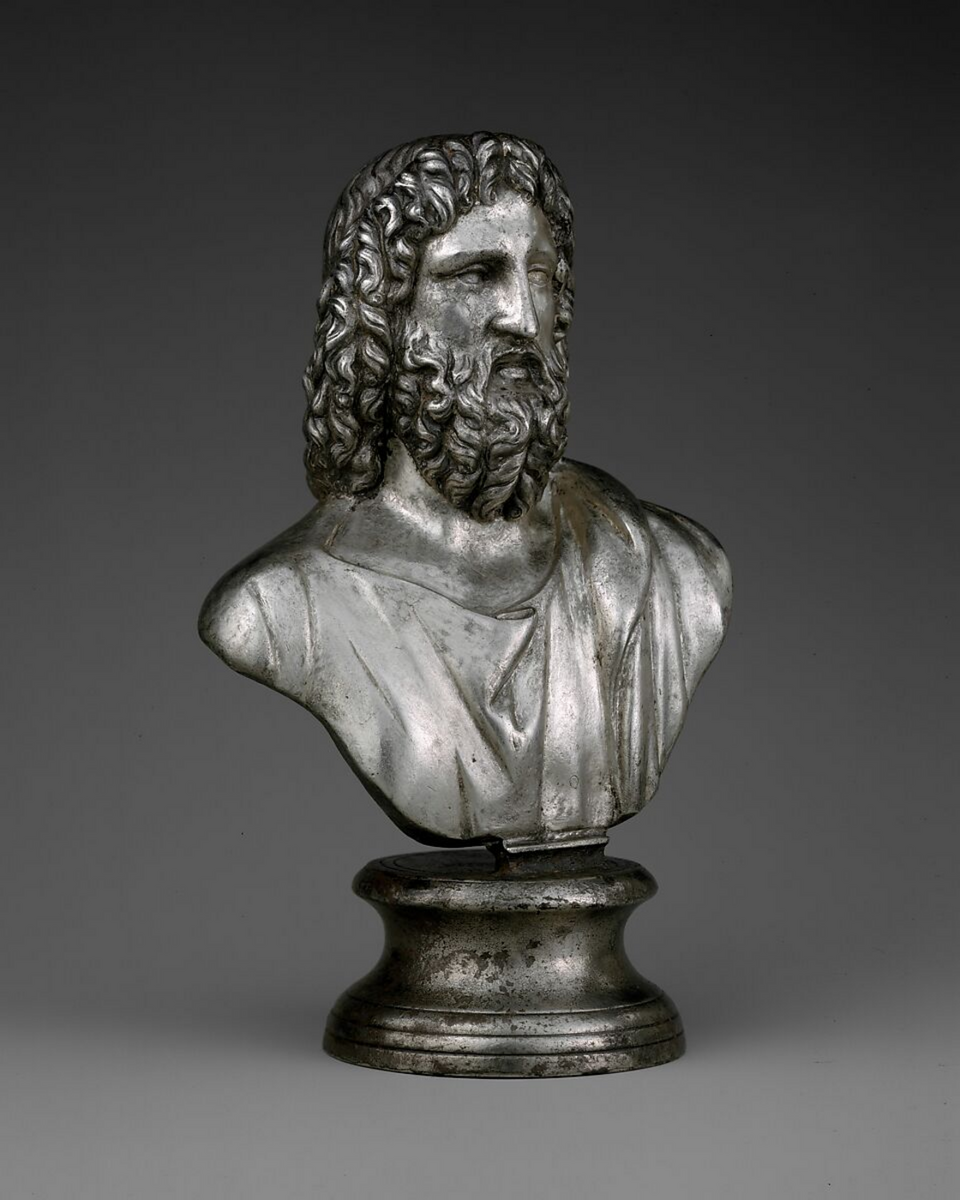
Museum staff note that many depictions of Serapis were precisely such portable busts, used for domestic worship. For pagans, this was a typical practice—using small busts in a household setting, since pagan forms of worship favored three-dimensional figures, as will be discussed further below.
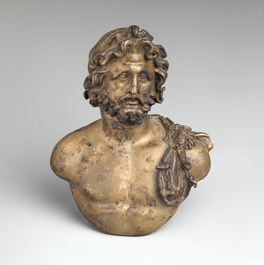
[1st century BC–1st century AD, bronze bust of Jupiter, Metropolitan Museum, USA] [large version] [source]
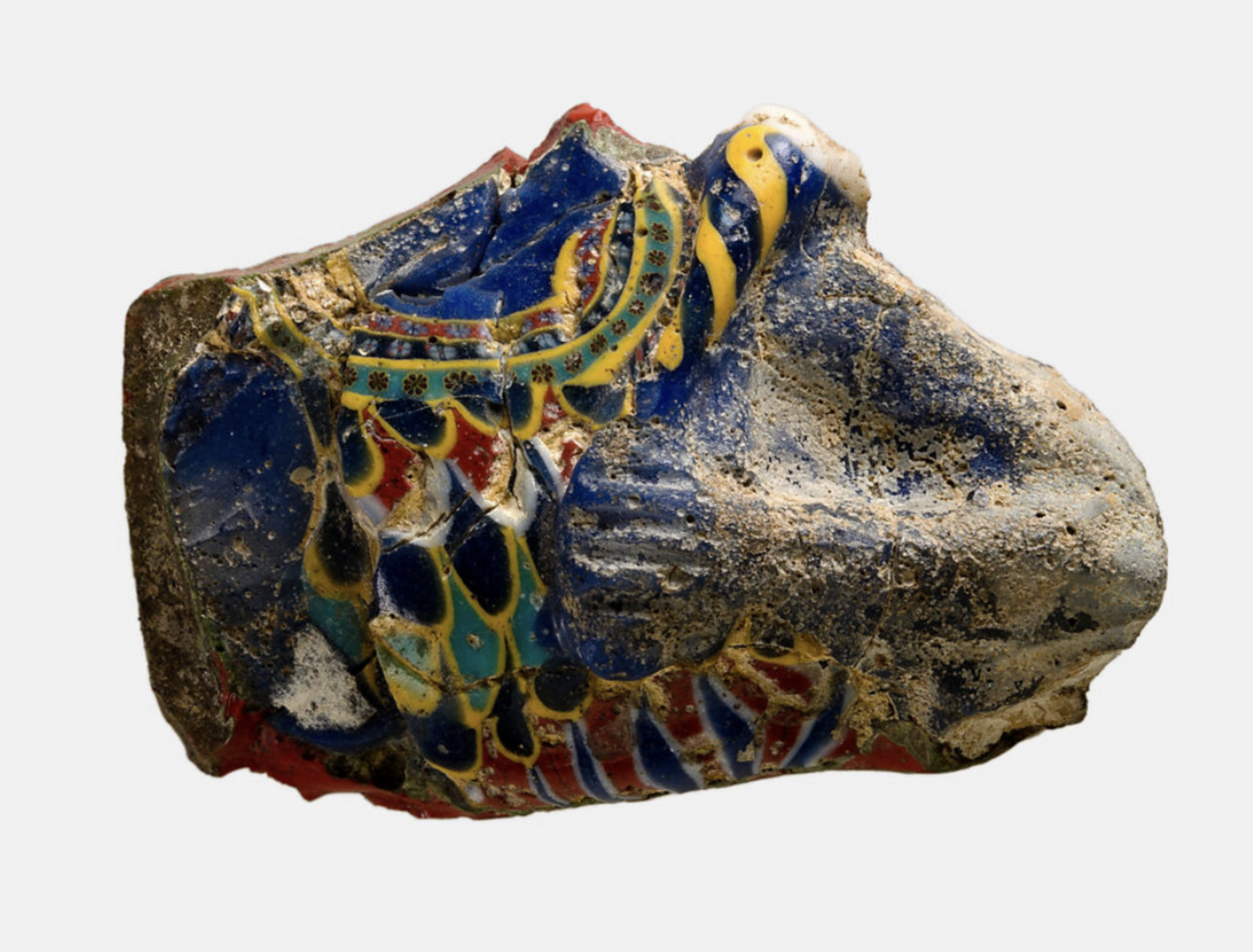
Most surviving examples are metal, as those made of more perishable materials have often decayed and survive only as fragments:
[2nd century BC–1st century AD, fragment of a painted bust of a deity] [large version] [source]
The text also contains the word "images" (εἰκόνας), but this term is too broad and denotes any kind of image created by any means. In the Bible, an "icon" (image) refers to the image of God (Col. 3:10), the image of Christ and the image of Adam (1 Cor. 15:49), Christ Himself (2 Cor. 4:4), humanity in general (Gen. 1:27), idols (Ezek. 7:20; Hos. 13:2), the image of the apocalyptic beast (Rev. 13:14), and other depictions, such as the image on a coin (Matt. 22:20; Mark 12:16). Irenaeus himself, in the same work, calls the 30-meter pagan statue made by Nebuchadnezzar an "image" (Book 5, 29).
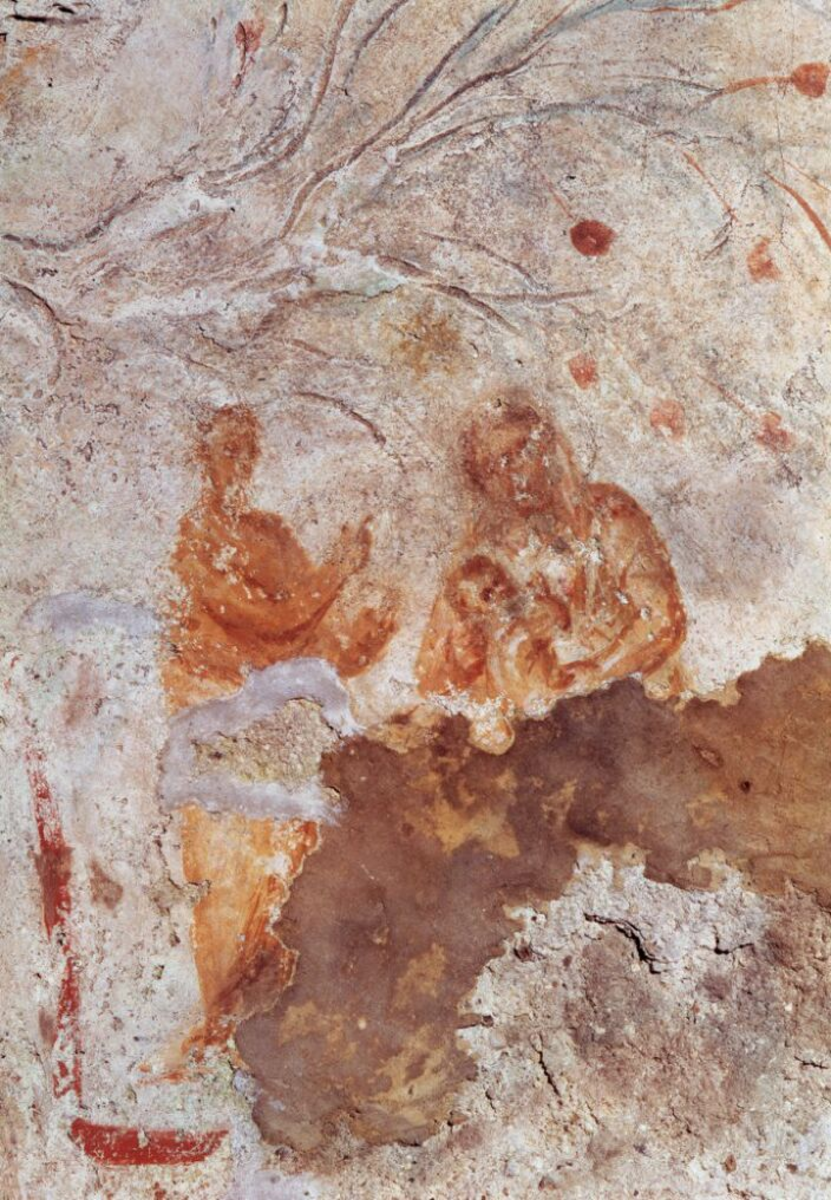
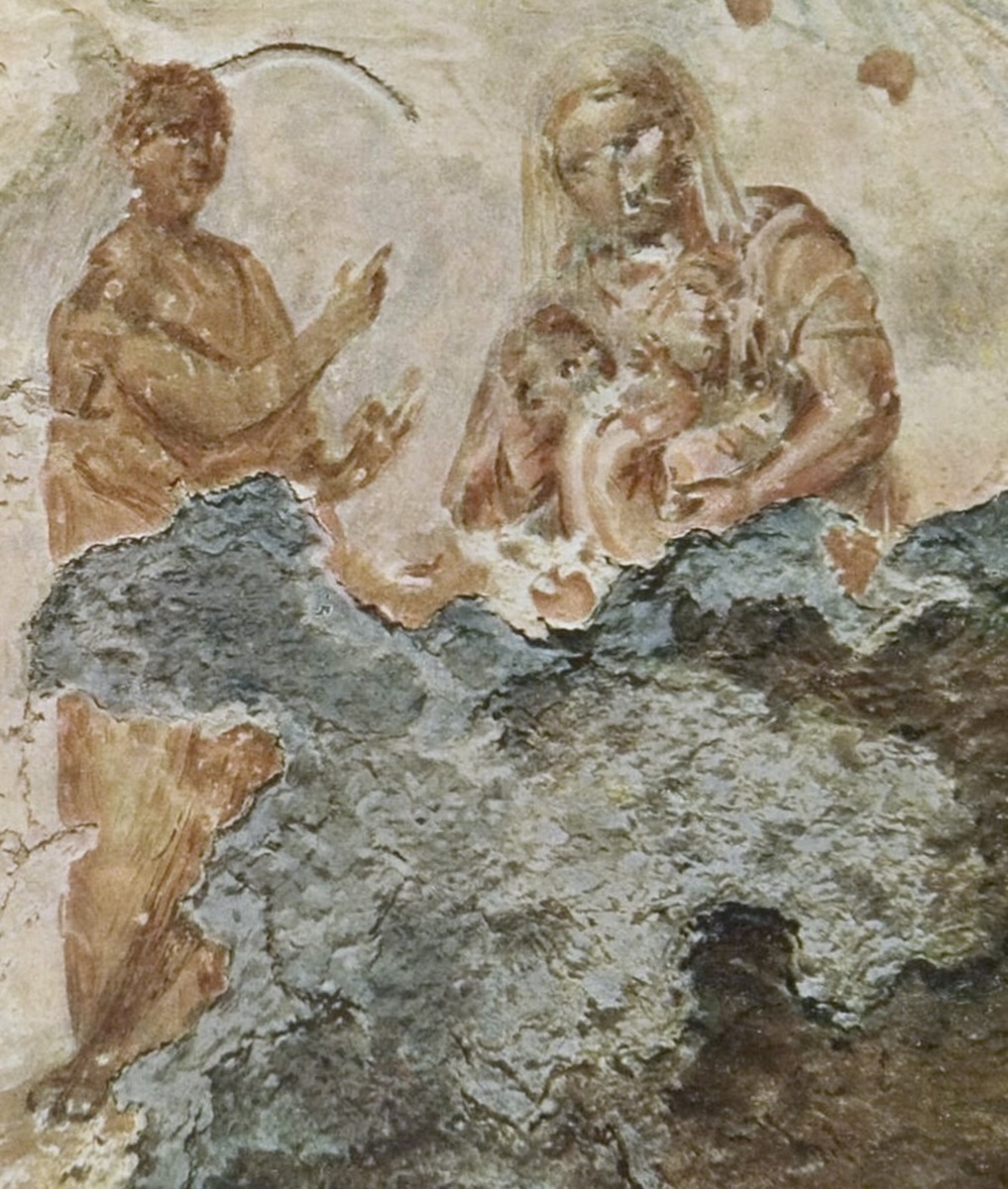
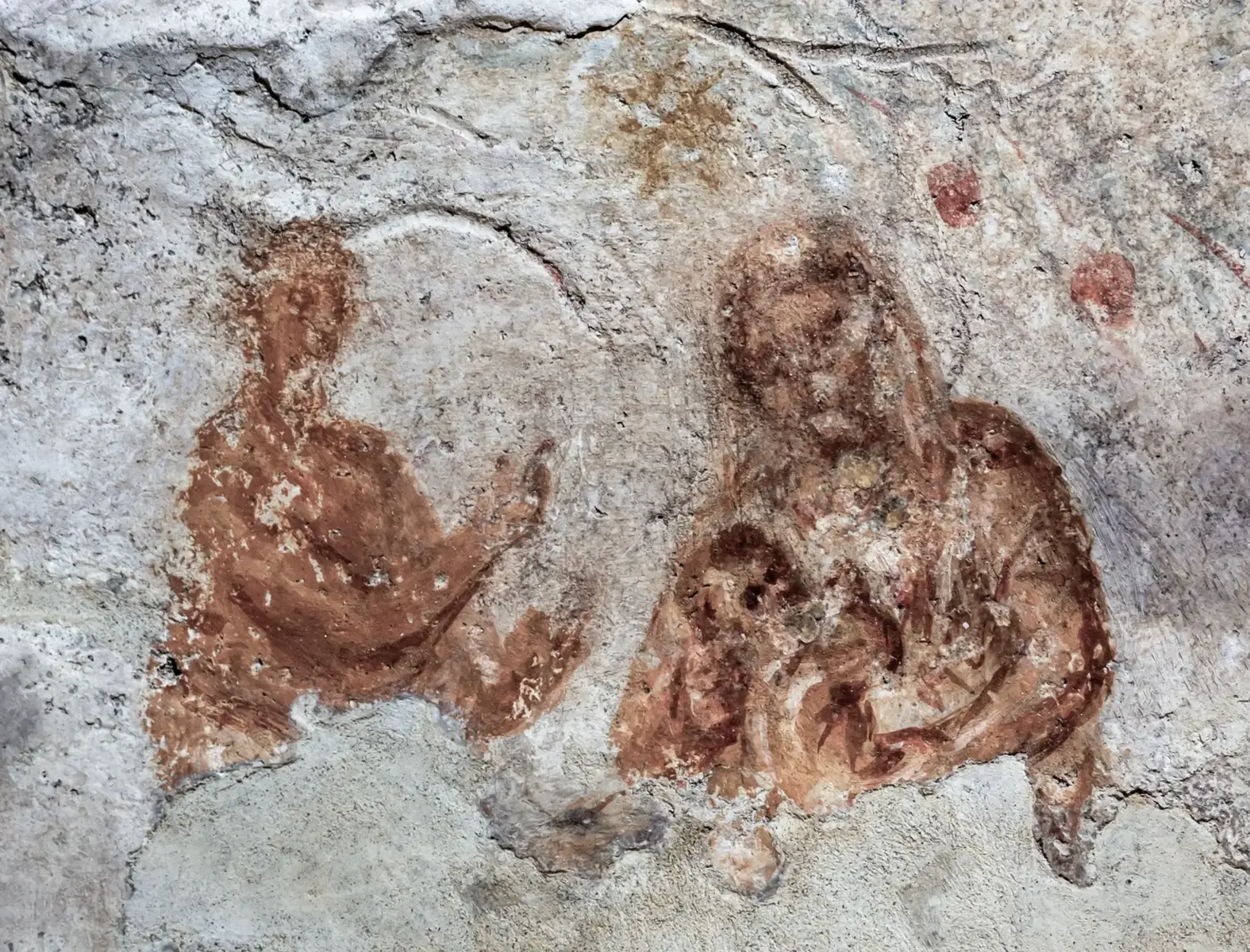
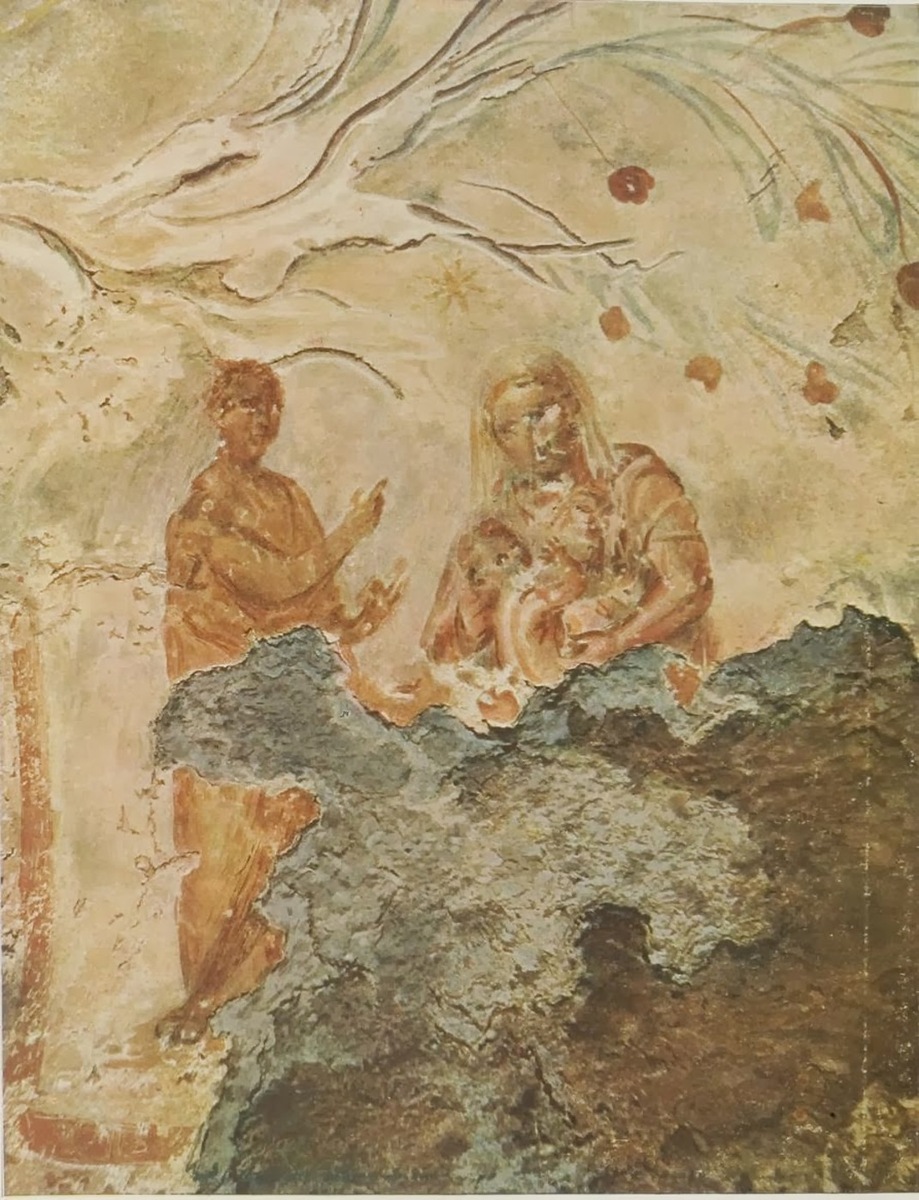
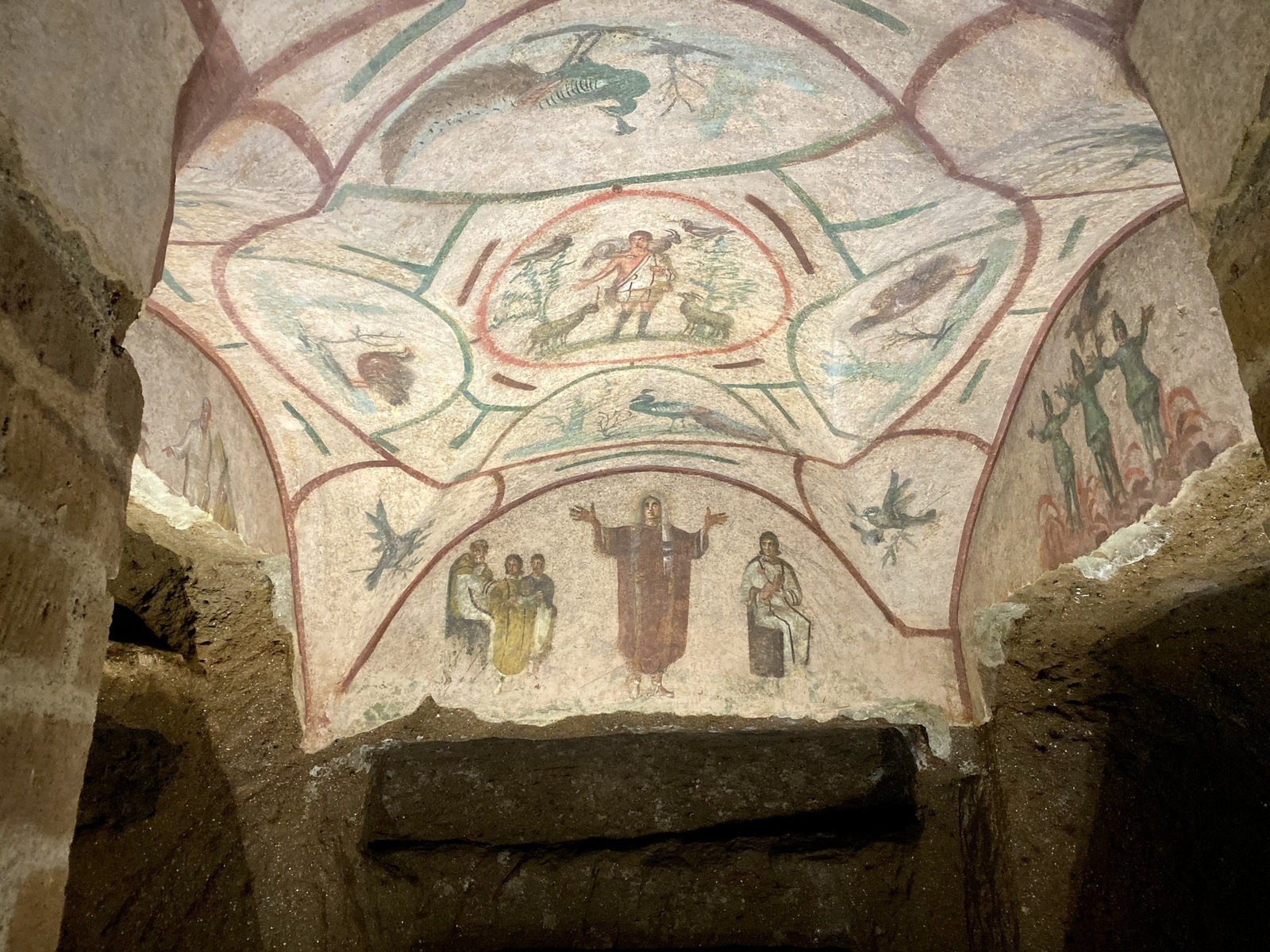
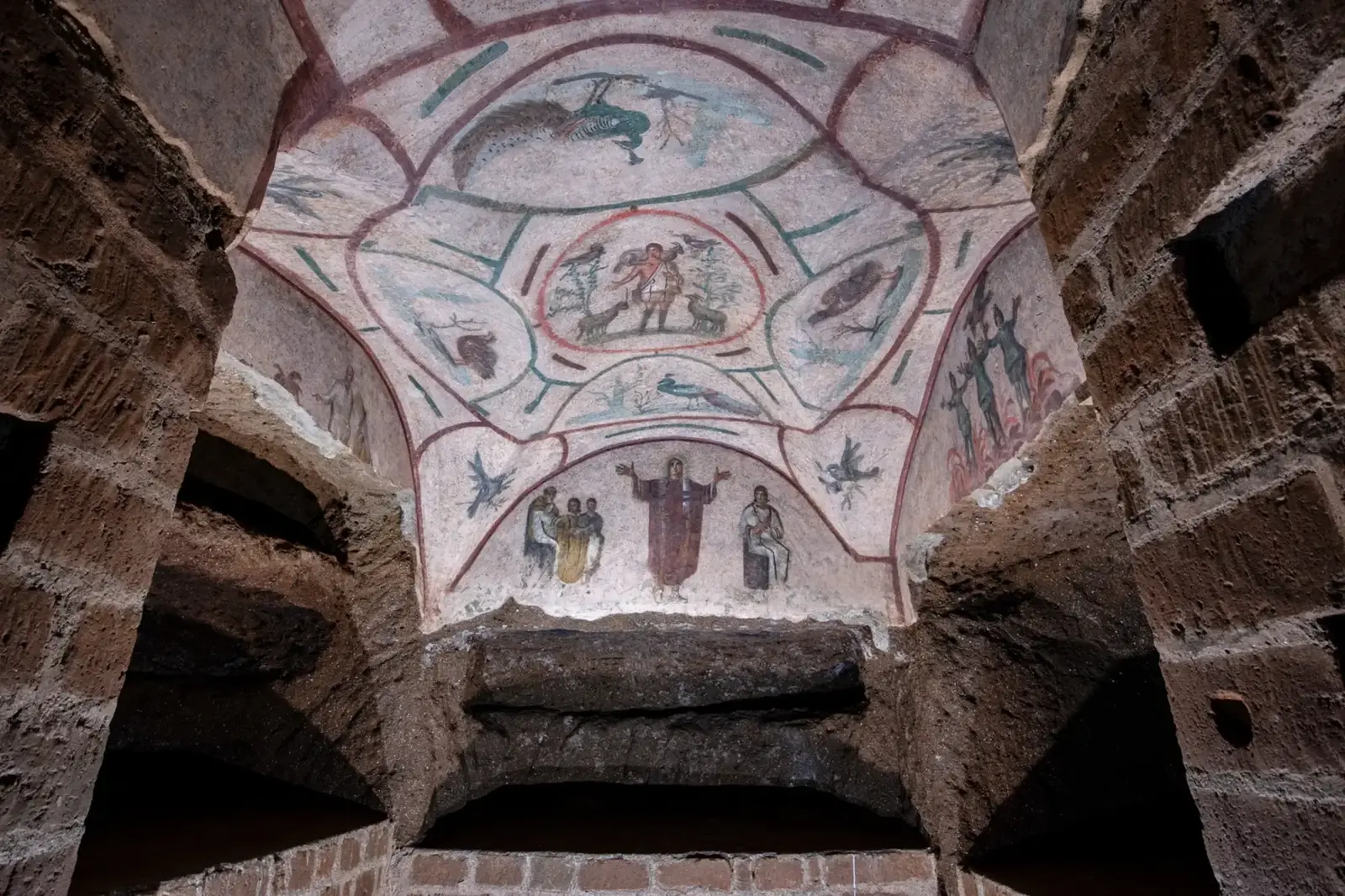
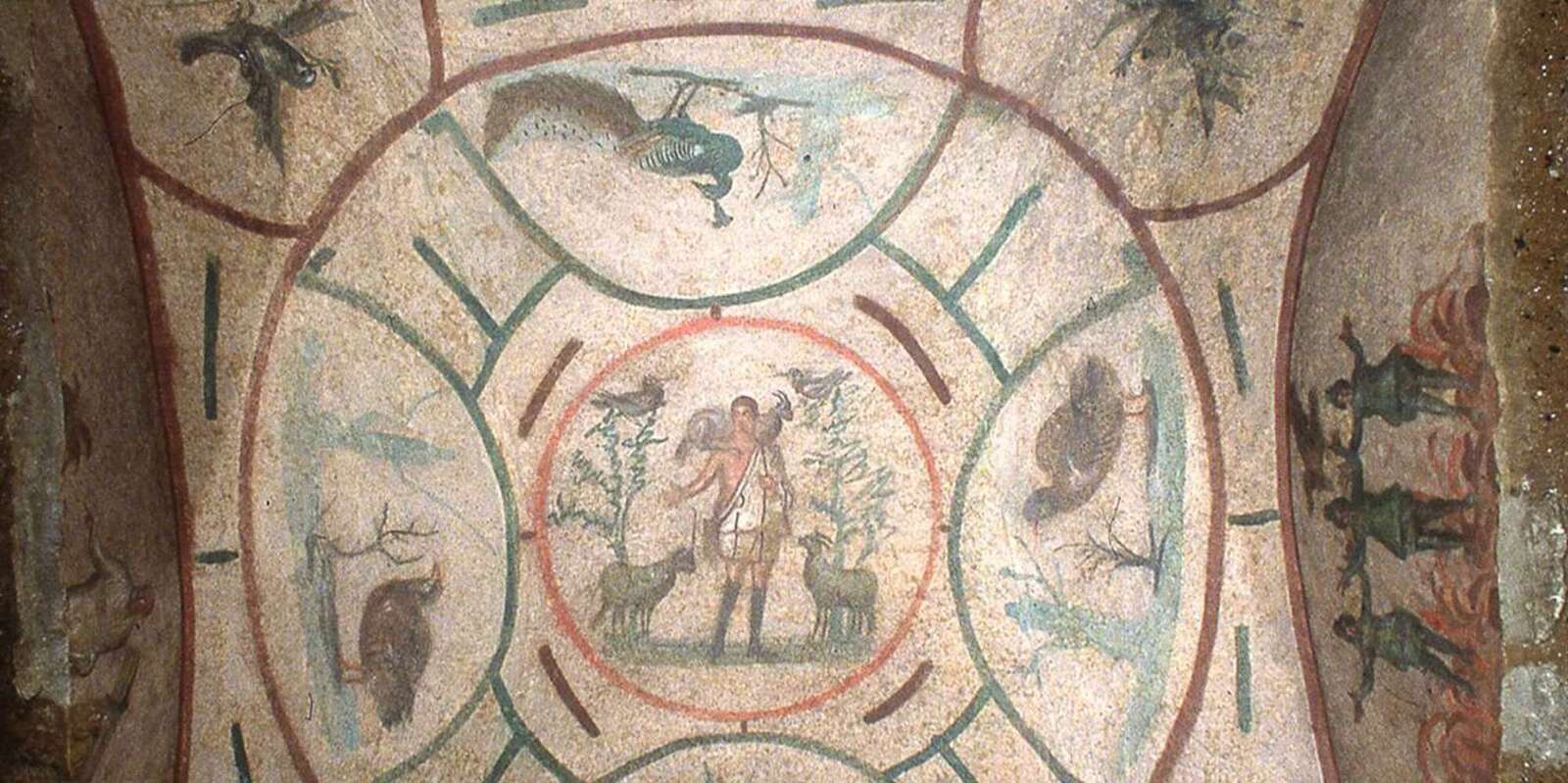
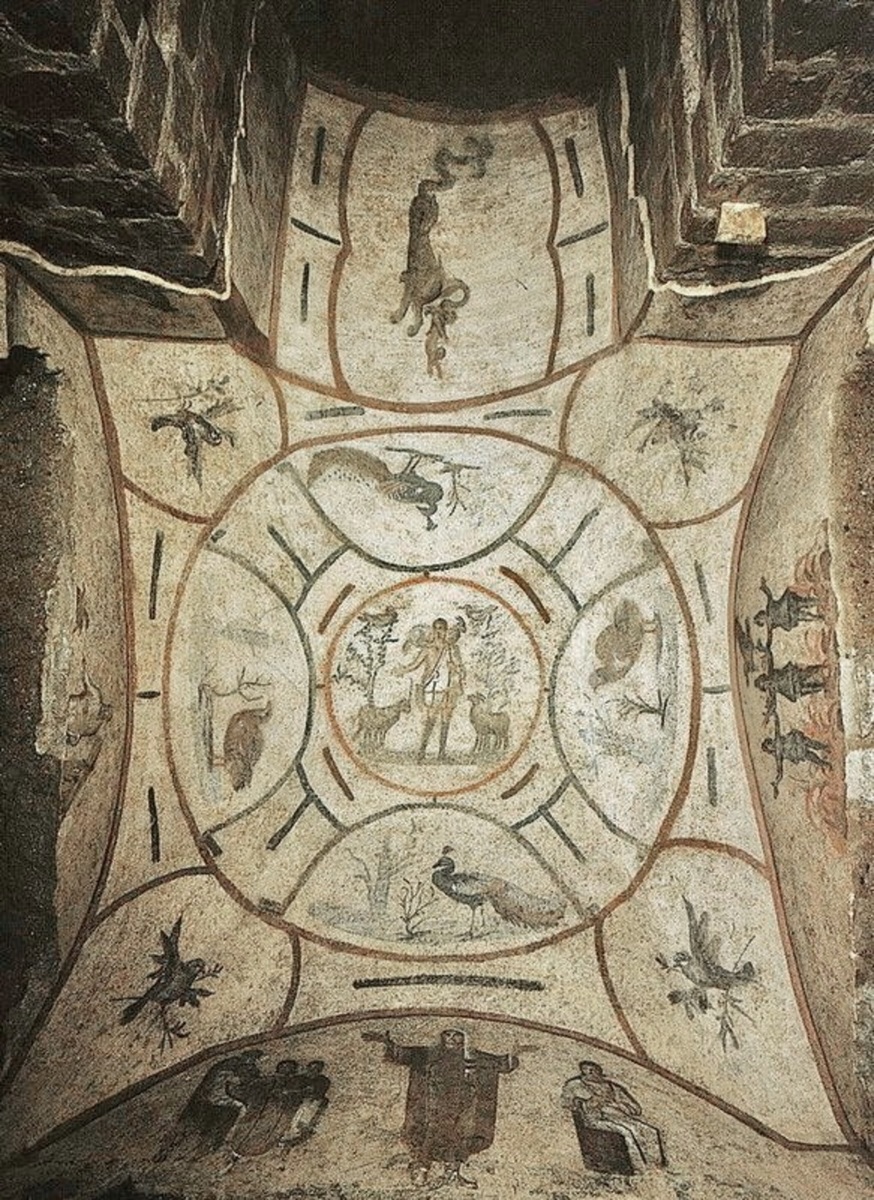
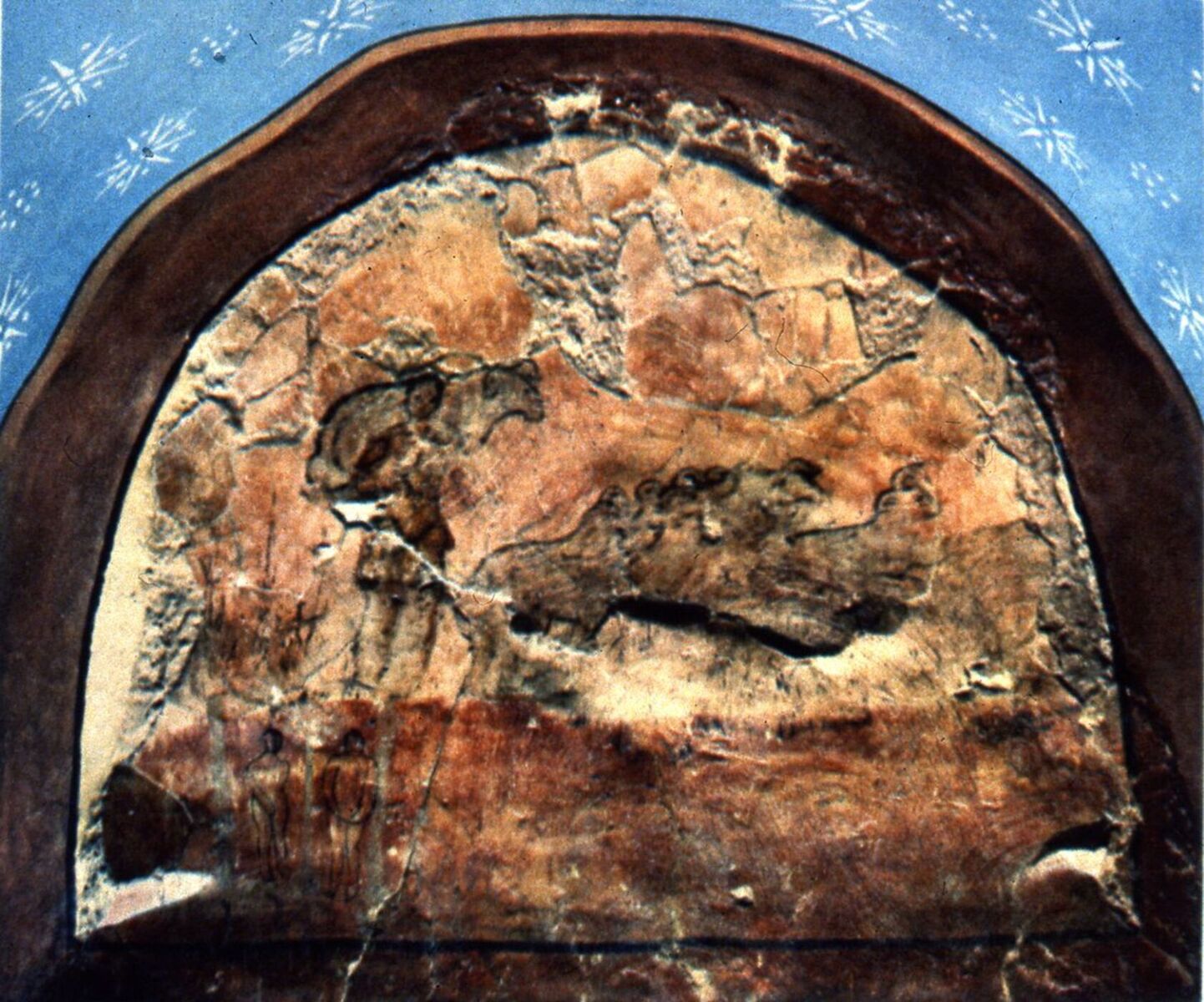
However, while pagans and Gnostics used statues and garlands for veneration, within the Church there were images of Christ and the apostles painted with colors on wooden panels, as testified by Eusebius of Caesarea within the Church itself (see Ecclesiastical History, Book 7, 18). Moreover, we can see surviving flat Christian images in the catacombs—ancient icons. Here are several examples from the Catacombs of Priscilla:
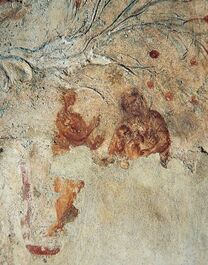
[2nd–3rd century, Theotokos and infant Christ] [large version] [ver 2] [ver 3] [ver 4] [ver 5]

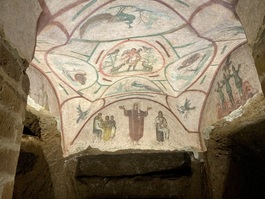
[3rd century, the Good Shepherd (Christ) and Old Testament scenes] [large version] [ver 2] [ver 3] [ver 4]
The Syrian Christian church at Dura-Europos (early 3rd century):
[Christ as the Good Shepherd (main view in the baptistery)] [large version]
"Made by Pilate"
The Gnostics claim that the image was made by Pilate during Christ's lifetime. Pilate was a pagan. Even if we were to believe the Gnostics, what kind of image would a high-ranking pagan have made?—most likely a three-dimensional one, since that was the common practice among pagans, suited to their rituals and more durable as an object, albeit more costly.
Coloring of Images
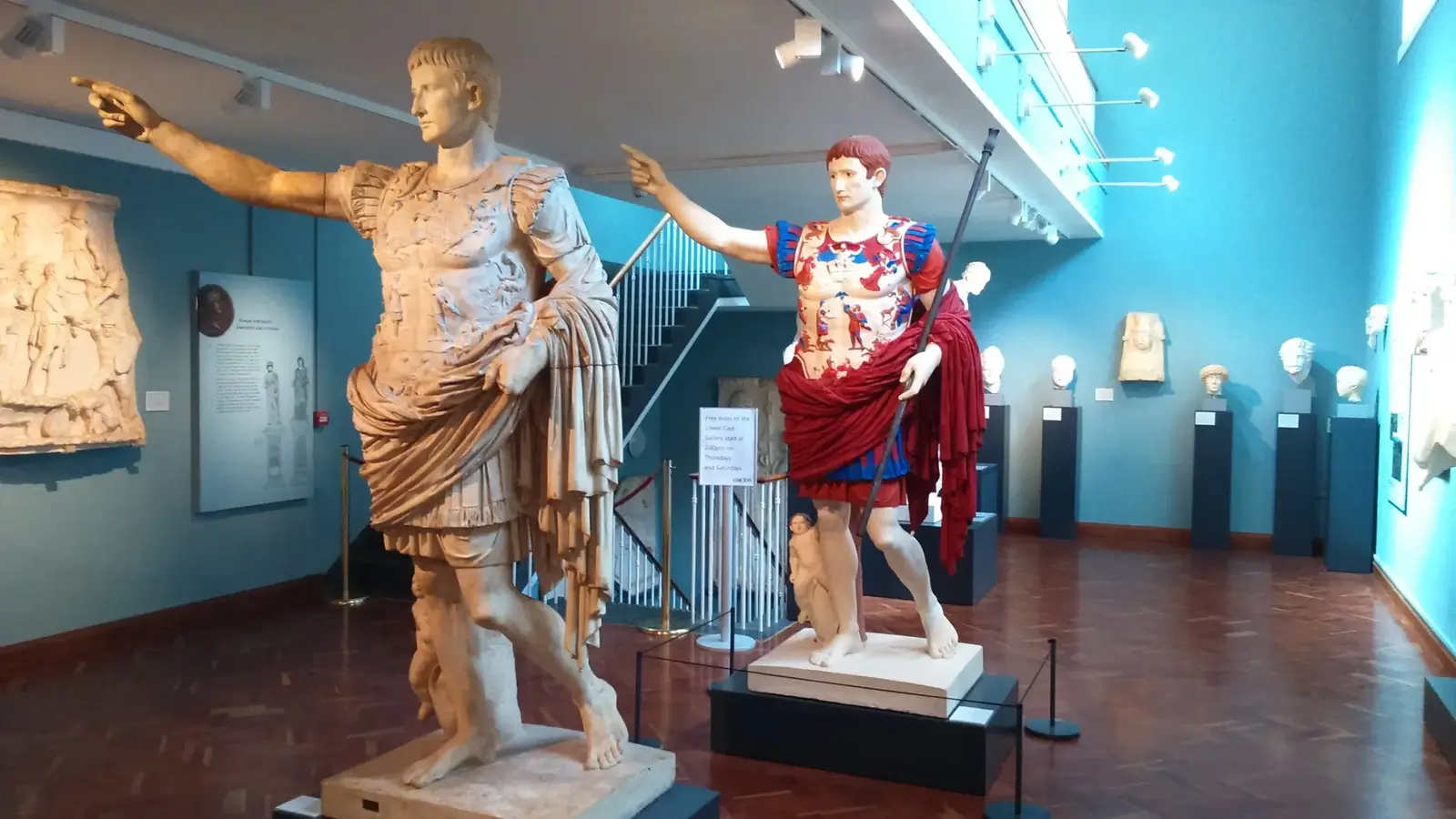
Contrary to later medieval Western assumptions, ancient peoples did not leave statues unpainted but colored them (so-called polychromy, example 1, 2). Therefore, the mention of paint in the text (Greek: ἐνζωγράφους διὰ χρωμάτων; Latin: depictas) may refer to the coloring of statues rather than to icon painting. In the same work, St. Irenaeus also writes that statues were covered with paint (Book 2, 19.8).
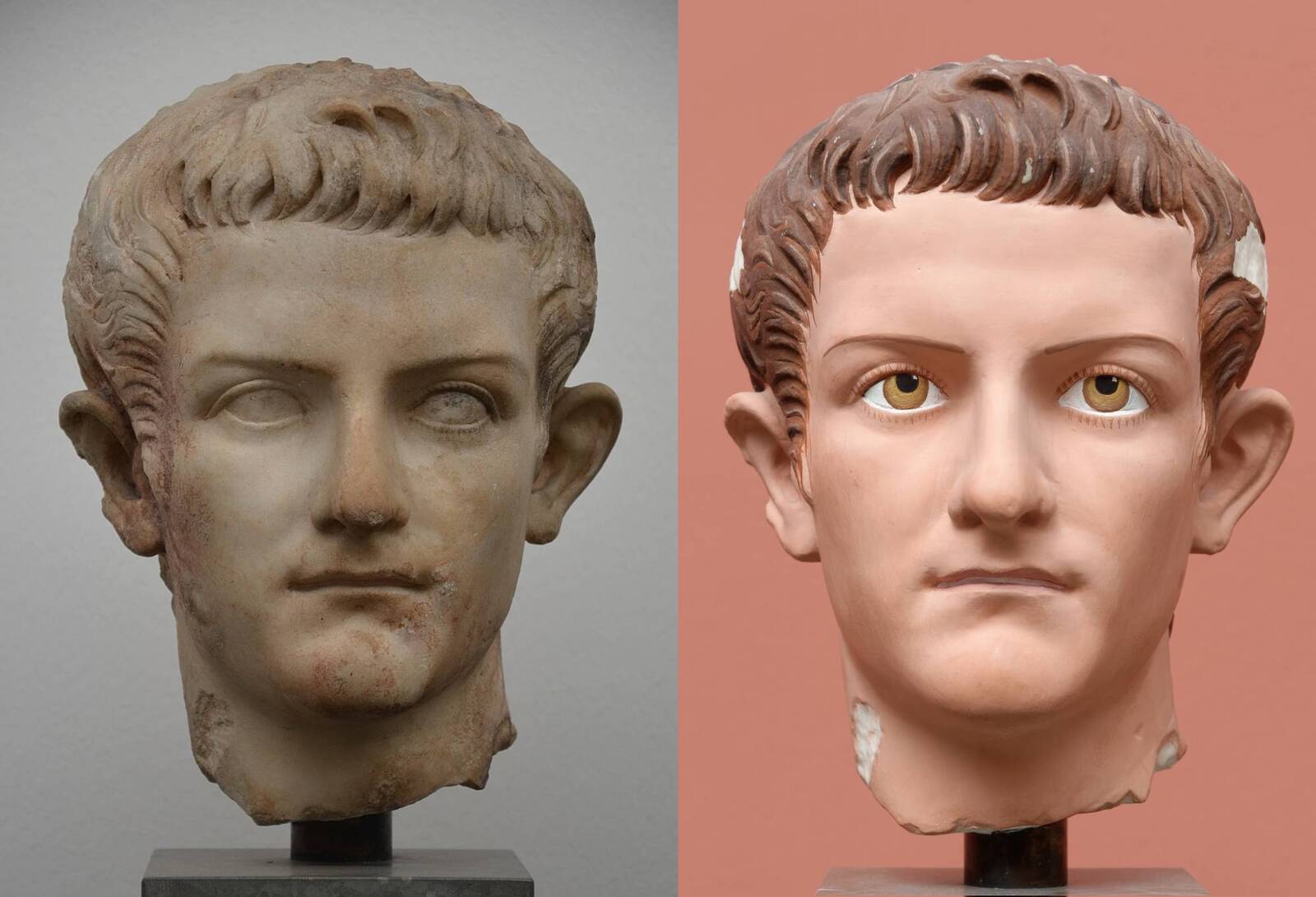
[1st century AD, Caligula; traces of painted eyelashes are faintly visible] [large version]
The Images Were "Constructed"
The Gnostics constructed the images as solid objects, as indirectly indicated by the verb κατασκευάζουσι (to construct/fabricate), which is often used in reference to massive objects: Noah's ark (1 Pet. 3:20), a house or the universe (Heb. 3:4), and molten or carved wooden idols (Epistle of Jeremiah 1:45–47).
The Images Were "Set Up"
After constructing them, the Gnostics set up the images, as indicated by the word ἱδρύσαντες (to erect, set up), used for the installation of large structures: temples, statues, altars, and columns (see Justin Martyr, First Apology 1.9.1). Church icons are generally small; the words "construct" and "set up" would be inappropriate for them.
Veneration of Statues Appears in the Very First Gnostic Sect
It is likely that later Gnostic sects inherited pagan forms of statue veneration from the founder of Gnosticism, Simon Magus, who sought to buy the gift of God from the apostles. Ultimately, as St. Irenaeus writes, he became the first sectarian (Book 1, 23.2), devising a method of creating Christian sects that became popular among his disciples and followers for the next five centuries. St. Irenaeus writes that already in the original Gnostic sect of Simon, there was an image of Simon (Book 1, 23.4), and that a statue was made in his honor. Justin Martyr also mentions a statue of Simon with the inscription "To Simon, the holy god," which stood on the Tiber River (First Apology 1, 26).
Thus, the Gnostics simply adopted what pagans were already producing and using—statues and busts. The Church, however, for various reasons, primarily used flat iconography painted on panels or walls.
2. Crowns
The Gnostics venerated the images in the most typical pagan manner—by placing сrowns on the heads of statues (an example even appears in the Old Testament: Epistle of Jeremiah 1:8). Such honor was given not only to statues but also to great men, emperors, and soldiers; and in mockery, Christ was treated similarly when a crown of thorns was placed on His head (Mk. 15:17). The Church does not use this form of veneration; therefore, flat images suffice, and three-dimensionality is unnecessary. Moreover, such a manner of veneration was entirely unacceptable to Christians, as reflected in Tertullian's work On the Soldier’s Crown, and also in St. Justin’s Apology: «And neither do we honour with many sacrifices and garlands of flowers such deities as men have formed and set in shrines and called gods; since we see that these are soulless and dead <…> And this is the sole accusation you bring against us, that we do not reverence the same gods as you do, nor offer to the dead libations and the savour of fat, and crowns for their statues, and sacrifices» (Apology 1, 9 and 24). The Gnostics, however, had this need because, having adopted pagan practice, they also venerated images in a pagan way: "They crown these images."
3. Sacrifices Made Around the Images
Pagan mysteries were performed around the images, and sacrifices were offered: "they perform other rites around them (circa eas) in the same manner as the Gentiles do (similiter ut gentes faciunt)." St. Epiphanius of Cyprus, quoting Irenaeus, adds: "Having set up these images, they then perform the customs of the pagans. And what are the customs of the pagans, if not sacrifices and the like?"
Thus, while the Gnostics imitated the pagans in their rituals around images and offered sacrifices to them, the Church neither then nor now offers sacrifices to images. Rather, she has one single offering of sacrifice, established by Christ Himself—bread and wine in the Eucharist—and this sacrifice is in no way connected to icons.
Doctrinal Differences
Christ
The aforementioned group of Gnostics considered Christ to be an ordinary man, the son of Joseph and Mary, who in their understanding was in no way different from Pythagoras, Plato, Aristotle, and the other philosophers. In their view, these men possessed special knowledge and power, by which they could command angels (that is, the creators of the world, according to their teaching), and after death their souls were able to overcome the barrier of the angels and reach the Father. They placed not only the apostles on a level no lower than Christ, but even themselves, and some considered themselves superior to Christ. The Church, by contrast, believes in Christ as God, and venerates the saints as friends of Christ, who abide with Christ.
This is a fundamental difference, because a false teaching about Jesus leads to the veneration of "another Jesus" (a fabricated idol), as the Apostle writes (2 Cor. 11:4). According to the Apostle's word, one can preach another Jesus whom the apostles did not preach—which in this case is precisely what happened among the Gnostics, since they invested the image of Jesus with a different conception and teaching, venerating a fabricated idol of their own invention while calling it Jesus. This case parallels the Old Testament veneration of the bronze serpent (a type of Christ's sufferings), which certain enterprising people later filled with false content: the image was correct, but the teaching within was about Nehushtan (2 Kings 18:4). In any case, there is no evidence that even the external image used by the Gnostics was correct. Their teaching, as shown, is entirely false.
Summoning Spirits and Sorcery
The Gnostics indeed summoned spirits and demons, practiced sorcery, used incantations, and prepared magical love potions (Against Heresies, 1.25.3). That is, the presence of a visible image, as typically occurred in pagan cults, was used for summoning a spirit that was expected to appear for interrogation. The Orthodox Church does not summon spirits and does not link the efficacy of prayer to the mechanical presence of an image, unlike magical rituals. However, the Orthodox faith is such that when beholding images of God and His friends, the believer is disposed to render them honor, referring that honor to the prototype—to God Himself and His friends. The Church does not summon spirits for interrogation, as do priest-mediums or modern psychics. Christian prayer consists of one-sided petitions, words of gratitude, and doxology addressed to God and His friends. Christians do not expect any spirit to appear for interrogation. Nor does the Church use incantations—that is, sounds that by themselves are believed to produce magical effects.
The Gnostics Imitated the Church, Not Vice Versa
Irenaeus himself indicates that the Gnostics were engaged in mimicry: they copied the Church's sacraments (using cups of wine, dipping people in water) and methods of preaching. A key characteristic of the Gnostics—as of all sectarians in general—was mimicry; they needed and profited from appearing outwardly similar to the Church in order to steal believers from her by means of external resemblance. The Church, on the other hand, has no need whatsoever to resemble the Gnostics, against whom she fought. While borrowing external features of the Church, the Gnostics filled everything with pagan and occult content: they practiced divination, summoned spirits, prepared magical potions, and engaged in debauchery. The heretic Marcus even attempted to mimic the Christian gift of speaking in tongues, but substituted the content: he taught his adepts simply to open their mouths, move their tongues, and utter frantic sounds and mutterings, persuading people that this was the gracious gift (Against Heresies, 1.13.3).
This is what could be said briefly. The following section provides important details regarding the issues and the ancient texts referenced in this work.
Introduction to the Issues
This is where we should have begun, but it was decided to start directly with the substance of the matter so as not to weary the reader with a lengthy preface.
So, all those who establish their own churches after Christ has already done so must first and foremost prove that what Christ gathered has fallen and apostatized from Him. Therefore, one enterprising person after another has found it necessary to gather his own new church, to which he now invites everyone, dividing believers and, in order to justify his actions, constantly seeking ways to slander what was originally gathered by Christ.
One of the most popular ways to slander the Church gathered by Christ is to attach to it any derogatory label one can manage. The most frequent of these is the label of paganism, and the most primitive way to attach it is to claim that the veneration of icons was borrowed from pagans.
This method of accusation is classic and most widespread among Protestant preachers. The reason is simple: the ancient Christians have many such statements against pagan statues and practices, since paganism was one of the first and foremost challenges facing Christ's Church, and one of the most distinctive features of paganism was the veneration of false gods, their statues, and temples. Therefore, with "proper" cutting of texts, interpretation, and ignoring inconvenient words, one can repeatedly turn the Christians' statements about pagans against the Church, achieving the goal of attaching the desired label.
However, this article concerns only one author (St. Irenaeus of Lyons, 2nd century), because his statement stands out from the rest. The veneration of images is mentioned in connection with a pseudo-Christian Gnostic sect, not pagans, and moreover, it concerns an image of Christ (at least, according to the Gnostics' own claim). It is noteworthy, however, that St. Irenaeus says nothing against icons or their veneration; speaking of the Gnostics, he merely points out how they use a relief image of Christ: they place it alongside images of well-known philosophers, put garlands on them, and perform around them the same rituals that pagans perform.
Fragment of the Ancient Greek Text (3rd Century)
Irenaeus of Lyons wrote in Greek, but the Greek text of this passage survives only partially in the works of other authors. For example, there is a quotation in the work of a 3rd-century author (Hippolytus or Origen):
"Some of them even brand their own disciples on the back part of the lobe of the right ear... and they also make images of Christ, saying that they were made at that time by Pilate..."
«4. Τούτων τινὲς καὶ καυτηριάζουσι τοὺς ἰδίους μαθητὰς ἐν τοῖς ὀπίσω μέρεσι τοῦ λοβοῦ τοῦ δεξιοῦ ὠτός .... καὶ εἰκόνας δὲ .... κατασκευάζουσι* τοῦ Χριστοῦ, λέγοντες ὑπὸ Πιλάτου τῷ καιρῷ ἐκείνῳ γενέσθαι ...»
κατασκευάζουσι — to prepare, build, construct, manufacture, produce, arrange, organize. The verb κατασκευάζω is more often used to denote the process of erecting, constructing, or manufacturing an object from material (wood, stone, metal)—that is, creating a three-dimensional or composite object. It implies the work of a craftsman-builder or sculptor who "erects" or "assembles" an image.
In the Bible and the Church Fathers, this word is used either of God's creation of something (man, light, the paths of man), or of the building of cities or massive structures such as buildings, three-dimensional idols, or garlands for idols.
Latin Translation (Early 5th Century)
An early Latin translation of Irenaeus's work also exists. Here is the passage of interest in translation from the Latin, which we provide below:
"Others, however, brand their own disciples, cauterizing them on the back part of the protruding part of the right ear. 3. Hence also Marcellina, who came to Rome under Anicetus and adhered to this teaching, led many astray. They call themselves Gnostics, and they have certain images—some painted, others fashioned from other materials—claiming that the form of Christ was made by Pilate at the time when Jesus was among men. And they crown these images with garlands, and set them up alongside the images of the world's philosophers—namely, with the image of Pythagoras, Plato, Aristotle, and the rest; and they perform other rites around them (circa eas) in the same manner as the Gentiles do around their images."
4. Alii vero ex ipsis signant, cauteriantes suos discipulos in posterioribus partibus exstantiæ dextræ auris. 3 Unde et Marcellina, quæ Romam sub Aniceto venit, cum esset hujus doctrinæ, multos dexterminavit. Gnosticos se autem vocant: etiam imagines, quasdam quidem depictas, quasdam autem et de reliqua materia fabricatas habent, dicentes formam Christi factam a Pilato, illo in tempore quo fuit Jesus cum hominibus. Et has coronant, et proponunt eas cum imaginibus mundi philosophorum, videlicet cum imagine Pythagoræ, et Platonis, et Aristotelis, et reliquorum; et reliquam observationem circa eas similiter ut gentes faciunt.
coronant — they crown (place crowns upon), wreathe with garlands. This expression indicates the three-dimensionality of the image, upon which a wreath can be placed—something most commonly done by pagans in venerating idols and heroes.
Partial Preservation of the Text — Not All That Deserves Attention
Both texts (Greek and Latin) clearly have problems with textual preservation. For just in the previous paragraph (4), St. Irenaeus was speaking of how the Carpocratians descended into madness, doing godless and impious things, but in paragraph 5, the author directly seems to contradict himself, saying that if the Carpocratians do something impious, he would not believe it (this paragraph is present in Theodoret but absent in Hippolytus):
«Καὶ εἰ μὲν πράσσεται παρ’ αὐτοῖς τὰ ἄθεα, καὶ ἔκθεσμα, καὶ ἀπειρημένα, ἐγὼ οὐκ ἂν πιστεύσαιμι»
«Et si quidem fiant hæc apud eos, quæ sunt irreligiosa, et injusta, et vetita, ego nequaquam credam»
Let us simply note this circumstance for now. We will return to it immediately in the next section.
Ancient Greek Text of Epiphanius of Cyprus (4th Century)
This is the only complete Greek text of this passage, and it comes from an author who spoke Greek (like Irenaeus), read Irenaeus's work in Greek, and wrote in Greek himself.
Today we cannot read the ancient text directly, but Epiphanius of Cyprus could read it in the 4th century. Epiphanius, whether literally or in paraphrase (that is, preserving the meaning), quotes this same chapter of Irenaeus of Lyons concerning the Carpocratians in his work Panarion. Here is how the passage that created a contradiction in other textual variants reads in the Panarion:
"Such are their writings that a reasonable reader marvels, is amazed, and does not believe that these things could be done by living human beings—not only like us in the city, but even with wild beasts, and even like wild beasts and cattle, daring to act as is fitting for dogs and swine."
This is quite another matter. Such a text harmoniously fits into the overall narrative and has no contradictions with the preceding paragraphs, nor with the general meaning of the treatise, in which heretics are not excused but condemned. Therefore, it is worthwhile to read this passage from the Panarion regarding the mention of images among the Gnostics:
6. <…> They have images painted with colors, as well as [images] of gold, silver, and other materials, which they say are three-dimensional impressions (ἐκτυπώματα) of Jesus, and that they were made under Pontius Pilate—that is, three-dimensional impressions of Jesus himself when He dwelt among the human race. Such images they keep in secret; and they also have [images] of certain philosophers: Pythagoras, Plato, Aristotle, and others. Along with these philosophers, they place other impressions of Jesus, and having set them up, they worship and perform pagan mysteries. For having set up these images, they then perform the customs of the pagans. And what are the customs of the pagans, if not sacrifices and the like? But salvation, they say, is only of the soul, and not of the bodies.
6. <…> ἔχουσι δὲ εἰκόνας ἐνζωγράφους διὰ χρωμάτων, ἀλλὰ καὶ οἱ μὲν ἐκ χρυσοῦ καὶ ἀργύρου καὶ λοιπῆς ὕλης, 1.311 ἅτινα ἐκτυπώματά φασιν εἶναι τοῦ Ἰησοῦ καὶ ταῦτα ὑπὸ Ποντίου Πιλάτου γεγενῆσθαι, τουτέστιν τὰ ἐκτυπώματα τοῦ αὐτοῦ Ἰησοῦ ὅτε ἐνεδήμει τῷ τῶν ἀνθρώπων γένει. κρύβδην δὲ τὰς τοιαύτας ἔχουσιν, ἀλλὰ καὶ φιλοσόφων τινῶν, Πυθαγόρου καὶ Πλάτωνος καὶ Ἀριστοτέλους καὶ λοιπῶν, μεθ' ὧν φιλοσόφων καὶ ἕτερα ἐκτυπώματα τοῦ Ἰησοῦ τιθέασιν, ἱδρύσαντές τε προσκυνοῦσι καὶ τὰ τῶν ἐθνῶν ἐπιτελοῦσι μυστήρια. στήσαντες γὰρ ταύτας τὰς εἰκόνας τὰ τῶν ἐθνῶν ἔθη λοιπὸν ποιοῦσι.
τίνα δέ ἐστιν τὰ ἐθνῶν ἔθη ἀλλ' ἢ θυσίαι καὶ τὰ ἄλλα; ψυχῆς δὲ εἶναι μόνης σωτηρίαν φασὶ καὶ οὐχὶ σωμάτων.
(Panarion, Against the Carpocratians, 6)
«ἐκ-τύπωμα» — a raised image, a relief impression (Plato: ἐκτυπωμάτων πρόσωπα — sculptural images of faces).
«ἐκτυπώματα» (ektypōmata) — a noun derived from the verb ἐκτυπόω (to beat out, stamp, press out, mold, or make in relief). It means a relief, impression, bas-relief, or even a statue. Unlike a flat drawing (γραφική), ektypoma implies volume, convexity, or a form produced by casting or embossing.
«ἐκ χρυσοῦ καὶ ἀργύρου καὶ λοιπῆς ὕλης» — "Of gold, silver, and other material." Gold and silver in antiquity were rarely used for painting in the modern sense (oil/tempera on metal was rare for cult statues of that period). Most often, precious metals were used for embossed reliefs or cast statuettes.
«ἱδρύσαντές» — "having set up." This word (ἵδρυσις — to erect, set up) in a religious context refers to statues, altars, temples, and columns. It carries a connotation of massiveness and is more applicable to statues that were erected, rather than hung or leaned (which would be the case for flat wooden icons). It is precisely to the erection of pagan statues that this word is applied by Justin Martyr in the same period (2nd century):
And neither do we honour with many sacrifices and garlands of flowers such deities as men have formed and set (ἱδρύσαντες — set up) in shrines and called gods
Combining the data from Hippolytus (κατασκευάζουσι — they construct/fabricate) and Epiphanius (ἐκτυπώματα + ἱδρύσαντές), we get the following picture:
The Gnostic Carpocratians manufactured three-dimensional images (busts, statuettes, or reliefs) from metal (gold, silver) or possibly wood/stone ("other material"). Then, they made them pictorial (ἐνζωγράφους), coloring these three-dimensional figures with paints (διὰ χρωμάτων).
Modern people are accustomed to seeing ancient statues in the form of bare stone without colors, but in fact ancient statues and reliefs were painted. The stone simply survived while the paint did not—though there are specimens on which small traces of paint remain:
[1st century AD, Caligula; traces of painted eyelashes are faintly visible] [large version]
Attention should also be paid to the garlands placed on the images. First, this is the most classic way of honoring gods and heroes in paganism. It is for this very reason that Roman soldiers placed a garland on Christ—not of noble laurel, but of thorns—not to honor, but to mock (John 19:2-3). Second, it is not really possible to hang a garland on an icon, unlike a statue.
Conclusion
Analysis of the ancient texts shows that Gnostic groups inherited the veneration of statues from the founder of Gnosticism—Simon Magus. The forms of images used by the Gnostics were three-dimensional, so that pagan methods of image veneration could be applied to them: placing garlands, erecting monuments in the middle of a room as in a sanctuary, for the purpose of performing pagan mysteries, sorcery, and debauchery around them.
The Church had no need for three-dimensional images, since she did not employ pagan practices, but venerated images in the same way as the prophet David and Joshua did in the Old Testament (in venerating the image, they venerated the prototype).