
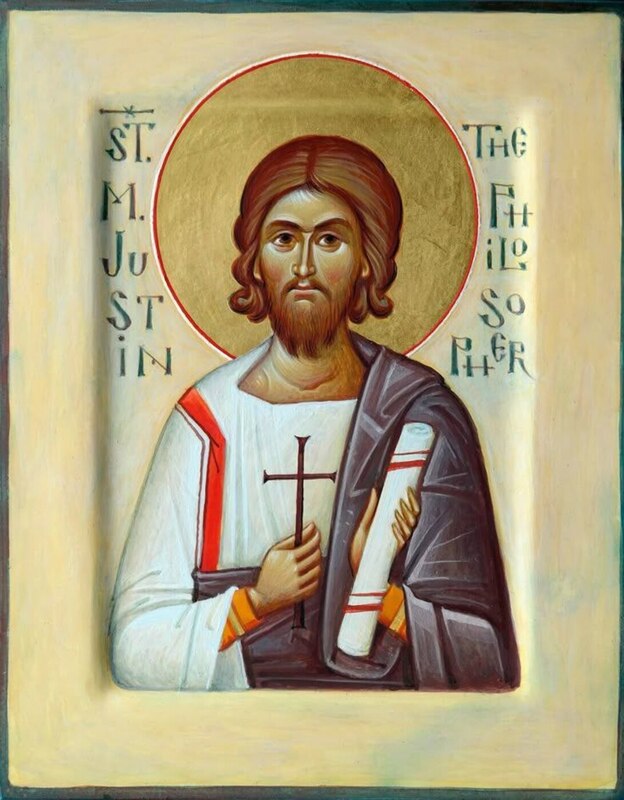
The section with the works of the martyr Justin in Greek: go. You can also switch to other languages at the top, above the list of works.
Biography
Commemoration day: June 1 (14)
He was born in Shechem, the ancient city of Samaria. Justin’s parents, who were Greeks, were pagans. From childhood the saint was distinguished by a deep mind, a love of learning and a burning desire to know the Truth. He studied thoroughly the various schools of Greek philosophy — the Stoics, the Peripatetics, the Pythagoreans and the Platonists — and became convinced that none of these pagan doctrines opens the way to the knowledge of the true God.
Once, as he was walking in a solitary place outside the city and pondering where to seek the path to the knowledge of the Truth, he met an old man who, in a long conversation, unfolded to Justin the essence of the Christian doctrine and advised him to seek the answer to all the questions of life in the books of Holy Scripture.
In his thirtieth year Justin received holy Baptism (between 133 and 137). From that time he devoted his gifts and his extensive philosophical learning to preaching the Gospel among the pagans. He began to travel through the Roman Empire, sowing everywhere the seeds of the saving faith. Justin opened a school in which he taught Christian philosophy. He consistently defended the truth and the saving power of the Christian doctrine, convincingly refuting both pagan speculations (as, for example, in his dispute with the Cynic philosopher Crescens) and the heretical distortions of Christianity (in particular, he spoke out against the teaching of the Gnostic Marcion).
About the year 155, when the emperor Antoninus Pius (138-161) began a persecution against the Christians, Saint Justin personally presented an “Apology” to him in defence of the Christians Ptolemy and Lucius, who had been unjustly condemned to death, the name of the third has not come down to us. In the “Apology” he proved the falsity of the accusations brought against the Christians “on behalf of the unjustly hated and persecuted Christians”.
At Ephesus a disputation took place between Saint Justin and the rabbi Trypho. On the basis of the Old Testament prophetic writings the Christian philosopher proved the truth of the Christian faith. This dispute was set out by Saint Justin in his work “Dialogue with Trypho the Jew”.
The second “Apology” of Saint Justin was addressed to the Roman senate. It was written in 161, soon after the accession of Marcus Aurelius (161-180). It is in his apologies that the idea first appears that for the pagans philosophy was the forerunner of Christianity. It is interesting that they also contain information about the practices of Baptism and the Eucharist in use at that time. Justin also wrote a large work against the Gnostics which has not survived to our day, the so-called “Syntagma against all heresies”.
Returning to Italy, Saint Justin, like the Apostles, preached the Gospel everywhere and brought many to the Christian faith. According to the “Acts of Justin”, during his stay in Rome he and six of his disciples were arrested and brought before the court of the prefect Quintus Junius Rusticus (163-168), a Stoic philosopher and the teacher of the emperor Marcus Aurelius. To the prefect’s question about the doctrine which the martyr held, he answered: “I have endeavoured to learn all doctrines; but I have acquiesced at last in the true doctrines, those namely of the Christians, even though they do not please those who hold false opinions.” Justin confessed his faith in God, “the maker and fashioner of the whole creation”, and in “the Lord Jesus Christ, the Son of God, who had also been preached beforehand by the prophets as about to be present with the race of men, the herald of salvation and teacher of good doctrines.” After Justin and his disciples had resolutely confessed themselves Christians, the prefect Rusticus asked whether he was certain that after scourging and execution he would ascend into heaven. “I hope that, if I endure these things, I shall have His gifts. For I know that, to all who have thus lived, there abides the divine favour,” answered the martyr. In spite of the prefect’s threats, the martyrs refused to sacrifice to the idols, after which they were scourged and beheaded.
The opinion widespread in the literature that the Cynic Crescens was involved in Justin’s death rests on the testimony of Eusebius of Caesarea. Since all reliable sources, including the “Acts of Justin”, are silent about this, it cannot be determined whether Crescens, who was hostile to Justin, had any part in his arrest and death.
Doctrine
Justin the Martyr expounds the Christian faith which he received from the old man
Wherefore, Trypho, I will proclaim to you, and to those who wish to become proselytes, the divine message which I heard from that man.
God
The boundless attributes of God
For the ineffable Father and Lord of all neither has come to any place, nor walks, nor sleeps, nor rises up, but remains in His own place, wherever that is, quick to behold and quick to hear, having neither eyes nor ears, but being of indescribable might; and He sees all things, and knows all things, and none of us escapes His observation; and He is not moved or confined to a spot in the whole world, for He existed before the world was made.
The name of God
But to the Father of all, who is unbegotten, there is no name given. For by whatever name He be called, He has as His elder the person who gives Him the name. But these words, Father, and God, and Creator, and Lord, and Master, are not names, but appellations derived from His good deeds and functions.
The consubstantiality of God
God begat before all creatures a Beginning, [who was] a certain rational power [proceeding] from Himself, who is called by the Holy Spirit, now the Glory of the Lord, now the Son, again Wisdom, again an Angel, then God, and then Lord and Logos; and on another occasion He calls Himself Captain, when He appeared in human form to Joshua the son of Nave (Nun). For He can be called by all those names, since He ministers to the Father's will, and since He was begotten of the Father by an act of will; just as we see happening among ourselves: for when we give out some word, we beget the word; yet not by abscission, so as to lessen the word [which remains] in us, when we give it out: and just as we see also happening in the case of a fire, which is not lessened when it has kindled [another], but remains the same; and that which has been kindled by it likewise appears to exist by itself, not diminishing that from which it was kindled. The Word of Wisdom, who is Himself this God begotten of the Father of all things, and Word, and Wisdom, and Power, and the Glory of the Begetter, will bear evidence to me
<…>
These are the words:'And God said, Behold, Adam has become as one of us, to know good and evil.' In saying, therefore,'as one of us,'[Moses] has declared that [there is a certain] number of persons associated with one another, and that they are at least two.
<…>
But this Offspring, which was truly brought forth from the Father, was with the Father before all the creatures
There is one will in God
He who is said to have appeared to Abraham, and to Jacob, and to Moses, and who is called God, is distinct from Him who made all things,--numerically, I mean, not [distinct] in will.
God is triune
Our teacher of these things is Jesus Christ, who also was born for this purpose, and was crucified under Pontius Pilate, procurator of Judaea, in the times of Tiberius Caesar; and that we reasonably worship Him, having learned that He is the Son of the true God Himself, and holding Him in the second place, and the prophetic Spirit in the third, we will prove.
The Son of God is not a separate God from the Father
this power was begotten from the Father, by His power and will, but not by abscission, as if the essence of the Father were divided; as all other things partitioned and divided
The Son of God was born of God in a peculiar manner
And if we assert that the Word of God was born of God in a peculiar manner, different from ordinary generation
God was born as a man of a virgin
And hear again how Isaiah in express words foretold that He should be born of a virgin; for he spoke thus: "Behold, a virgin shall conceive, and bring forth a son, and they shall say for His name, 'God with us.'"
<…>
Moreover, the prophecy, 'Behold, the virgin shall conceive, and bear a son,' was uttered respecting Him. For if He to whom Isaiah referred was not to be begotten of a virgin, of whom did the Holy Spirit declare, 'Behold, the Lord Himself shall give us a sign: behold, the virgin shall conceive, and bear a son?' For if He also were to be begotten of sexual intercourse, like all other first-born sons, why did God say that He would give a sign which is not common to all the first-born sons? But that which is truly a sign, and which was to be made trustworthy to mankind,--namely, that the first-begotten of all creation should become incarnate by the Virgin's womb, and be a child
<…>
For I have already proved that He was the only-begotten of the Father of all things, being begotten in a peculiar manner Word and Power by Him, and having afterwards become man through the Virgin, as we have learned from the memoirs.
<…>
Therefore neither Abraham, nor Isaac, nor Jacob, nor any other man, saw the Father and ineffable Lord of all, and also of Christ, but [saw] Him who was according to His will His Son, being God, and the Angel because He ministered to His will; whom also it pleased Him to be born man by the Virgin; who also was fire when He conversed with Moses from the bush.
<…>
who have known this Christ, Son of God, who was before the morning star and the moon, and submitted to become incarnate, and be born of this virgin of the family of David
In these books, then, of the prophets we found Jesus our Christ foretold as coming, born of a virgin, growing up to man's estate, and healing every disease and every sickness, and raising the dead, and being hated, and unrecognised, and crucified, and dying, and rising again, and ascending into heaven, and being, and being called, the Son of God. We find it also predicted that certain persons should be sent by Him into every nation to publish these things, and that rather among the Gentiles [than among the Jews] men should believe on Him.
<…>
For by the power of God He was conceived by a virgin
<…>
through the power of the Word, according to the will of God the Father and Lord of all, He was born of a virgin as a man, and was named Jesus, and was crucified, and died, and rose again, and ascended into heaven
<…>
the Father of the universe has a Son; who also, being the first-begotten Word of God, is even God. And of old He appeared in the shape of fire and in the likeness of an angel to Moses and to the other prophets; but now in the times of your reign, having, as we before said, become Man by a virgin, according to the counsel of the Father, for the salvation of those who believe on Him, He endured both to be set at nought and to suffer, that by dying and rising again He might conquer death.
The Mother of God remained a virgin
This, then, "Behold, a virgin shall conceive," signifies that a virgin should conceive without intercourse. For if she had had intercourse with any one whatever, she was no longer a virgin; but the power of God having come upon the virgin, overshadowed her, and caused her while yet a virgin to conceive.
Christ is God
For when you say that this Christ existed as God before the ages, then that He submitted to be born and become man, yet that He is not man of man, this [assertion] appears to me to be not merely paradoxical, but also foolish.
And I replied to this, "I know that the statement does appear to be paradoxical, especially to those of your race, who are ever unwilling to understand or to perform the [requirements] of God, but [ready to perform] those of your teachers, as God Himself declares. Now assuredly, Trypho," I continued,"[the proof] that this man is the Christ of God does not fail, though I be unable to prove that He existed formerly as Son of the Maker of all things, being God, and was born a man by the Virgin.
<…>
For there are some, my friends," I said, "of our race, who admit that He is Christ, while holding Him to be man of men; with whom I do not agree, nor would I, even though most of those who have [now] the same opinions as myself should say so; since we were enjoined by Christ Himself to put no faith in human doctrines, but in those proclaimed by the blessed prophets and taught by Himself.
<…>
He is witnessed to by Him who established these things, as deserving to be worshipped, as God and as Christ.
<…>
and made Him known, being Christ, as God strong and to be worshipped.
<…>
confirms our hope which depends on the crucified Christ, not because He who has been crucified is cursed by God, but because God foretold that which would be done by you all, and by those like to your, who do not know that this is He who existed before all, who is the eternal Priest of God, and King, and Christ.
<…>
and since we find it recorded in the memoirs of His apostles that He is the Son of God, and since we call Him the Son, we have understood that He proceeded before all creatures from the Father by His power and will
<…>
Now I have proved at length that Christ is called God.
<…>
And that Christ would act so when He became man was foretold by the mystery of Jacob's wrestling with Him who appeared to him, in that He ministered to the will of the Father, yet nevertheless is God, in that He is the first-begotten of all creatures.
<…>
But if you knew, Trypho," continued I, "who He is that is called at one time the Angel of great counsel, and a Man by Ezekiel, and like the Son of man by Daniel, and a Child by Isaiah, and Christ and God to be worshipped by David, and Christ and a Stone by many, and Wisdom by Solomon, and Joseph and Judah and a Star by Moses, and the East by Zechariah, and the Suffering One and Jacob and Israel by Isaiah again, and a Rod, and Flower, and Corner-Stone, and Son of God, you would not have blasphemer Him who has now come, and been born, and suffered, and ascended to heaven; who shall also come again, and then your twelve tribes shall mourn. For if you had understood what has been written by the prophets, you would not have denied that He was God, Son of the only, unbegotten, unutterable God.
<…>
[saw] Him who was according to His will His Son, being God, and the Angel because He ministered to His will; whom also it pleased Him to be born man by the Virgin; who also was fire when He conversed with Moses from the bush.
<…>
And that Christ being Lord, and God the Son of God, and appearing formerly in power as Man, and Angel, and in the glory of fire as at the bush, so also was manifested at the judgment executed on Sodom, has been demonstrated fully by what has been said.
<…>
Christ is called both God and Lord of hosts, and Jacob, in parable by the Holy Spirit
And the first power after God the Father and Lord of all is the Word, who is also the Son; and of Him we will, in what follows, relate how He took flesh and became man.
<…>
the Father of the universe has a Son; who also, being the first-begotten Word of God, is even God. And of old He appeared in the shape of fire and in the likeness of an angel to Moses and to the other prophets; but now in the times of your reign, having, as we before said, become Man by a virgin, according to the counsel of the Father, for the salvation of those who believe on Him, He endured both to be set at nought and to suffer, that by dying and rising again He might conquer death.
Christ is God and man
how it is declared that He would come forth from the highest heavens, and again return to the same places, in order that you may recognise Him as God coming forth from above, and man living among men; and [how it is declared] that He will again appear, and they who pierced Him shall see Him, and shall bewail Him.
by Reason (or the Word, the Logos) Himself, who took shape, and became man, and was called Jesus Christ
<…>
the Father of the universe has a Son; who also, being the first-begotten Word of God, is even God. And of old He appeared in the shape of fire and in the likeness of an angel to Moses and to the other prophets; but now in the times of your reign, having, as we before said, become Man by a virgin, according to the counsel of the Father, for the salvation of those who believe on Him, He endured both to be set at nought and to suffer, that by dying and rising again He might conquer death.
For next to God, we worship and love the Word who is from the unbegotten and ineffable God, since also He became man for our sakes, that, becoming a partaker of our sufferings, He might also bring us healing.
Christ’s human body and soul belong wholly to God
because Christ, who appeared for our sakes, became the whole rational being, both body, and reason, and soul.
The law of Moses
Christ fulfilled the law to fulfil the will of the Father
yet I have admitted that He endured all these not as if He were justified by them, but completing the dispensation which His Father, the Maker of all things, and Lord and God, wished Him [to complete].
The law of Moses is abolished
For the law promulgated on Horeb is now old, and belongs to yourselves alone; but this is for all universally. Now, law placed against law has abrogated that which is before it, and a covenant which comes after in like manner has put an end to the previous one; and an eternal and final law--namely, Christ--has been given to us, and the covenant is trustworthy, after which there shall be no law, no commandment, no ordinance.
<…>
Do you see that the elements are not idle, and keep no Sabbaths? Remain as you were born. For if there was no need of circumcision before Abraham, or Of the observance of Sabbaths, of feasts and sacrifices, before Moses; no more need is there of them now, after that, according to the will of God, Jesus Christ the Son of God has been born without sin, of a virgin sprung from the stock of Abraham. For when Abraham himself was in un-circumcision, he was justified and blessed by reason of the faith which he reposed in God, as the Scripture tells. Moreover, the Scriptures and the facts themselves compel us to admit that He received circumcision for a sign, and not for righteousness.
<…>
the Gentiles, who have believed on Him, and have repented of the sins which they have committed, they shall receive the inheritance along with the patriarchs and the prophets, and the just men who are descended from Jacob, even although they neither keep the Sabbath, nor are circumcised, nor observe the feasts. Assuredly they shall receive the holy inheritance of God.
<…>
and think it not strange that we drink hot water on the Sabbaths, since God directs the government of the universe on this day equally as on all others; and the priests, as on other days, so on this, are ordered to offer sacrifices; and there are so many righteous men who have performed none of these legal ceremonies, and yet are witnessed to by God Himself.
<…>
But though a man be a Scythian or a Persian, if he has the knowledge of God and of His Christ, and keeps the everlasting righteous decrees, he is circumcised with the good and useful circumcision, and is a friend of God, and God rejoices in his gifts and offerings.
<…>
But lest I appear now to diverge to other subjects, understand what I say: the blood of that circumcision is obsolete, and we trust in the blood of salvation; there is now another covenant, and another law has gone forth from Zion.
<…>
As, then, circumcision began with Abraham, and the Sabbath and sacrifices and offerings and feasts with Moses, and it has been proved they were enjoined on account of the hardness of your people's heart, so it was necessary, in accordance with the Father's will, that they should have an end in Him who was born of a virgin, of the family of Abraham and tribe of Judah, and of David; in Christ the Son of God, who was proclaimed as about to come to all the world, to be the everlasting law and the everlasting covenant, even as the forementioned prophecies show.
The true meaning of the law of Moses is figurative and eternal, and the law is fulfilled by Christians
God even can be accused by those who have no understanding, of not having always instructed all in the same righteous statutes. For such institutions seemed to be unreasonable and unworthy of God to many men, who had not received grace to know that your nation were called to conversion and repentance of spirit, while they were in a sinful condition and labouring under spiritual disease; and that the prophecy which was announced subsequent to the death of Moses is everlasting. And this is mentioned in the Psalm, my friends. And that we, who have been made wise by them, confess that the statutes of the Lord are sweeter than honey and the honey-comb, is manifest from the fact that, though threatened with death, we do not deny His name. Moreover, it is also manifest to all, that we who believe in Him pray to be kept by Him from strange, i.e., from wicked and deceitful, spirits; as the word of prophecy, personating one of those who believe in Him, figurativelydeclares.
The reason for the law of Moses
The reason for the sacrifices
"Likewise I again ask you," said I, "did God enjoin your fathers to present the offerings and sacrifices because He had need of them, or because of the hardness of their hearts and tendency to idolatry?"
"The latter," said he, "the Scriptures in like manner compel us to admit."
<…>
And that you may learn that it was for the sins of your own nation, and for their idolatries and not because there was any necessity for such sacrifices, that they were likewise enjoined, listen to the manner in which He speaks of these by Amos, one of the twelve, saying:
<…>
Accordingly He neither takes sacrifices from you nor commanded them at first to be offered because they are needful to Him, but because of your sins. For indeed the temple, which is called the temple in Jerusalem, He admitted to be His house or court, not as though He needed it, but in order that you, in this view of it, giving yourselves to Him, might not worship idols. And that this is so, Isaiah says:
<…>
As, then, circumcision began with Abraham, and the Sabbath and sacrifices and offerings and feasts with Moses, and it has been proved they were enjoined on account of the hardness of your people's heart, so it was necessary, in accordance with the Father's will, that they should have an end in Him who was born of a virgin, of the family of Abraham and tribe of Judah, and of David; in Christ the Son of God
<…>
for I say, that some injunctions were laid on you in reference to the worship of God and practice of righteousness; but some injunctions and acts were likewise mentioned in reference to the mystery of Christ, on account of the hardness of your people's hearts.
The reason for the Sabbath
Moreover, that God enjoined you to keep the Sabbath, and impose on you other precepts for a sign, as I have already said, on account of your unrighteousness, and that of your fathers,--as He declares that for the sake of the nations, lest His name be profaned among them, therefore He permitted some of you to remain alive,--these words of His can prove to you:
The prophets reminded them of the Sabbath because of the corruption of the people, their abandonment of the worship of God and their turning to idolatry:
And I replied, "I have passed them by, my friends, not because such prophecies were contrary to me, but because you have understood, and do understand, that although God commands you by all the prophets to do the same things which He also commanded by Moses, it was on account of the hardness of your hearts, and your ingratitude towards Him, that He continually proclaims them, in order that, even in this way, if you repented, you might please Him, and neither sacrifice your children to demons, nor be partakers with thieves, nor lovers of gifts, nor hunters after revenge, nor fail in doing judgment for orphans, nor be inattentive to the justice due to the widow nor have your hands full of blood.
...
So that, as in the beginning, these things were enjoined you because of your wickedness, in like manner because of your stedfastness in it, or rather your increased proneness to it, by means of the same precepts He calls you to a remembrance or knowledge of it.
The general reason
Therefore we must confess that He, who is ever the same, has commanded these and such like institutions on account of sinful men, and we must declare Him to be benevolent, foreknowing, needing nothing, righteous and good.
<...>
your nation were called to conversion and repentance of spirit, while they were in a sinful condition and labouring under spiritual disease
<…>
You perceive that God by Moses laid all such ordinances upon you on account of the hardness of your people's hearts, in order that, by the large number of them, you might keep God continually, and in every action, before your eyes, and never begin to act unjustly or impiously. For He enjoined you to place around you [a fringe] of purple dye, in order that you might not forget God; and He commanded you to wear a phylactery, certain characters, which indeed we consider holy, being engraved on very thin parchment; and by these means stirring you up to retain a constant remembrance of God: at the same time, however, convincing you, that in your hearts you have not even a faint remembrance of God's worship.
...
and we know that the ordinances imposed by reason of the hardness of your people's hearts, contribute nothing to the performance of righteousness and of piety.
He consecrates his whole life to God, not to the Sabbath
The new law requires you to keep perpetual sabbath, and you, because you are idle for one day, suppose you are pious, not discerning why this has been commanded you: and if you eat unleavened bread, you say the will of God has been fulfilled. The Lord our God does not take pleasure in such observances: if there is any perjured person or a thief among you, let him cease to be so; if any adulterer, let him repent; then he has kept the sweet and true sabbaths of God.
<…>
Moreover, all those righteous men already mentioned, though they kept no Sabbaths, were pleasing to God; and after them Abraham with all his descendants until Moses, under whom your nation appeared unrighteous and ungrateful to God, making a calf in the wilderness: wherefore God, accommodating Himself to that nation, enjoined them also to offer sacrifices, as if to His name, in order that you might not serve idols. Which precept, however, you have not observed; nay, you sacrificed your children to demons. And you were commanded to keep Sabbaths, that you might retain the memorial of God. For His word makes this announcement, saying, 'That ye may know that I am God who redeemed you.'
Sunday is greater than the Sabbath
it is possible for us to show how the eighth day possessed a certain mysterious import, which the seventh day did not possess, and which was promulgated by God through these rites. But lest I appear now to diverge to other subjects, understand what I say: the blood of that circumcision is obsolete, and we trust in the blood of salvation; there is now another covenant, and another law has gone forth from Zion.
The assemblies on Sunday
In the Roman Empire this day of the week was called the day of the sun:
And on the day called Sunday, all who live in cities or in the country gather together to one place, and the memoirs of the apostles or the writings of the prophets are read, as long as time permits; then, when the reader has ceased, the president verbally instructs, and exhorts to the imitation of these good things. Then we all rise together and pray, and, as we before said, when our prayer is ended, bread and wine and water are brought, and the president in like manner offers prayers and thanksgivings, according to his ability, and the people assent, saying Amen; and there is a distribution to each, and a participation of that over which thanks have been given, and to those who are absent a portion is sent by the deacons.
...
But Sunday is the day on which we all hold our common assembly, because it is the first day on which God, having wrought a change in the darkness and matter, made the world; and Jesus Christ our Saviour on the same day rose from the dead. For He was crucified on the day before that of Saturn (Saturday); and on the day after that of Saturn, which is the day of the Sun, having appeared to His apostles and disciples, He taught them these things, which we have submitted to you also for your consideration.
Salvation (Soteriology)
God became man in order to save men
Jesus Christ is the only proper Son who has been begotten by God, being His Word and first-begotten, and power; and, becoming man according to His will, He taught us these things for the conversion and restoration of the human race
<…>
the Father of the universe has a Son; who also, being the first-begotten Word of God, is even God. And of old He appeared in the shape of fire and in the likeness of an angel to Moses and to the other prophets; but now in the times of your reign, having, as we before said, become Man by a virgin, according to the counsel of the Father, for the salvation of those who believe on Him, He endured both to be set at nought and to suffer, that by dying and rising again He might conquer death.
For next to God, we worship and love the Word who is from the unbegotten and ineffable God, since also He became man for our sakes, that, becoming a partaker of our sufferings, He might also bring us healing.
Faith and works are necessary for salvation
For, impelled by the desire of the eternal and pure life, we seek the abode that is with God, the Father and Creator of all, and hasten to confess our faith, persuaded and convinced as we are that they who have proved to God by their works that they followed Him, and loved to abide with Him where there is no sin to cause disturbance, can obtain these things.
<…>
God foreknowing all that shall be done by all men, and it being His decree that the future actions of men shall all be recompensed according to their several value, He foretells by the Spirit of prophecy that He will bestow meet rewards according to the merit of the actions done
<…>
we seek the abode that is with God, the Father and Creator of all, and hasten to confess our faith, persuaded and convinced as we are that they who have proved to God by their works that they followed Him, and loved to abide with Him where there is no sin to cause disturbance, can obtain these things.
<…>
and if men by their works show themselves worthy of this His design, they are deemed worthy, and so we have received--of reigning in company with Him, being delivered from corruption and suffering. For as in the beginning He created us when we were not, so do we consider that, in like manner, those who choose what is pleasing to Him are, on account of their choice, deemed worthy of incorruption and of fellowship with Him.
<…>
we hold this view, that it is alike impossible for the wicked, the covetous, the conspirator, and for the virtuous, to escape the notice of God, and that each man goes to everlasting punishment or salvation according to the value of his actions.
For if all men knew this, no one would choose wickedness even for a little, knowing that he goes to the everlasting punishment of fire; but would by all means restrain himself, and adorn himself with virtue, that he might obtain the good gifts of God, and escape the punishments.
<…>
And let those who are not found living as He taught, be understood to be no Christians, even though they profess with the lip the precepts of Christ; for not those who make profession, but those who do the works, shall be saved, according to His word: "Not every one who saith to Me, Lord, Lord, shall enter into the kingdom of heaven, but he that doeth the will of My Father which is in heaven. For whosoever heareth Me, and doeth My sayings, heareth Him that sent Me. And many will say unto Me, Lord, Lord, have we not eaten and drunk in Thy name, and done wonders? And then will I say unto them, Depart from Me, ye workers of iniquity. Then shall there be wailing and gnashing of teeth, when the righteous shall shine as the sun, and the wicked are sent into everlasting fire. For many shall come in My name, clothed outwardly in sheep's clothing, but inwardly being ravening wolves. By their works ye shall know them. And every tree that bringeth not forth good fruit, is hewn down and cast into the fire." And as to those who are not living pursuant to these His teachings, and are Christians only in name, we demand that all such be punished by you.
<…>
we believe (or rather, indeed, are persuaded) that every man will suffer punishment in eternal fire according to the merit of his deed, and will render account according to the power he has received from God, as Christ intimated when He said, "To whom God has given more, of him shall more be required."
<…>
And we have learned that those only are deified who have lived near to God in holiness and virtue; and we believe that those who live wickedly and do not repent are punished in everlasting fire.
And besides, they beguile themselves and you, supposing that the everlasting kingdom will be assuredly given to those of the dispersion who are of Abraham after the flesh, although they be sinners, and faithless, and disobedient towards God, which the Scriptures have proved is not the case. For if so, Isaiah would never have said this: 'And unless the Lord of Sabaoth had left us a seed, we would have been like Sodom and Gomorrah.' And Ezekiel: 'Even if Noah, and Jacob, and Daniel were to pray for sons or daughters, their request should not be granted.' But neither shall the father perish for the son, nor the son for the father; but every one for his own sin, and each shall be saved for his own righteousness.
<…>
God, wishing men and angels to follow His will, resolved to create them free to do righteousness; possessing reason, that they may know by whom they are created, and through whom they, not existing formerly, do now exist; and with a law that they should be judged by Him, if they do anything contrary to right reason
<…>
but you have not accepted God's Christ. For he who knows not Him, knows not the will of God; and he who insults and hates Him, insults and hates Him that sent Him. And whoever believes not in Him, believes not the declarations of the prophets, who preached and proclaimed Him to all.
All men have an inclination to evil
For the restraint which human laws could not effect, the Word, inasmuch as He is divine, would have effected, had not the wicked demons, taking as their ally the lust of wickedness which is in every man, and which draws variously to all manner of vice, scattered many false and profane accusations, none of which attach to us.
Men are able to distinguish good from evil
it is in the nature of man to know good and evil
The necessity of repentance for sins
having repented of his sins, that he may receive remission of them from God; and not as you deceive yourselves, and some others who resemble you in this, who say, that even though they be sinners, but know God, the Lord will not impute sin to them. We have as proof of this the one fall of David, which happened through his boasting, which was forgiven then when he so mourned and wept, as it is written. But if even to such a man no remission was granted before repentance, and only when this great king, and anointed one, and prophet, mourned and conducted himself so, how can the impure and utterly abandoned, if they weep not, and mourn not, and repent not, entertain the hope that the Lord will not impute to them sin?
The sacraments
Baptism (regeneration) by water and faith
For Christ, being the first-born of every creature, became again the chief of another race regenerated by Himself through water, and faith, and wood, containing the mystery of the cross; even as Noah was saved by wood when he rode over the waters with his household.
<…>
I mean, that by water, faith, and wood, those who are afore-prepared, and who repent of the sins which they have committed, shall escape from the impending judgment of God.
<…>
hasten to know in what way forgiveness of sins, and a hope of inheriting the promised good things, shall be yours. But there is no other [way] than this,--to become acquainted with this Christ, to be washed in the fountain spoken of by Isaiah for the remission of sins; and for the rest, to live sinless lives.
They are regenerated by being washed in water
As many as are persuaded and believe that what we teach and say is true, and undertake to be able to live accordingly, are instructed to pray and to entreat God with fasting, for the remission of their sins that are past, we praying and fasting with them. Then they are brought by us where there is water, and are regenerated in the same manner in which we were ourselves regenerated. For, in the name of God, the Father and Lord of the universe, and of our Saviour Jesus Christ, and of the Holy Spirit, they then receive the washing with water. For Christ also said, "Except ye be born again, ye shall not enter into the kingdom of heaven.
Baptism frees from former sins
I will also relate the manner in which we dedicated ourselves to God when we had been made new through Christ; lest, if we omit this, we seem to be unfair in the explanation we are making. As many as are persuaded and believe that what we teach and say is true, and undertake to be able to live accordingly, are instructed to pray and to entreat God with fasting, for the remission of their sins that are past, we praying and fasting with them. Then they are brought by us where there is water, and are regenerated in the same manner in which we were ourselves regenerated. For, in the name of God, the Father and Lord of the universe, and of our Saviour Jesus Christ, and of the Holy Spirit, they then receive the washing with water. For Christ also said, "Except ye be born again, ye shall not enter into the kingdom of heaven. Now, that it is impossible for those who have once been born to enter into their mothers' wombs, is manifest to all. And how those who have sinned and repent shall escape their sins, is declared by Esaias the prophet, as I wrote above; he thus speaks: "Wash you, make you clean; put away the evil of your doings from your souls; learn to do well; judge the fatherless, and plead for the widow: and come and let us reason together, saith the Lord. And though your sins be as scarlet, I will make them white like wool; and though they be as crimson, I will make them white as snow. But if ye refuse and rebel, the sword shall devour you: for the mouth of the Lord hath spoken it." And for this [rite] we have learned from the apostles this reason. Since at our birth we were born without our own knowledge or choice, by our parents coming together, and were brought up in bad habits and wicked training; in order that we may not remain the children of necessity and of ignorance, but may become the children of choice and knowledge, and may obtain in the water the remission of sins formerly committed, there is pronounced over him who chooses to be born again, and has repented of his sins, the name of God the Father and Lord of the universe; he who leads to the layer the person that is to be washed calling him by this name alone. For no one can utter the name of the ineffable God; and if any one dare to say that there is a name, he raves with a hopeless madness. And this washing is called illumination, because they who learn these things are illuminated in their understandings. And in the name of Jesus Christ, who was crucified under Pontius Pilate, and in the name of the Holy Ghost, who through the prophets foretold all things about Jesus, he who is illuminated is washed.
The Eucharist is the true body and blood of Jesus Christ
For not as common bread and common drink do we receive these; but in like manner as Jesus Christ our Saviour, having been made flesh by the Word of God, had both flesh and blood for our salvation, so likewise have we been taught that the food which is blessed by the prayer of His word, and from which our blood and flesh by transmutation are nourished, is the flesh and blood of that Jesus who was made flesh.
The mystery, then, of the lamb which God enjoined to be sacrificed as the passover, was a type of Christ; with whose blood, in proportion to their faith in Him, they anoint their houses, i.e., themselves, who believe on Him.
The bloodless sacrifice offered to God in the Eucharist
Accordingly, God, anticipating all the sacrifices which we offer through this name, and which Jesus the Christ enjoined us to offer, i.e., in the Eucharist of the bread and the cup, and which are presented by Christians in all places throughout the world, bears witness that they are well-pleasing to Him. But He utterly rejects those presented by you and by those priests of yours
<…>
Now, that prayers and giving of thanks, when offered by worthy men, are the only perfect and well-pleasing sacrifices to God, I also admit. For such alone Christians have undertaken to offer, and in the remembrance effected by their solid and liquid food [the Eucharist], whereby the suffering of the Son of God which He endured is brought to mind
<…>
For He has been gracious towards the Gentiles also; and our sacrifices He esteems more grateful than yours.
<…>
"And the offering of fine flour, sirs," I said, "which was prescribed to be presented on behalf of those purified from leprosy, was a type of the bread of the Eucharist, the celebration of which our Lord Jesus Christ prescribed, in remembrance of the suffering which He endured on behalf of those who are purified in soul from all iniquity, in order that we may at the same time thank God for having created the world, with all things therein, for the sake of man, and for delivering us from the evil in which we were, and for utterly overthrowing principalities and powers by Him who suffered according to His will.
<…>
He then speaks of those Gentiles, namely us, who in every place offer sacrifices to Him, i.e., the bread of the Eucharist, and also the cup of the Eucharist, affirming both that we glorify His name, and that you profane.
He has no need of streams of blood and libations and incense; whom we praise to the utmost of our power by the exercise of prayer and thanksgiving for all things wherewith we are supplied
<…>
as we have been taught that the only honour that is worthy of Him is not to consume by fire what He has brought into being for our sustenance, but to use it for ourselves and those who need, and with gratitude to Him to offer thanks by invocations and hymns for our creation, and for all the means of health, and for the various qualities of the different kinds of things, and for the changes of the seasons; and to present before Him petitions for our existing again in incorruption through faith in Him.
Sayings about the Eucharist
Who shall announce to you the everlasting place? The man who walks in righteousness, speaks in the right way, hates sin and unrighteousness, and keeps his hands pure from bribes, stops the ears from hearing the unjust judgment of blood closes the eyes from seeing unrighteousness: he shall dwell in the lofty cave of the strong rock. Bread shall be given to him, and his water [shall be] sure. Ye shall see the King with glory, and your eyes shall look far off.
...
Now it is evident, that in this prophecy [allusion is made] to the bread which our Christ gave us to eat, in remembrance of His being made flesh for the sake of His believers, for whom also He suffered; and to the cup which He gave us to drink, in remembrance of His own blood, with giving of thanks.
A description of the celebration of the Eucharist
But we, after we have thus washed him who has been convinced and has assented to our teaching, bring him to the place where those who are called brethren are assembled, in order that we may offer hearty prayers in common for ourselves and for the baptized [illuminated] person, and for all others in every place... Having ended the prayers, we salute one another with a kiss. There is then brought to the president of the brethren bread and a cup of wine mixed with water; and he taking them, gives praise and glory to the Father of the universe, through the name of the Son and of the Holy Ghost, and offers thanks at considerable length for our being counted worthy to receive these things at His hands. And when he has concluded the prayers and thanksgivings, all the people present express their assent by saying Amen. This word Amen answers in the Hebrew language to genoito [so be it]. And when the president has given thanks, and all the people have expressed their assent, those who are called by us deacons give to each of those present to partake of the bread and wine mixed with water over which the thanksgiving was pronounced, and to those who are absent they carry away a portion.
And this food is called among us Eukaristia [the Eucharist], of which no one is allowed to partake but the man who believes that the things which we teach are true, and who has been washed with the washing that is for the remission of sins, and unto regeneration, and who is so living as Christ has enjoined. For not as common bread and common drink do we receive these; but in like manner as Jesus Christ our Saviour, having been made flesh by the Word of God, had both flesh and blood for our salvation, so likewise have we been taught that the food which is blessed by the prayer of His word, and from which our blood and flesh by transmutation are nourished, is the flesh and blood of that Jesus who was made flesh.
Rites of the divine service
as we have been taught that the only honour that is worthy of Him is not to consume by fire what He has brought into being for our sustenance, but to use it for ourselves and those who need, and with gratitude to Him to offer thanks by invocations and hymns for our creation, and for all the means of health, and for the various qualities of the different kinds of things, and for the changes of the seasons; and to present before Him petitions for our existing again in incorruption through faith in Him.
Veneration of the saints and of holy things
He venerates the angels
But both Him, and the Son (who came forth from Him and taught us these things, and the host of the other good angels who follow and are made like to Him), and the prophetic Spirit, we worship and adore, knowing them in reason and truth, and declaring without grudging to every one who wishes to learn, as we have been taught.
He venerates the cross
And this, as the prophet foretold, is the greatest symbol of His power and rule; as is also proved by the things which fall under our observation. For consider all the things in the world, whether without this form they could be administered or have any community. For the sea is not traversed except that trophy which is called a sail abide safe in the ship; and the earth is not ploughed without it: diggers and mechanics do not their work, except with tools which have this shape... And the power of this form is shown by your own symbols on what are called "vexilla" [banners] and trophies, with which all your state possessions are made, using these as the insignia of your power and government, even though you do so unwittingly.
For the lamb, which is roasted, is roasted and dressed up in the form of the cross. For one spit is transfixed right through from the lower parts up to the head, and one across the back, to which are attached the legs of the lamb.
The lot of the soul after death
The existence of souls after death
And that which was said out of the bush to Moses, "I am that I am, the God of Abraham, and the God of Isaac, and the God of Jacob, and the God of your fathers," this signified that they, even though dead, are yet in existence, and are men belonging to Christ Himself.
The old man (who converted Justin to Christianity):
The soul assuredly is or has life. If, then, it is life, it would cause something else, and not itself, to live, even as motion would move something else than itself. Now, that the soul lives, no one would deny. But if it lives, it lives not as being life, but as the partaker of life; but that which partakes of anything, is different from that of which it does partake. Now the soul partakes of life, since God wills it to live. Thus, then, it will not even partake [of life] when God does not will it to live. For to live is not its attribute, as it is God's; but as a man does not live always, and the soul is not for ever conjoined with the body, since, whenever this harmony must be broken up, the soul leaves the body, and the man exists no longer; even so, whenever the soul must cease to exist, the spirit of life is removed from it, and there is no more soul, but it goes back to the place from whence it was taken.
Justin:
And the prayer that His soul should be saved from the sword, and lion's mouth, and hand of the dog, was a prayer that no one should take possession of His soul: so that, when we arrive at the end of life, we may ask the same petition from God, who is able to turn away every shameless evil angel from taking our souls. And that the souls survive, I have shown to you from the fact that the soul of Samuel was called up by the witch, as Saul demanded. And it appears also, that all the souls of similar righteous men and prophets fell under the dominion of such powers, as is indeed to be inferred from the very facts in the case of that witch.
Hence also God by His Son teaches us for whose sake these things seem to have been done, always to strive earnestly, and at death to pray that our souls may not fall into the hands of any such power.
But since sensation remains to all who have ever lived, and eternal punishment is laid up (i.e., for the wicked), see that ye neglect not to be convinced, and to hold as your belief, that these things are true. For let even necromancy, and the divinations you practise by immaculate children, and the evoking of departed human souls, and those who are called among the magi, Dream-senders and Assistant-spirits (Familiars), and all that is done by those who are skilled in such matters--let these persuade you that even after death souls are in a state of sensation
<…>
For while we say that all things have been produced and arranged into a world by God, we shall seem to utter the doctrine of Plato; and while we say that there will be a burning up of all, we shall seem to utter the doctrine of the Stoics: and while we affirm that the souls of the wicked, being endowed with sensation even after death, are punished, and that those of the good being delivered from punishment spend a blessed existence, we shall seem to say the same things as the poets and philosophers
<…>
For Moses is more ancient than all the Greek writers. And whatever both philosophers and poets have said concerning the immortality of the soul, or punishments after death, or contemplation of things heavenly, or doctrines of the like kind, they have received such suggestions from the prophets as have enabled them to understand and interpret these things. And hence there seem to be seeds of truth among all men
The toll-houses (the trials of the soul after death)
And the prayer that His soul should be saved from the sword, and lion's mouth, and hand of the dog, was a prayer that no one should take possession of His soul: so that, when we arrive at the end of life, we may ask the same petition from God, who is able to turn away every shameless evil angel from taking our souls. And that the souls survive, I have shown to you from the fact that the soul of Samuel was called up by the witch, as Saul demanded. And it appears also, that all the souls of similar righteous men and prophets fell under the dominion of such powers, as is indeed to be inferred from the very facts in the case of that witch.
Hence also God by His Son teaches us for whose sake these things seem to have been done, always to strive earnestly, and at death to pray that our souls may not fall into the hands of any such power.
The souls of the righteous are in a better place and see God, while the souls of sinners suffer in another place
Justin tells of his conversion to Christianity and gives the words of the old Christian man:
But I do not say, indeed, that all souls die; for that were truly a piece of good fortune to the evil. What then? The souls of the pious remain in a better place, while those of the unjust and wicked are in a worse, waiting for the time of judgment. Thus some which have appeared worthy of God never die; but others are punished so long as God wills them to exist and to be punished
And whatever both philosophers and poets have said concerning the immortality of the soul, or punishments after death, or contemplation of things heavenly, or doctrines of the like kind, they have received such suggestions from the prophets as have enabled them to understand and interpret these things. And hence there seem to be seeds of truth among all men
The souls of the martyrs go to the Father and the heavenly King
And he said nothing else in answer to Lucius than this: "You also seem to me to be such an one." And when Lucius answered, "Most certainly I am," he again ordered him also to be led away. And he professed his thanks, knowing that he was delivered from such wicked rulers, and was going to the Father and King of the heavens.
Christians attain to life with God
And reckon ye that it is for your sakes we have been saying these things; for it is in our power, when we are examined, to deny that we are Christians; but we would not live by telling a lie. For, impelled by the desire of the eternal and pure life, we seek the abode that is with God, the Father and Creator of all, and hasten to confess our faith, persuaded and convinced as we are that they who have proved to God by their works that they followed Him, and loved to abide with Him where there is no sin to cause disturbance, can obtain these things.
<…>
if men by their works show themselves worthy of this His design, they are deemed worthy, and so we have received--of reigning in company with Him, being delivered from corruption and suffering. For as in the beginning He created us when we were not, so do we consider that, in like manner, those who choose what is pleasing to Him are, on account of their choice, deemed worthy of incorruption and of fellowship with Him.
Christ is the judge of the living and the dead
I have frequently remarked that this very Christ is the Judge of all the living and the dead.
Gehenna is a place of torment
And hell is a place where those are to be punished who have lived wickedly, and who do not believe that those things which God has taught us by Christ will come to pass.
Eternal torments in hell
but to you and all who unjustly hate us, and do not repent, brings eternal punishment by fire.
<…>
and we say that the same thing will be done, but at the hand of Christ, and upon the wicked in the same bodies united again to their spirits which are now to undergo everlasting punishment; and not only, as Plato said, for a period of a thousand years.
<…>
seeing that we hold this view, that it is alike impossible for the wicked, the covetous, the conspirator, and for the virtuous, to escape the notice of God, and that each man goes to everlasting punishment or salvation according to the value of his actions.
For if all men knew this, no one would choose wickedness even for a little, knowing that he goes to the everlasting punishment of fire; but would by all means restrain himself, and adorn himself with virtue, that he might obtain the good gifts of God, and escape the punishments.
<…>
since we believe (or rather, indeed, are persuaded) that every man will suffer punishment in eternal fire according to the merit of his deed, and will render account according to the power he has received from God, as Christ intimated when He said, "To whom God has given more, of him shall more be required."
which, if it issued in insensibility, would be a godsend to all the wicked. But since sensation remains to all who have ever lived, and eternal punishment is laid up (i.e., for the wicked), see that ye neglect not to be convinced, and to hold as your belief, that these things are true.
<…>
And we have learned that those only are deified who have lived near to God in holiness and virtue; and we believe that those who live wickedly and do not repent are punished in everlasting fire.
<…>
For among us the prince of the wicked spirits is called the serpent, and Satan, and the devil, as you can learn by looking into our writings. And that he would be sent into the fire with his host, and the men who follow him, and would be punished for an endless duration, Christ foretold.
<…>
but to you and all who unjustly hate us, and do not repent, brings eternal punishment by fire.
<…>
For the prophets have proclaimed two advents of His: the one, that which is already past, when He came as a dishonoured and suffering Man; but the second, when, according to prophecy, He shall come from heaven with glory, accompanied by His angelic host, when also He shall raise the bodies of all men who have lived, and shall clothe those of the worthy with immortality, and shall send those of the wicked, endued with eternal sensibility, into everlasting fire with the wicked devils.
<…>
And in what kind of sensation and punishment the wicked are to be, hear from what was said in like manner with reference to this; it is as follows: "Their worm shall not rest, and their fire shall not be quenched;" and then shall they repent, when it profits them not.
<…>
Nor can the devils persuade men that there will be no conflagration for the punishment of the wicked.
the unjust and intemperate shall be punished in eternal fire, but that the virtuous and those who lived like Christ shall dwell with God in a state that is free from suffering,--we mean, those who have become Christians
<…>
assuring him that there shall be punishment in eternal fire inflicted upon those who do not live temperately and conformably to right reason.
<…>
And they, having been shut up in eternal fire, shall suffer their just punishment and penalty.
when purified from our former sins, and [rescued] from the affliction and the fiery trial by which the devil and all his coadjutors try us; out of which Jesus the Son of God has promised again to deliver us
<…>
But these filthy garments, which have been put by you on all who have become Christians by the name of Jesus, God shows shall be taken away from us, when He shall raise all men from the dead, and appoint some to be incorruptible, immortal, and free from sorrow in the everlasting and imperishable kingdom; but shall send others away to the everlasting punishment of fire.
<…>
And this was a mysterious type of Christ being about to cut your nation in two, and to raise those worthy of the honour to the everlasting kingdom along with the holy patriarchs and prophets; but He has said that He will send others to the condemnation of the unquenchable fire along with similar disobedient and impenitent men from all the nations. 'For they shall come,' He said, 'from the west and from the east, and shall sit down with Abraham, and Isaac, and Jacob in the kingdom of heaven; but the children of the kingdom shall be cast out into outer darkness.'
<…>
since we know from Isaiah that the members of those who have transgressed shall be consumed by the worm and unquenchable fire, remaining immortal; so that they become a spectacle to all flesh.
<…>
in order that, by this dispensation, the serpent that sinned from the beginning, and the angels like him, may be destroyed, and that death may be contemned, and for ever quit, at the second coming of the Christ Himself, those who believe in Him and live acceptably,--and be no more: when some are sent to be punished unceasingly into judgment and condemnation of fire; but others shall exist in freedom from suffering, from corruption, and from grief, and in immortality
Torments are justice
And that no one may say what is said by those who are deemed philosophers, that our assertions that the wicked are punished in eternal fire are big words and bugbears, and that we wish men to live virtuously through fear, and not because such a life is good and pleasant; I will briefly reply to this, that if this be not so, God does not exist; or, if He exists, He cares not for men and neither virtue nor vice is anything, and, as we said before, lawgivers unjustly punish those who transgress good commandments. But since these are not unjust, and their Father teaches them by the word to do the same things as Himself, they who agree with them are not unjust.
Eschatology
Only two comings of Christ
If therefore Scripture compels you to admit that two advents of Christ were predicted to take place,--one in which He would appear suffering, and dishonoured, and without comeliness; but the other in which He would come glorious, and Judge of all, as has been made manifest in many of the forecited passages,--shall we not suppose that the word of God has proclaimed that Elijah shall be the precursor of the great and terrible day, that is, of His second advent?
<…>
"And, accordingly, our Lord in His teaching," I continued, "proclaimed that this very thing would take place, saying that Elijah would also come. And we know that this shall take place when our Lord Jesus Christ shall come in glory from heaven; whose first manifestation the Spirit of God who was in Elijah preceded as herald in [the person of] John, a prophet among your nation; after whom no other prophet appeared among you.
<…>
O unreasoning men! understanding not what has been proved by all these passages, that two advents of Christ have been announced: the one, in which He is set forth as suffering, inglorious, dishonoured, and crucified; but the other, in which He shall come from heaven with glory
<…>
For the vine planted by God and Christ the Saviour is His people. But the rest of the prophecy shall be fulfilled at His second coming.
<…>
And that it was declared by symbol, even in the time of Moses, that there would be two advents of this Christ, as I have mentioned previously, [is manifest] from the symbol of the goats presented for sacrifice during the fast.
<…>
And the two goats which were ordered to be offered during the fast, of which one was sent away as the scape [goat], and the other sacrificed, were similarly declarative of the two appearances of Christ: the first, in which the elders of your people, and the priests, having laid hands on Him and put Him to death, sent Him away as the scape [goat]; and His second appearance, because in the same place in Jerusalem you shall recognise Him whom you have dishonoured, and who was an offering for all sinners willing to repent, and keeping the fast which Isaiah speaks of
For the prophets have proclaimed two advents of His: the one, that which is already past, when He came as a dishonoured and suffering Man; but the second, when, according to prophecy, He shall come from heaven with glory, accompanied by His angelic host, when also He shall raise the bodies of all men who have lived, and shall clothe those of the worthy with immortality, and shall send those of the wicked, endued with eternal sensibility, into everlasting fire with the wicked devils.
The second coming of Christ is for the resurrection, the judgment, punishment and reward
For the prophets have proclaimed two advents of His: the one, that which is already past, when He came as a dishonoured and suffering Man; but the second, when, according to prophecy, He shall come from heaven with glory, accompanied by His angelic host, when also He shall raise the bodies of all men who have lived, and shall clothe those of the worthy with immortality, and shall send those of the wicked, endued with eternal sensibility, into everlasting fire with the wicked devils.
<…>
For having heard it proclaimed through the prophets that the Christ was to come, and that the ungodly among men were to be punished by fire
The second coming of Christ may take place at any moment
so short a time is left you in which to become proselytes. If Christ's coming shall have anticipated you, in vain you will repent, in vain you will weep; for He will not hear you.
<…>
our Lord Jesus Christ ascended to heaven, after He rose again from the dead, the times now running on to their consummation; and he whom Daniel foretells would have dominion for a time, and times, and an half, is even already at the door, about to speak blasphemous and daring things against the Most High.
<…>
For Christ is King, and Priest, and God, and Lord, and angel, and man, and captain, and stone, and a Son born, and first made subject to suffering, then returning to heaven, and again coming with glory, and He is preached as having the everlasting kingdom: so I prove from all the Scriptures. ... He shall judge the poor of the people, and shall save the children of the needy, and shall abase the slanderer. He shall co-endure with the sun, and before the moon unto all generations.
<…>
Wherefore we pray for you and for all other men who hate us; in order that you, having repented along with us, may not blaspheme Him who, by His works, by the mighty deeds even now wrought through His name, by the words He taught, by the prophecies announced concerning Him, is the blameless, and in all things irreproachable, Christ Jesus; but, believing on Him, may be saved in His second glorious advent, and may not be condemned to fire by Him.
<…>
Then he replied, "Let these things be so as you say--namely, that it was foretold Christ would suffer, and be called a stone; and after His first appearance, in which it had been announced He would suffer, would come in glory, and be Judge finally of all, and eternal King and Priest. Now show if this man be He of whom these prophecies were made."
<…>
For you utter many blasphemies, in that you seek to persuade us that this crucified man was with Moses and Aaron, and spoke to them in the pillar of the cloud; then that he became man, was crucified, and ascended up to heaven, and comes again to earth, and ought to be worshipped.
<…>
in order that, by this dispensation, the serpent that sinned from the beginning, and the angels like him, may be destroyed, and that death may be contemned, and for ever quit, at the second coming of the Christ Himself, those who believe in Him and live acceptably,--and be no more: when some are sent to be punished unceasingly into judgment and condemnation of fire; but others shall exist in freedom from suffering, from corruption, and from grief, and in immortality.
All await the second coming of Christ
And the prophecy, "He shall be the expectation of the nations," signified that there would be some of all nations who should look for Him to come again. And this indeed you can see for yourselves, and be convinced of by fact. For of all races of men there are some who look for Him who was crucified in Judaea, and after whose crucifixion the land was straightway surrendered to you as spoil of war.
Justin thinks that Christ will come to judge in his own lifetime
He thinks that this generation will be saved, and perhaps even those who have not yet been born:
For among us the prince of the wicked spirits is called the serpent, and Satan, and the devil, as you can learn by looking into our writings. And that he would be sent into the fire with his host, and the men who follow him, and would be punished for an endless duration, Christ foretold. For the reason why God has delayed to do this, is His regard for the human race. For He fore-knows that some are to be saved by repentance, some even that are perhaps not yet born.
Christ has been enthroned in heaven
And again, in another prophecy, the Spirit of prophecy, through the same David, intimated that Christ, after He had been crucified, should reign, and spoke as follows: ... But our Jesus Christ, being crucified and dead, rose again, and having ascended to heaven, reigned; and by those things which were published in His name among all nations by the apostles, there is joy afforded to those who expect the immortality promised by Him.
The eternal kingdom of Christ
For the former gave them a temporary inheritance, seeing he was neither Christ who is God, nor the Son of God; but the latter, after the holy resurrection, shall give us the eternal possession.
<…>
Jesus the Son of God has promised again to deliver us, and invest us with prepared garments, if we do His commandments; and has undertaken to provide an eternal kingdom [for us].
<…>
And this was a mysterious type of Christ being about to cut your nation in two, and to raise those worthy of the honour to the everlasting kingdom along with the holy patriarchs and prophets; but He has said that He will send others to the condemnation of the unquenchable fire along with similar disobedient and impenitent men from all the nations.
<…>
For Christ is King, and Priest, and God, and Lord, and angel, and man, and captain, and stone, and a Son born, and first made subject to suffering, then returning to heaven, and again coming with glory, and He is preached as having the everlasting kingdom: so I prove from all the Scriptures. ... He shall judge the poor of the people, and shall save the children of the needy, and shall abase the slanderer. He shall co-endure with the sun, and before the moon unto all generations.
The kingdom of Christ is not a human kingdom
In his letter to the Roman authorities the martyr Justin defends the Christians and reassures the rulers, saying that the kingdom which the Christians await is no threat to Rome, and that no threat should be seen in it, because it is not a human kingdom:
And when you hear that we look for a kingdom, you suppose, without making any inquiry, that we speak of a human kingdom; whereas we speak of that which is with God, as appears also from the confession of their faith made by those who are charged with being Christians, though they know that death is the punishment awarded to him who so confesses. For if we looked for a human kingdom, we should also deny our Christ, that we might not be slain; and we should strive to escape detection, that we might obtain what we expect. But since our thoughts are not fixed on the present, we are not concerned when men cut us off; since also death is a debt which must at all events be paid.
The millennium before the second coming of Christ
In Justin’s time the Jews were still forbidden to return to the destroyed Jerusalem:
And ye are convinced that Jerusalem has been laid waste, as was predicted. And concerning its desolation, and that no one should be permitted to inhabit it, there was the following prophecy by Isaiah: "Their land is desolate, their enemies consume it before them, and none of them shall dwell therein." And that it is guarded by you lest any one dwell in it, and that death is decreed against a Jew apprehended entering it, you know very well.
Justin speaks of this at a time when Jerusalem had been destroyed by the Romans in consequence of the Jewish revolts, when the Jews were forbidden to live in Jerusalem, and when cruel persecutions were being carried out against the Christians. Justin speaks of the restoration of Jerusalem and of the kingdom of the Christians in it, but he also mentions that there are Christians who understand the words about the thousand-year kingdom differently:
But tell me, do you really admit that this place, Jerusalem, shall be rebuilt; and do you expect your people to be gathered together, and made joyful with Christ and the patriarchs, and the prophets, both the men of our nation, and other proselytes who joined them before your Christ came? or have you given way, and admitted this in order to have the appearance of worsting us in the controversies?
Then I answered, "I am not so miserable a fellow, Trypho, as to say one thing and think another. I admitted to you formerly, that I and many others are of this opinion, and [believe] that such will take place, as you assuredly are aware; but, on the other hand, I signified to you that many who belong to the pure and pious faith, and are true Christians, think otherwise. Moreover, I pointed out to you that some who are called Christians, but are godless, impious heretics, teach doctrines that are in every way blasphemous, atheistical, and foolish.
<…>
For if you have fallen in with some who are called Christians, but who do not admit this [truth], and venture to blaspheme the God of Abraham, and the God of Isaac, and the God of Jacob; who say there is no resurrection of the dead, and that their souls, when they die, are taken to heaven; do not imagine that they are Christians, even as one, if he would rightly consider it, would not admit that the Sadducees, or similar sects of Genistae, Meristae, Gelilaeans, Hellenists, Pharisees, Baptists, are Jews
<…>
But I and others, who are right-minded Christians on all points, are assured that there will be a resurrection of the dead, and a thousand years in Jerusalem, which will then be built, adorned, and enlarged, the prophets Ezekiel and Isaiah and others declare.
<…>
Now we have understood that the expression used among these words, 'According to the days of the tree [of life] shall be the days of my people; the works of their toil shall abound' obscurely predicts a thousand years. For as Adam was told that in the day he ate of the tree he would die, we know that he did not complete a thousand years. We have perceived, moreover, that the expression, 'The day of the Lord is as a thousand years,' is connected with this subject. And further, there was a certain man with us, whose name was John, one of the apostles of Christ, who prophesied, by a revelation that was made to him, that those who believed in our Christ would dwell a thousand years in Jerusalem; and that thereafter the general, and, in short, the eternal resurrection and judgment of all men would likewise take place. Just as our Lord also said, 'They shall neither marry nor be given in marriage, but shall be equal to the angels, the children of the God of the resurrection.'
Important! It should be borne in mind that the holy fathers of the 1st century, including those who had learned from the apostle John the Theologian (the author of the Revelation), did not speak of a thousand-year kingdom of Christians in Jerusalem. There is a testimony which a 2nd-century author attributes to the grandchildren of the apostle in the 1st century (quotations), that the kingdom of Christ will not be on earth but in heaven. From about the 3rd century the Church clearly testifies that the words about the thousand-year kingdom from the book of Revelation should be understood allegorically, as most of the rest of the book of Revelation, in which the vision of the apostle John is set forth. This thousand-year period is the whole time from the first to the second coming of the Lord Jesus Christ. Quotations: https://bibleox.com/en/en/w/Millennium-against-Chiliasm
Justin also reports that Christians await precisely the second coming of Christ (and not a thousand-year kingdom), that this coming may take place at any moment, that only one coming of Christ remains ahead, that Christians await an eternal (and not a thousand-year) kingdom which is not like human kingdoms, that Christ Himself has already been enthroned in heaven, and that at the second coming of Christ all the remaining events must take place: one universal resurrection of all men, one universal judgment, the punishment of sinners, the reward of the righteous, and the passing of all this into the eternal state.
This quotation needs a separate comment:
For if you have fallen in with some who are called Christians, but who do not admit this [truth], and venture to blaspheme the God of Abraham, and the God of Isaac, and the God of Jacob; who say there is no resurrection of the dead, and that their souls, when they die, are taken to heaven; do not imagine that they are Christians, even as one, if he would rightly consider it, would not admit that the Sadducees, or similar sects of Genistae, Meristae, Gelilaeans, Hellenists, Pharisees, Baptists, are Jews
Justin was a philosopher. Here he exposes the Gnostic teachings of his time, which borrowed and reworked Platonic ideas. In some of these teachings the body is a prison for the mind, a consequence of the fall from God. In the end the return of all these minds to their original state — as invisible minds abiding with God — is expected. It is precisely this ancient philosophical teaching that the philosopher Justin condemns here. Detailed analysis and proofs (ru).
That the souls of the righteous after death go to the Father and to the heavenly King (to Christ, who has been enthroned in heaven), he acknowledges directly in another place:
And he said nothing else in answer to Lucius than this: "You also seem to me to be such an one." And when Lucius answered, "Most certainly I am," he again ordered him also to be led away. And he professed his thanks, knowing that he was delivered from such wicked rulers, and was going to the Father and King of the heavens.
But I do not say, indeed, that all souls die; for that were truly a piece of good fortune to the evil. What then? The souls of the pious remain in a better place, while those of the unjust and wicked are in a worse, waiting for the time of judgment. Thus some which have appeared worthy of God never die; but others are punished so long as God wills them to exist and to be punished.
One universal resurrection and one universal judgment
But these filthy garments, which have been put by you on all who have become Christians by the name of Jesus, God shows shall be taken away from us, when He shall raise all men from the dead, and appoint some to be incorruptible, immortal, and free from sorrow in the everlasting and imperishable kingdom; but shall send others away to the everlasting punishment of fire.
<…>
But if He so shone forth and was so mighty in His first advent (which was without honour and comeliness, and very contemptible), that in no nation He is unknown, and everywhere men have repented of the old wickedness in each nation's way of living, so that even demons were subject to His name, and all powers and kingdoms feared His name more than they feared all the dead, shall He not on His glorious advent destroy by all means all those who hated Him, and who unrighteously departed from Him, but give rest to His own, rewarding them with all they have looked for?
<…>
since that Lord of mine, as One strong and powerful, comes to demand back His own from all, and will not condemn His steward if He recognises that he, by the knowledge that the Lord is powerful and has come to demand His own, has given it to every bank, and has not digged for any cause whatsoever.
<…>
who has now come, and been born, and suffered, and ascended to heaven; who shall also come again, and then your twelve tribes shall mourn. For if you had understood what has been written by the prophets, you would not have denied that He was God, Son of the only, unbegotten, unutterable God.
<…>
for it conduces to your hereby knowing Jesus, whom we also know to have been Christ the Son of God, who was crucified, and rose again, and ascended to heaven, and will come again to judge all men, even up to Adam himself.
In the resurrection men rise up sound
even if any one be labouring under a defect of body, yet be an observer of the doctrines delivered by Him, He shall raise him up at His second advent perfectly sound, after He has made him immortal, and incorruptible, and free from grief.
Resurrection in their own bodies
Such favour as you grant to these, grant also to us, who not less but more firmly than they believe in God; since we expect to receive again our own bodies, though they be dead and cast into the earth, for we maintain that with God nothing is impossible.
...
so also judge ye that it is not impossible that the bodies of men, after they have been dissolved, and like seeds resolved into earth, should in God's appointed time rise again and put on incorruption.
Various questions
Who can be saved and who cannot be saved
Salvation and those who keep the law of Moses
In the opinion of Saint Justin, even those Christians can be saved who, through weakness of conscience, are afraid to abandon the observance of the law of Moses. Justin considers that such a one could be saved, provided only that he does not separate himself from the other Christians (who do not Judaize), teaches no one and compels no one to Judaize:
In my opinion, Trypho, such an one will be saved, if he does not strive in every way to persuade other men,--I mean those Gentiles who have been circumcised from error by Christ, to observe the same things as himself, telling them that they will not be saved unless they do so. This you did yourself at the commencement of the discourse, when you declared that I would not be saved unless I observe these institutions.
Why then have you said, 'In my opinion, such an one will be saved,' unless there are some who affirm that such will not be saved?
There are such people, Trypho," I answered; "and these do not venture to have any intercourse with or to extend hospitality to such persons; but I do not agree with them. But if some, through weak-mindedness, wish to observe such institutions as were given by Moses, from which they expect some virtue, but which we believe were appointed by reason of the hardness of the people's hearts, along with their hope in this Christ, and [wish to perform] the eternal and natural acts of righteousness and piety, yet choose to live with the Christians and the faithful, as I said before, not inducing them either to be circumcised like themselves, or to keep the Sabbath, or to observe any other such ceremonies, then I hold that we ought to join ourselves to such, and associate with them in all things as kinsmen and brethren. But if, Trypho," I continued, "some of your race, who say they believe in this Christ, compel those Gentiles who believe in this Christ to live in all respects according to the law given by Moses, or choose not to associate so intimately with them, I in like manner do not approve of them. But I believe that even those, who have been persuaded by them to observe the legal dispensation along with their confession of God in Christ, shall probably be saved. And I hold, further, that such as have confessed and known this man to be Christ, yet who have gone back from some cause to the legal dispensation, and have denied that this man is Christ, and have repented not before death, shall by no means be saved. Further, I hold that those of the seed of Abraham who live according to the law, and do not believe in this Christ before death, shall likewise not be saved, and especially those who have anathematized and do anathematize this very Christ in the synagogues, and everything by which they might obtain salvation and escape the vengeance of fire. For the goodness and the loving-kindness of God, and His boundless riches, hold righteous and sinless the man who, as Ezekiel tells, repents of sins; and reckons sinful, unrighteous, and impious the man who falls away from piety and righteousness to unrighteousness and ungodliness. Wherefore also our Lord Jesus Christ said, 'In whatsoever things I shall take you, in these I shall judge you.'
How the righteous of the Old Testament will be saved
Tell me, then, shall those who lived according to the law given by Moses, live in the same manner with Jacob, Enoch, and Noah, in the resurrection of the dead, or not?
When I quoted, sir, the words spoken by Ezekiel, that 'even if Noah and Daniel and Jacob were to beg sons and daughters, the request would not be granted them,' but that each one, that is to say, shall be saved by his own righteousness, I said also, that those who regulated their lives by the law of Moses would in like manner be saved. For what in the law of Moses is naturally good, and pious, and righteous, and has been prescribed to be done by those who obey it; and what was appointed to be performed by reason of the hardness of the people's hearts; was similarly recorded, and done also by those who were under the law. Since those who did that which is universally, naturally, and eternally good are pleasing to God, they shall be saved through this Christ in the resurrection equally with those righteous men who were before them, namely Noah, and Enoch, and Jacob, and whoever else there be, along with those who have known this Christ, Son of God
Freedom and fate
We have learned from the prophets, and we hold it to be true, that punishments, and chastisements, and good rewards, are rendered according to the merit of each man's actions. Since if it be not so, but all things happen by fate, neither is anything at all in our own power. For if it be fated that this man, e.g., be good, and this other evil, neither is the former meritorious nor the latter to be blamed. And again, unless the human race have the power of avoiding evil and choosing good by free choice, they are not accountable for their actions, of whatever kind they be. But that it is by free choice they both walk uprightly and stumble, we thus demonstrate. We see the same man making a transition to opposite things. Now, if it had been fated that he were to be either good or bad, he could never have been capable of both the opposites, nor of so many transitions. But not even would some be good and others bad, since we thus make fate the cause of evil, and exhibit her as acting in opposition to herself; or that which has been already stated would seem to be true, that neither virtue nor vice is anything, but that things are only reckoned good or evil by opinion; which, as the true word shows, is the greatest impiety and wickedness. But this we assert is inevitable fate, that they who choose the good have worthy rewards, and they who choose the opposite have their merited awards.
But neither do we affirm that it is by fate that men do what they do, or suffer what they suffer, but that each man by free choice acts rightly or sins; and that it is by the influence of the wicked demons that earnest men, such as Socrates and the like, suffer persecution and are in bonds, while Sardanapalus, Epicurus, and the like, seem to be blessed in abundance and glory. The Stoics, not observing this, maintained that all things take place according to the necessity of fate. But since God in the beginning made the race of angels and men with free-will, they will justly suffer in eternal fire the punishment of whatever sins they have committed. And this is the nature of all that is made, to be capable of vice and virtue. For neither would any of them be praiseworthy unless there were power to turn to both [virtue and vice].
He preferred the Septuagint
compel you not to believe your teachers, who venture to assert that the explanation which your seventy elders that were with Ptolemy the king of the Egyptians gave, is untrue in certain respects? For some statements in the Scriptures, which appear explicitly to convict them of a foolish and vain opinion, these they venture to assert have not been so written. But other statements, which they fancy they can distort and harmonize with human actions, these, they say, refer not to this Jesus Christ of ours, but to him of whom they are pleased to explain them.
<…>
But I am far from putting reliance in your teachers, who refuse to admit that the interpretation made by the seventy elders who were with Ptolemy [king] of the Egyptians is a correct one; and they attempt to frame another. And I wish you to observe, that they have altogether taken away many Scriptures from the translations effected by those seventy elders who were with Ptolemy, and by which this very man who was crucified is proved to have been set forth expressly as God, and man, and as being crucified, and as dying; but since I am aware that this is denied by all of your nation, I do not address myself to these points, but I proceed to carry on my discussions by means of those passages which are still admitted by you.
<…>
But you in these matters venture to pervert the expositions which your elders that were with Ptolemy king of Egypt gave forth, since you assert that the Scripture is not so as they have expounded it, but says, 'Behold, the young woman shall conceive,' as if great events were to be inferred if a woman should beget from sexual intercourse
<…>
to contend against you about the reading which you so interpret, saying it is written, 'Till the things laid up for Him come;' though the Seventy have not so explained it, but thus, 'Till He comes for whom this is laid up.'
<…>
But in the version of the Seventy it is written, 'Behold, ye die like men, and fall like one of the princes, in order to manifest the disobedience of men,--I mean of Adam and Eve,--and the fall of one of the princes, i.e., of him who was called the serpent, who fell with a great overthrow, because he deceived Eve.
<…>
And having said this, I added: "The Seventy have translated it, 'He set the bounds of the nations according to the number of the angels of God.'
<…>
My friends, I now refer to the Scriptures as the Seventy have interpreted them; for when I quoted them formerly as you possess them, I made proof of you [to ascertain] how you were disposed.
<…>
saying (as the Seventy have translated, I continued): 'Let us take away the righteous, for he is distasteful to us;' whereas at the commencement of the discussion I added what your version has: 'Let us bind the righteous, for he is distasteful to us.'
The history of the Septuagint
And when Ptolemy king of Egypt formed a library, and endeavoured to collect the writings of all men, he heard also of these prophets, and sent to Herod, who was at that time king of the Jews, requesting that the books of the prophets be sent to him. And Herod the king did indeed send them, written, as they were, in the foresaid Hebrew language. And when their contents were found to be unintelligible to the Egyptians, he again sent and requested that men be commissioned to translate them into the Greek language. And when this was done, the books remained with the Egyptians, where they are until now. They are also in the possession of all Jews throughout the world
He called the Gospel the memoirs of the apostles and the writings of the apostles
and since we find it recorded in the memoirs of His apostles that He is the Son of God, and since we call Him the Son, we have understood that He proceeded before all creatures from the Father by His power and will
<…>
when He kept silence, and chose to return no answer to any one in the presence of Pilate; as has been declared in the memoirs of His apostles, in order that what is recorded by Isaiah might have efficacious fruit
<…>
when the voice spake to Him, 'Thou art my Son: this day have I begotten Thee,' is recorded in the memoirs of the apostles to have come to Him and tempted Him
<…>
in the memoirs which I say were drawn up by His apostles and those who followed them, [it is recorded] that His sweat fell down like drops of blood
<…>
those who hunted Him were both gathered together and assiduously striving to condemn Him. And this is recorded to have happened in the memoirs of His apostles.
<…>
For I have already proved that He was the only-begotten of the Father of all things, being begotten in a peculiar manner Word and Power by Him, and having afterwards become man through the Virgin, as we have learned from the memoirs.
<…>
For when Christ was giving up His spirit on the cross, He said, 'Father, into Thy hands I commend my spirit,' as I have learned also from the memoirs.
<…>
For He exhorted His disciples to surpass the pharisaic way of living, with the warning, that if they did not, they might be sure they could not be saved; and these words are recorded in the memoirs
<…>
and when living with them sang praises to God, as is made evident in the memoirs of the apostles.
<…>
And when it is said that He changed the name of one of the apostles to Peter; and when it is written in the memoirs of Him that this so happened, as well as that He changed the names of other two brothers, the sons of Zebedee, to Boanerges, which means sons of thunder
<…>
And that He would rise again on the third day after the crucifixion, it is written in the memoirs
He accepted the book of Revelation
And further, there was a certain man with us, whose name was John, one of the apostles of Christ, who prophesied, by a revelation that was made to him, that those who believed in our Christ would dwell a thousand years in Jerusalem; and that thereafter the general, and, in short, the eternal resurrection and judgment of all men would likewise take place. Just as our Lord also said, 'They shall neither marry nor be given in marriage, but shall be equal to the angels, the children of the God of the resurrection.'
Heretics
which those of the Gentiles who know God, the Maker of all things through Jesus the crucified, do not venture to do, but abide every torture and vengeance even to the extremity of death, rather than worship idols, or eat meat offered to idols.
And Trypho said, "I believe, however, that many of those who say that they confess Jesus, and are called Christians, eat meats offered to idols, and declare that they are by no means injured in consequence."
The fact that there are such men confessing themselves to be Christians, and admitting the crucified Jesus to be both Lord and Christ, yet not teaching His doctrines, but those of the spirits of error, causes us who are disciples of the true and pure doctrine of Jesus Christ, to be more faithful and stedfast in the hope announced by Him.
<...>
There are, therefore, and there were many, my friends, who, coming forward in the name of Jesus, taught both to speak and act impious and blasphemous things; and these are called by us after the name of the men from whom each doctrine and opinion had its origin. (For some in one way, others in another, teach to blaspheme the Maker of all things, and Christ, who was foretold by Him as coming, and the God of Abraham, and of Isaac, and of Jacob, with whom we have nothing in common, since we know them to be atheists, impious, unrighteous, and sinful, and confessors of Jesus in name only, instead of worshippers of Him. Yet they style themselves Christians, just as certain among the Gentiles inscribe the name of God upon the works of their own hands, and partake in nefarious and impious rites.) Some are called Marcians, and some Valentinians, and some Basilidians, and some Saturnilians, and others by other names; each called after the originator of the individual opinion, just as each one of those who consider themselves philosophers, as I said before, thinks he must bear the name of the philosophy which he follows, from the name of the father of the particular doctrine.
as among the Greeks those who teach such theories as please themselves are all called by the one name "Philosopher," though their doctrines be diverse, so also among the Barbarians this name on which accusations are accumulated is the common property of those who are and those who seem wise. For all are called Christians.
<…>
And let those who are not found living as He taught, be understood to be no Christians, even though they profess with the lip the precepts of Christ; for not those who make profession, but those who do the works, shall be saved, according to His word: "Not every one who saith to Me, Lord, Lord, shall enter into the kingdom of heaven, but he that doeth the will of My Father which is in heaven. For whosoever heareth Me, and doeth My sayings, heareth Him that sent Me. And many will say unto Me, Lord, Lord, have we not eaten and drunk in Thy name, and done wonders? And then will I say unto them, Depart from Me, ye workers of iniquity. Then shall there be wailing and gnashing of teeth, when the righteous shall shine as the sun, and the wicked are sent into everlasting fire. For many shall come in My name, clothed outwardly in sheep's clothing, but inwardly being ravening wolves. By their works ye shall know them. And every tree that bringeth not forth good fruit, is hewn down and cast into the fire." And as to those who are not living pursuant to these His teachings, and are Christians only in name, we demand that all such be punished by you.
Monasticism
And many, both men and women, who have been Christ's disciples from childhood, remain pure at the age of sixty or seventy years; and I boast that I could produce such from every race of men.
False prophets can work miracles
which, indeed, the false prophets, who are filled with the lying unclean spirit, neither have done nor do, but venture to work certain wonderful deeds for the purpose of astonishing men, and glorify the spirits and demons of error.
He accuses the pagans who took objects for gods
And neither do we honour with many sacrifices and garlands of flowers such deities as men have formed and set in shrines and called gods; since we see that these are soulless and dead, and have not the form of God (for we do not consider that God has such a form as some say that they imitate to His honour), but have the names and forms of those wicked demons which have appeared. For why need we tell you who already know, into what forms the craftsmen, carving and cutting, casting and hammering, fashion the materials? And often out of vessels of dishonour, by merely changing the form, and making an image of the requisite shape, they make what they call a god;
<...>
What infatuation! that dissolute men should be said to fashion and make gods for your worship, and that you should appoint such men the guardians of the temples where they are enshrined; not recognising that it is unlawful even to think or say that men are the guardians of gods.
He accuses the pagans of worshipping an idol that has no likeness to God
And neither do we honour with many sacrifices and garlands of flowers such deities as men have formed and set in shrines and called gods; since we see that these are soulless and dead, and have not the form of God (for we do not consider that God has such a form as some say that they imitate to His honour), but have the names and forms of those wicked demons which have appeared. For why need we tell you who already know, into what forms the craftsmen, carving and cutting, casting and hammering, fashion the materials? And often out of vessels of dishonour, by merely changing the form, and making an image of the requisite shape, they make what they call a god; which we consider not only senseless, but to be even insulting to God, who, having ineffable glory and form, thus gets His name attached to things that are corruptible, and require constant service.
Fasting
As many as are persuaded and believe that what we teach and say is true, and undertake to be able to live accordingly, are instructed to pray and to entreat God with fasting, for the remission of their sins that are past, we praying and fasting with them.
He is obedient to the laws of the state
And everywhere we, more readily than all men, endeavour to pay to those appointed by you the taxes both ordinary and extraordinary, as we have been taught by Him; for at that time some came to Him and asked Him, if one ought to pay tribute to Caesar; and He answered, "Tell Me, whose image does the coin bear?" And they said, "Caesar's." And again He answered them, "Render therefore to Caesar the things that are Caesar's, and to God the things that are God's."
Whence to God alone we render worship, but in other things we gladly serve you, acknowledging you as kings and rulers of men, and praying that with your kingly power you be found to possess also sound judgment.
Testimonies of ancient writers and holy fathers concerning Justin
Tertullian (~155-220)
Nor shall we hear it said of us from any quarter, that we have of our own mind fashioned our own materials, since these have been already produced, both in respect of the opinions and their refutations, in carefully written volumes, by so many eminently holy and excellent men, not only those who have lived before us, but those also who were contemporary with the heresiarchs themselves: for instance Justin, philosopher and martyr; Miltiades, the sophist of the churches; Irenæus, that very exact inquirer into all doctrines; our own Proculus, the model of chaste old age and Christian eloquence. All these it would be my desire closely to follow in every work of faith, even as in this particular one.
Methodius of Olympus, hieromartyr (~260-312)
He calls Justin a man not far removed from the apostles in virtue:
Now Justin of Neapolis, a man not far removed either from the times or from the virtues of the apostles, says that that which is mortal is inherited, but that life inherits; and that flesh dies, but that the kingdom of heaven lives.
(On the Resurrection, against Origen)
Epiphanius of Cyprus, bishop (~315-403)
He calls the martyr Justin the Philosopher a saint and a friend of God:
13. Tatianists. Tatian was a contemporary of the holy martyr and philosopher Justin. And after the death of the martyr and philosopher Justin, having become a disciple of Marcion, he was corrupted by his doctrines and taught the same as he, adding other things besides Marcion. It was said that he came from Mesopotamia.
<…>
Then a certain Tatian rose up as their successor, either having lived in their own times or having presented his vain teaching after them. At first, as one who came from the Greeks and possessed a Greek education, he was a contemporary of Justin the Philosopher, a holy man and a friend of God, who believed in Christ from among the Samaritans. For this Justin was a Samaritan by birth, believed in Christ, performed great deeds, showed forth a virtuous life, and at last, having accepted martyrdom for Christ from the Romans under the governor Rusticus and the emperor Hadrian, was deemed worthy of the perfect crown in the flower of his age, namely at thirty years. Having been his contemporary, the aforementioned Tatian at first had a good disposition and a sound faith, while he was with the holy martyr Justin. But when Saint Justin had died, what happened to Tatian was like what happens to a blind man who, if the guide who led him before leaves him, then, when he comes to a precipice, in his blindness rushes down irresistibly until he falls to death, <…> [he departed] after the death of Saint Justin to the eastern lands, and during his stay there he fell into evil opinions, and began, in accordance with the tales of Valentinus, to introduce certain aeons and certain principles and heavenly offspring.
Jerome of Stridon, venerable (~347-419)
He places the writings of Justin the Philosopher on a par with those of Ignatius the God-bearer, Polycarp of Smyrna and Irenaeus of Lyons, while setting Tertullian aside:
Now that I have cleared the rocks and shoals I must spread sail and make all speed to reach his epilogue. Feeling himself to be a smatterer, he there produces Tertullian as a witness and quotes the words of Victorinus bishop of Petavium. Of Tertullian I say no more than that he did not belong to the Church. But as regards Victorinus, I assert what has already been proved from the Gospel—that he spoke of the brethren of the Lord not as being sons of Mary, but brethren in the sense I have explained, that is to say, brethren in point of kinship not by nature. We are, however, spending our strength on trifles, and, leaving the fountain of truth, are following the tiny streams of opinion. Might I not array against you the whole series of ancient writers? Ignatius, Polycarp, Irenæus, Justin Martyr, and many other apostolic and eloquent men, who against Ebion, Theodotus of Byzantium, and Valentinus, held these same views, and wrote volumes replete with wisdom. If you had ever read what they wrote, you would be a wiser man. But I think it better to reply briefly to each point than to linger any longer and extend my book to an undue length.
(On the Perpetual Virginity of the Blessed Mary)
Justin, a philosopher, and wearing the garb of philosopher, a citizen of Neapolis, a city of Palestine, and the son of Priscus Bacchius, laboured strenuously in behalf of the religion of Christ, insomuch that he delivered to Antoninus Pius and his sons and the senate, a work written Against the nations, and did not shun the ignominy of the cross. <…> At last, accused of being a Christian, through the efforts and wiles of Crescens, he shed his blood for Christ.
Theodoret of Cyrus, blessed (386-457)
He ranks Justin among the saints and says that he adorns the choir of martyrs, calling him a loud-voiced preacher of the truth:
Which of the holy fathers did not proclaim this same teaching?! <…>
And his teacher Alexander fought for these dogmas [about God]. Such also were Eustathius, Meletius, Flavian, the lamps of the East, Ephrem, the lyre of the Holy Spirit, who daily waters the Syrian people with streams of grace, John (Chrysostom) and Atticus (of Constantinople), the loud-voiced preachers of the truth and, older than these, Ignatius, Polycarp, Irenaeus, Justin and Hippolytus, of whom the greater part not only shines in the ranks of the hierarchs, but also adorns the choir of martyrs.
(Letters)