
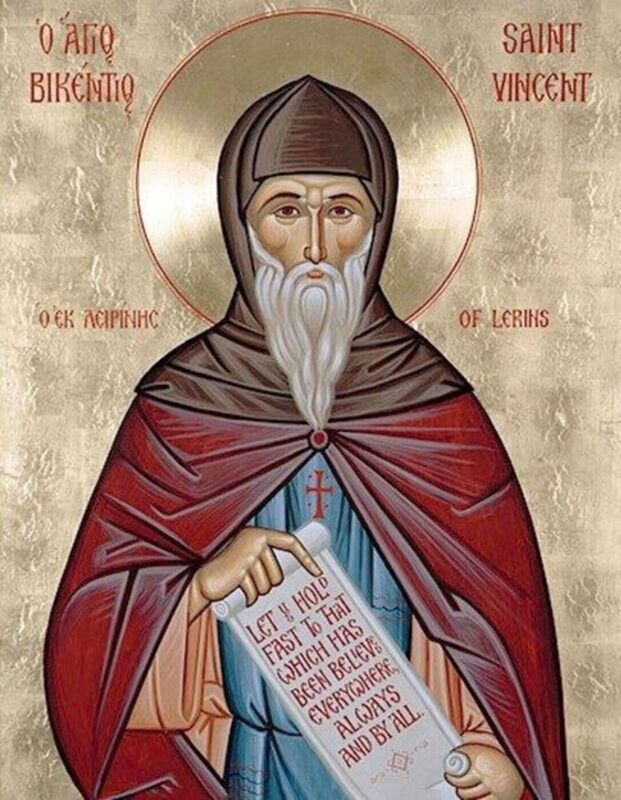
Vincent of Lérins, 5th century

Works of the ancient Holy Fathers and Church Writers

Vincent of Lérins, 5th century

Texte préparé par la communauté bibleox

Nous voulons que ce texte soit accessible à tous — c'est pourquoi nous avons préparé cette traduction. Malheureusement, il n'est pas toujours possible de trouver des traductions toutes prêtes, alors nous les créons nous-mêmes. Des outils automatiques et des humains y travaillent. Vous pouvez aussi aider ! Certaines parties peuvent ne pas sembler parfaites, mais nous avons essayé de préserver la précision du sens. Si vous remarquez une inexactitude ou souhaitez améliorer le texte — les critiques sont bienvenues ! Mieux encore — rejoignez la communauté et proposez vos modifications. Comme les contenus de Wikipédia, ce texte est diffusé librement sous licence CC BY-SA.

Venerable († before 450)
Ce texte est disponible dans d'autres langues :

Commemoration day: May 24 (June 6)

Biography

Information about the life of Saint Vincent is extremely scarce. The primary biographical source about him is the work "De viris illustribus" (On Illustrious Men) by Gennadius of Massilia, composed around 495 AD as a continuation of the work of the same name by Saint Jerome of Stridon.

Vincent was born in the city of Toul in the northeast of modern France. He was the blood brother of Saint Lupus of Troyes. After service in the army (Latin: secularis militia), he entered the Lérins Monastery of Saint Honoratus, where he was tonsured a monk. In 434, under the pseudonym Peregrinus, he wrote his most famous work, "Commonitorium". He reposed during the reign of the emperors Theodosius II and Valentinian III, i.e., in or before 450 AD. Vincent was highly esteemed by his contemporaries; for instance, Saint Eucherius of Lyon called him a holy man, outstanding in eloquence and knowledge.

80
Publié par: Rodion Vlasov
Vous souhaitez corriger ou compléter ? Contactez-nous: https://t.me/bibleox_live
Ou éditez l'article vous-même: Éditer