Establishment of sacrament of the Eucharist
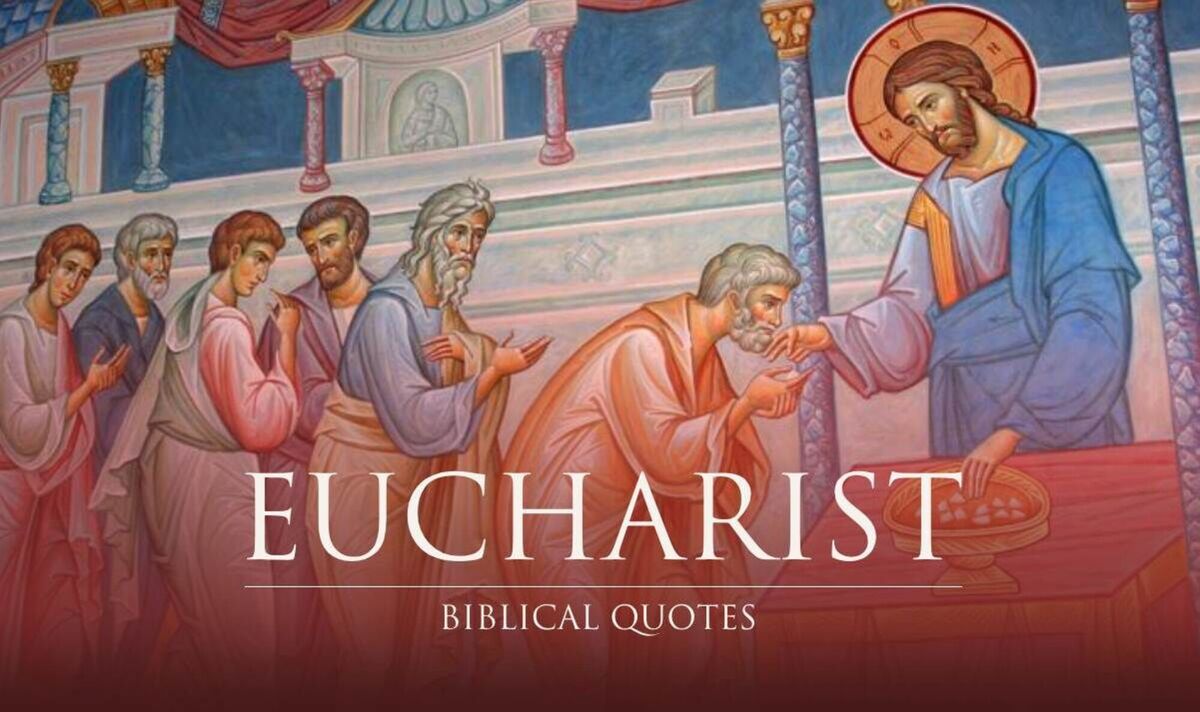
The Lord and God Jesus Christ established the sacrament of the Eucharist at the Last Supper, gathering only 12 apostles:
"And as they were eating, Jesus took bread, blessed and broke it, and gave it to the disciples and said, “Take, eat; this is My body.” Then He took the cup, and gave thanks, and gave it to them, saying, “Drink from it, all of you. For this is My blood of the new covenant, which is shed for many for the remission of sins" (Mt. 26:26-28) / Also: Mr. 14:22-24; Lu. 22:19-20
The Apostle Paul, who became such after the Resurrection of the Savior, was taught to perform the Eucharist separately and personally by the risen Jesus Christ:
"For I received from the Lord that which I also delivered to you: that the Lord Jesus on the same night in which He was betrayed took bread; and when He had given thanks, He broke it and said, “Take, eat; this is My body which is broken for you; do this in remembrance of Me.” In the same manner He also took the cup after supper, saying, “This cup is the new covenant in My blood. This do, as often as you drink it, in remembrance of Me.”" (1Co. 11:23-25)
Impossibility of salvation without participation in the Eucharist
"Then Jesus said to them, “Most assuredly, I say to you, unless you eat the flesh of the Son of Man and drink His blood, you have no life in you. Whoever eats My flesh and drinks My blood has eternal life, and I will raise him up at the last day. For My flesh is food indeed, and My blood is drink indeed. He who eats My flesh and drinks My blood abides in Me, and I in him. As the living Father sent Me, and I live because of the Father, so he who feeds on Me will live because of Me. This is the bread which came down from heaven—not as your fathers ate the manna, and are dead. He who eats this bread will live forever.”" (Joh. 6:53-58)
Uniting in one Body through the Eucharist
Those participating in the Sacrament of the Eucharist are truly (in fact) united with Christ and with each other in His body:
"The cup of blessing which we bless, is it not the communion of the blood of Christ? The bread which we break, is it not the communion of the body of Christ? For we, though many, are one bread and one body; for we all partake of that one bread" (1Co. 10:16-17)
"Now you are the body of Christ, and members individually" (1Co. 12:27)
"But now in Christ Jesus you who once were far off have been brought near by the blood of Christ" (Eph. 2:13)
The sacrament — is the real Flesh and Blood of Jesus Christ
Bread is the flesh that Christ will give for the life of the world
In the Eucharist, believers take into themselves the true (real) Body and true Blood of Jesus Christ, which He gave for the life of the world, sacrificing Himself on the cross:
"I am the bread of life. Your fathers ate the manna in the wilderness, and are dead. This is the bread which comes down from heaven, that one may eat of it and not die. I am the living bread which came down from heaven. If anyone eats of this bread, he will live forever; and the bread that I shall give is My flesh, which I shall give for the life of the world.”" (Joh. 6:48-51)
Here the Lord directly says that this heavenly bread is His flesh, which He has now, and which He will give in the future for the life of the world. In the future, He will give up for execution not a symbol, not a memory, not a teaching, but His real flesh. And this is precisely the heavenly bread that He offers to eat.
The Blood of the Covenant is a great shrine
The heaviest punishment will be subject to the one who does not consider the Blood of the Covenant holy and thereby offends the Spirit of grace:
"Anyone who has rejected Moses’ law dies without mercy on the testimony of two or three witnesses. Of how much worse punishment, do you suppose, will he be thought worthy who has trampled the Son of God underfoot, counted the blood of the covenant by which he was sanctified a common thing, and insulted the Spirit of grace?" (Heb. 10:28-29)
"but he who blasphemes against the Holy Spirit never has forgiveness, but is subject to eternal condemnation" (Mr. 3:29)
Flesh of the Son of Man
Speaking about the Eucharist, Christ focuses on His human nature:
"Then Jesus said to them, “Most assuredly, I say to you, unless you eat the flesh of the Son of Man and drink His blood, you have no life in you" (Joh. 6:53)
Illness and death to those who partake unworthily
A test is required before eating. Those who partake unworthily are guilty, get sick and even die:
"Therefore whoever eats this bread or drinks this cup of the Lord in an unworthy manner will be guilty of the body and blood of the Lord. But let a man examine himself, and so let him eat of the bread and drink of the cup. For he who eats and drinks in an unworthy manner eats and drinks judgment to himself, not discerning the Lord’s body. For this reason many are weak and sick among you, and many die" (1Co. 11:27-30)
Figurative comparison of Christ with a door?
Communicating with the people, Christ compares himself to the door to a sheep pen:
"Then Jesus said to them again, “Most assuredly, I say to you, I am the door of the sheep" (Joh. 10:7)
Since here Christ figuratively calls himself a door, does this mean that the Eucharistic words about Flesh and Blood should also be understood figuratively? No, that doesn't mean it. Before the comparison with the door, the Savior told a parable about a shepherd entering the sheep pen through the door, and a thief who climbs somewhere else. By comparing Himself to a door, the Savior only ends this parable, explaining it to the people. Christ always spoke to the people in parables, and explained everything to his disciples in private:
"And the disciples came and said to Him, “Why do You speak to them in parables?” He answered and said to them, “Because it has been given to you to know the mysteries of the kingdom of heaven, but to them it has not been given" (Mt. 13:10-11)
"Therefore I speak to them in parables, because seeing they do not see, and hearing they do not hear, nor do they understand" (Mt. 13:13)
"And He said to them, “To you it has been given to know the mystery of the kingdom of God; but to those who are outside, all things come in parables" (Mr. 4:11)
"And with many such parables He spoke the word to them as they were able to hear it. But without a parable He did not speak to them. And when they were alone, He explained all things to His disciples" (Mr. 4:33-34)
Being alone with his disciples in the room of Zion and speaking with them about the Eucharist, Christ did not need parables, did not add parables, especially parables about the body and blood, that is, Christ spoke literally, and not figuratively. When communicating with the people, Christ also did not add any parables to his words about the Eucharist. He started from a conversation about Old Testament manna. This is not a parable, but a reality. The Jews actually ate manna so as not to actually die. And the Lord says that although they ate manna, they still died (like everyone else, in the end), and the one who eats Him will not die.
"he who feeds on Me will live because of Me. This is the bread which came down from heaven—not as your fathers ate the manna, and are dead. He who eats this bread will live forever.”" (Joh. 6:57-58)
“I will not drink of the fruit of the vine”
Some object to a realistic understanding of flesh and blood in the Eucharist, citing Christ's words about the fruit of the vine at the Last Supper.
Three evangelists speak about the fruit of the vine: Mark, Matthew and Luke. Evangelist Luke, unlike Mark and Matthew, describes the supper in more detail, mentioning several cups consumed:
First bowl
"Then He said to them, “With fervent desire I have desired to eat this Passover with you before I suffer; for I say to you, I will no longer eat of it until it is fulfilled in the kingdom of God.” Then He took the cup, and gave thanks, and said, “Take this and divide it among yourselves; for I say to you, I will not drink of the fruit of the vine until the kingdom of God comes.”" (Lu. 22:15-18)
Until now there was no Eucharist and no words about body and blood. There was only Easter dinner. The words about grape juice have already been said. After supper the Eucharist begins:
Second bowl
"And He took bread, gave thanks and broke it, and gave it to them, saying, “This is My body which is given for you; do this in remembrance of Me.” Likewise He also took the cup after supper, saying, “This cup is the new covenant in My blood, which is shed for you" (Lu. 22:19-20)
So, in the first part, only the traditional Jewish Passover meal is served, at which they necessarily drank 4 cups of wine and water and thanked God. There are no commands in Scripture to drink these 4 cups of wine. This was only a Jewish custom. The customs of the Jewish Passover meal are described in more detail in the Jewish Mishnah:
MISHANAH ONE
(א) עַרְבֵי פְסָחִים סָמוּךְ לַמִּנְחָה, לֹא יֹאכַל אָדָם עַד שֶׁתֶּחְשַׁךְ. וַאֲפִלּוּ עָנִי שֶׁבְּיִשְׂרָאֵל לֹא יֹאכַל עַד שֶׁיָּסֵב. וְלֹא יִפְחֲתוּ לוֹ מֵאַרְבָּעָה כוֹסוֹת שֶׁל יַיִן, וַאֲפִלּוּ מִן הַתַּמְחוּי:
ON THE EVE OF PASSACH, A PERSON SHOULD NOT EAT FROM SHORTLY BEFORE MINCHAH UNTIL IT COMES DARK. AND EVEN THE POOREST ONE IN THE PEOPLE OF ISRAEL SHOULD NOT EAT UNTIL THEY RELY UP FOR THE MEAL. AND NO ONE SHOULD DRINK LESS THAN FOUR GLASSES OF WINE - EVEN THE FOOD FROM A CHARITY KITCHEN.
For the first time, Christ only performs this custom: he takes the cup, thanks, and gives it to his disciples, not saying a word that it is His blood, but telling them to share it among themselves, which they obviously did. The cup is drunk. There is no mention of bread here at all. Then Christ speaks a phrase about the fruit of the vine (Luke 22:18), which he will no longer drink, and only after supper (Luke 22:20; 1 Cor. 11:25) Christ takes the bread and again takes the cup (this is already another cup, since the first one has already been drunk), gives it to the disciples, only now speaking about His body and blood.
Old Testament prototypes of the Eucharist
Easter lamb
An immaculate male lamb (a one-year-old lamb without blemishes) had to actually die for the sins of people, and then actually be eaten , entirely. Christ, the Lamb, literally embodies both parts of this image: - He really (not figuratively) dies for the sins of people; - They actually (not figuratively) eat it.
"Speak to all the congregation of Israel, saying: ‘On the tenth of this month every man shall take for himself a lamb, according to the house of his father, a lamb for a household. Your lamb shall be without blemish, a male of the first year. You may take it from the sheep or from the goats. Now you shall keep it until the fourteenth day of the same month. Then the whole assembly of the congregation of Israel shall kill it at twilight" (Ex. 12:3,5-6) (Ex. 12:21-22,25)
"But He was wounded for our transgressions, He was bruised for our iniquities; The chastisement for our peace was upon Him, And by His stripes we are healed. All we like sheep have gone astray; We have turned, every one, to his own way; And the LORD has laid on Him the iniquity of us all. He was oppressed and He was afflicted, Yet He opened not His mouth; He was led as a lamb to the slaughter, And as a sheep before its shearers is silent, So He opened not His mouth" (Isa. 53:5-7) (Ac. 8:32)
"But I was like a docile lamb brought to the slaughter" (Jer. 11:19)
"The next day John saw Jesus coming toward him, and said, “Behold! The Lamb of God who takes away the sin of the world! And looking at Jesus as He walked, he said, “Behold the Lamb of God!”" (Joh. 1:29,36)
"knowing that you were not redeemed with corruptible things, like silver or gold, from your aimless conduct received by tradition from your fathers, but with the precious blood of Christ, as of a lamb without blemish and without spot" (1Pe. 1:18-19)
"saying with a loud voice: “Worthy is the Lamb who was slain To receive power and riches and wisdom, And strength and honor and glory and blessing!”" (Rev. 5:12) (Rev. 7:17) (Rev. 14:1)
Manna
Manna in the desert, which strengthened the strength of the Jewish people on the way from Egyptian captivity to the promised land. They actually ate manna in the desert. It really protected people from death and gave life (there was no other food in the desert):
"Then the LORD said to Moses, “Behold, I will rain bread from heaven for you. And the people shall go out and gather a certain quota every day, that I may test them, whether they will walk in My law or not. And the house of Israel called its name Manna. And it was like white coriander seed, and the taste of it was like wafers made with honey" (Ex. 16:4,31)
"And when the dew fell on the camp in the night, the manna fell on it" (Nu. 11:9)
Since manna is only an image, a shadow of the future, and not the object itself, it did not give eternal life, but only extended earthly life, saved from starvation, in the end, all those Jews still died, just like people die. But Christ says that whoever eats Him will live forever:
"Our fathers ate the manna in the desert; as it is written, ‘He gave them bread from heaven to eat.’ ” Then Jesus said to them, “Most assuredly, I say to you, Moses did not give you the bread from heaven, but My Father gives you the true bread from heaven. For the bread of God is He who comes down from heaven and gives life to the world.” And Jesus said to them, “I am the bread of life. He who comes to Me shall never hunger, and he who believes in Me shall never thirst. I am the bread of life. Your fathers ate the manna in the wilderness, and are dead. This is the bread which comes down from heaven, that one may eat of it and not die" (Joh. 6:31-33,35,48-50)
"Whoever eats My flesh and drinks My blood has eternal life, and I will raise him up at the last day. <…> so he who feeds on Me will live because of Me. This is the bread which came down from heaven—not as your fathers ate the manna, and are dead. He who eats this bread will live forever.”" (Joh. 6:54-55,57-58)
Moreover, if we consider the entire Jewish path from Egyptian slavery to the Promised Land as the Christian’s path from slavery to sin to the Kingdom of Heaven, then here too the manna literally points to the Eucharist:
real Egyptian captivity - real slavery to sin.
the real way out of slavery at the bottom of the sea is real baptism (1Co. 10:2).
real 40-year wandering in the desert - real earthly life in the Church.
real manna and water - the real Flesh and Blood of the Savior, given by God.
the real land promised to the Jews is a real Kingdom, but now not earthly, but heavenly.
Sweet water in Marah
"So Moses brought Israel from the Red Sea; then they went out into the Wilderness of Shur. And they went three days in the wilderness and found no water. Now when they came to Marah, they could not drink the waters of Marah, for they were bitter. Therefore the name of it was called Marah. And the people complained against Moses, saying, “What shall we drink?” So he cried out to the LORD, and the LORD showed him a tree. When he cast it into the waters, the waters were made sweet. There He made a statute and an ordinance for them, and there He tested them" (Ex. 15:22-25)
Anointing the entrance to the house with the blood of a lamb
Anointing the entrance to the house with blood saved from death:
"And they shall take some of the blood and put it on the two doorposts and on the lintel of the houses where they eat it. And you shall take a bunch of hyssop, dip it in the blood that is in the basin, and strike the lintel and the two doorposts with the blood that is in the basin. And none of you shall go out of the door of his house until morning. For the LORD will pass through to strike the Egyptians; and when He sees the blood on the lintel and on the two doorposts, the LORD will pass over the door and not allow the destroyer to come into your houses to strike you" (Ex. 12:7,22-23)
Coal from the altar that cleanses sins
The sins of the prophet Isaiah were cleansed by the touch of a burning coal taken from the altar to his lips:
"So I said: “Woe is me, for I am undone! Because I am a man of unclean lips, And I dwell in the midst of a people of unclean lips; For my eyes have seen the King, The LORD of hosts.” Then one of the seraphim flew to me, having in his hand a live coal which he had taken with the tongs from the altar. And he touched my mouth with it, and said: “Behold, this has touched your lips; Your iniquity is taken away, And your sin purged.”" (Isa. 6:5-7)
Eating fruit from the tree
Humanity fell away from God, having actually tasted the fruit of the tree (Ge. 3:6), so humanity returns to God, eating the fruit of the tree of the cross. Man fell away from God through the tree of disobedience, but returns through the tree of obedience on the cross (Php. 2:8; Mt. 16:24). The fruit from the tree took life. The fruit from the tree returns to her. Whichever door a person came out through is the one he enters. Then the Lord said: “Do not eat” (Ge. 2:17) - they ate. Now he says “eat” (Mt. 26:26) - many make the same mistake, but now it’s the other way around - they don’t eat. Although then and now, this commandment was not difficult to keep:
"but of the fruit of the tree which is in the midst of the garden, God has said, ‘You shall not eat it, nor shall you touch it, lest you die’”" (Ge. 3:3) "but of the tree of the knowledge of good and evil you shall not eat, for in the day that you eat of it you shall surely die.”" (Ge. 2:17)
"And as they were eating, Jesus took bread, blessed and broke it, and gave it to the disciples and said, “Take, eat; this is My body.”" (Mt. 26:26) "This is the bread which came down from heaven—not as your fathers ate the manna, and are dead. He who eats this bread will live forever.”" (Joh. 6:58)
Changing the nature of items
Rod into the serpent and back (Ex. 4:3-4; Ex. 7:9-10,15);
Water into blood (Ex. 7:17,19-21);
Water into wine (Joh. 2:7-10).
Blessing of Bread and Wine
The immaterial God, who first created the universe out of nothing, created a worldwide flood, stopped the Sun, miraculously gives different food and water in any place, parted rivers and seas, repeatedly changed the nature of objects (rod, water), became material (incarnate), multiplying His blessing bread and fish (Mt. 14:15-21; Mt. 15:32-38; Mr. 6:35-44; Mr. 8:1-9; Lu. 9:12-17; Joh. 6:5-13), who created eyes to the man born blind, who restored the decayed flesh of Lazarus, at the Easter supper with his disciples not only distributed bread and wine, but after praying, blessed them and called them his Flesh and Blood:
"And as they were eating, Jesus took bread, blessed and broke it, and gave it to the disciples and said, “Take, eat; this is My body.” Then He took the cup, and gave thanks, and gave it to them, saying, “Drink from it, all of you. For this is My blood of the new covenant, which is shed for many for the remission of sins" (Mt. 26:26-28)
It is impossible to understand this blessing as something insignificant and empty.
Old Testament prophecies about the Eucharist
"Wisdom has built her house, She has hewn out her seven pillars; She has slaughtered her meat, She has mixed her wine, She has also furnished her table. She has sent out her maidens, She cries out from the highest places of the city, “Whoever is simple, let him turn in here!” As for him who lacks understanding, she says to him, “Come, eat of my bread And drink of the wine I have mixed. Forsake foolishness and live, And go in the way of understanding" (Pr. 9:1-6)
"“Ho! Everyone who thirsts, Come to the waters; And you who have no money, Come, buy and eat. Yes, come, buy wine and milk Without money and without price. Why do you spend money for what is not bread, And your wages for what does not satisfy? Listen carefully to Me, and eat what is good, And let your soul delight itself in abundance. Incline your ear, and come to Me. Hear, and your soul shall live; And I will make an everlasting covenant with you— The sure mercies of David" (Isa. 55:1-3)
“Wisdom will glorify herself and will be praised among her people. Come to me, you who desire me, and be satisfied with my fruits; Those who eat me will want to eat more, and those who drink me will want to drink more” ( Sir. 24:1,21,23 )
Criticism
A figurative comparison of Christ to a door?
When speaking to the people, Christ compares Himself to a door leading into a sheepfold:
“So again Jesus said to them, “Very truly, I tell you, I am the gate for the sheep” (John. 10:7)
Now, since Christ figuratively calls Himself a door, does this mean that the Eucharistic words about flesh and blood should also be understood figuratively? Not at all, it does not mean that. Before the comparison with the door, the Savior told a parable about the shepherd who enters through the door to the sheep into the fold, and the thief who climbs in somewhere else. By comparing Himself to the door, the Savior is merely concluding this parable, explaining it to the people. Christ always spoke to the people in parables, but explained everything privately to His disciples:
“Then the disciples came and asked him, “Why do you speak to them in parables?” He answered, “To you it has been given to know the secrets of the kingdom of heaven, but to them it has not been given” (Matt. 13:10-11)
“The reason I speak to them in parables is that ‘seeing they do not perceive, and hearing they do not listen, nor do they understand.’” (Matt. 13:13)
“And he said to them, “To you has been given the secret of the kingdom of God, but for those outside, everything comes in parables” (Mark. 4:11)
“With many such parables he spoke the word to them, as they were able to hear it; he did not speak to them except in parables, but he explained everything in private to his disciples” (Mark. 4:33-34)
While alone with His disciples in the upper room of Zion and speaking to them about the Eucharist, Christ did not add parables, much less parables about body and blood — that is, Christ spoke literally, not figuratively. When speaking to the people, Christ likewise added no parables to the words about the Eucharist. He began from a discussion of the Old Testament manna. This is not a parable, but reality. The Jews actually ate manna in order to actually not die. And thus, to point out to the listeners that manna was only an image, the Lord says that although they ate manna, it saved them only from hunger, yet in the end they still died (as all people die), whereas he who eats Him will not die (for this is no longer an image, but that which the image pointed to — the true heavenly bread, giving eternal life):
“Just as the living Father sent me, and I live because of the Father, so whoever eats me will live because of me. This is the bread that came down from heaven, not like that which your ancestors ate, and they died. But the one who eats this bread will live forever.”” (John. 6:57-58)
"I will not drink of the fruit of the vine"
Some object to the realistic understanding of the flesh and blood in the Eucharist, citing Christ's words about the fruit of the vine at the Last Supper.
The fruit of the vine is mentioned by three evangelists: Matthew, Mark, and Luke (Matthew 26:29; Mark 14:25; Luke 22:18). The Evangelist Luke, unlike Mark and Matthew, describes the supper in more detail, mentioning several cups that were drunk:
The first cup
“He said to them, “I have eagerly desired to eat this Passover with you before I suffer; for I tell you, I will not eat it until it is fulfilled in the kingdom of God.” Then he took a cup, and after giving thanks he said, “Take this and divide it among yourselves; for I tell you that from now on I will not drink of the fruit of the vine until the kingdom of God comes.”” (Luke. 22:15-18)
Christ commands that the contents of the cup be divided among the disciples. This cup is divided. There has not yet been the Eucharist or the words about the body and blood. It was only the Passover meal. After this cup of wine, Christ immediately speaks the phrase about the fruit of the vine, which He will no longer drink:
“for I tell you that from now on I will not drink of the fruit of the vine until the kingdom of God comes.”” (Luke. 22:18)
And only after the supper (Luke 22:20; 1 Cor. 11:25) does Christ celebrate the Eucharist, taking bread and taking the cup again (this is another cup, since the first had already been drunk), and gives it to the disciples, only now speaking of His body and blood:
The second cup
“Then he took a loaf of bread, and when he had given thanks, he broke it and gave it to them, saying, “This is my body, which is given for you. Do this in remembrance of me.” And he did the same with the cup after supper, saying, “This cup that is poured out for you is the new covenant in my blood” (Luke. 22:19-20)
Thus, in the first part, only the traditional Jewish Passover meal takes place, during which they would necessarily drink four cups of wine mixed with water and give thanks to God. There is no command in Scripture to drink these four cups of wine. This was merely a Jewish custom. The customs of the Jewish Passover meal are described in more detail in the Jewish Mishnah:
MISHNAH ONE
(א) עַרְבֵי פְסָחִים סָמוּךְ לַמִּנְחָה, לֹא יֹאכַל אָדָם עַד שֶׁתֶּחְשַׁךְ. וַאֲפִלּוּ עָנִי שֶׁבְּיִשְׂרָאֵל לֹא יֹאכַל עַד שֶׁיָּסֵב. וְלֹא יִפְחֲתוּ לוֹ מֵאַרְבָּעָה כוֹסוֹת שֶׁל יַיִן, וַאֲפִלּוּ מִן הַתַּמְחוּי:
On the eve of Passover, close to the time of the afternoon offering, a person must not eat until it grows dark. And even the poorest in Israel must not eat until he reclines [at the meal]. And they must give him no less than four cups of wine, even if he receives his food from the charity kitchen.
The first time, Christ merely performs this custom: He takes a cup, gives thanks, and gives it to His disciples, saying nothing about this being His blood, but telling them to divide it among themselves, which they obviously did. The cup is drunk. No mention of bread is made in the first instance. After the supper, however, bread is mentioned, the cup is mentioned again, and only then do the words about Christ's body and blood appear. Therefore, the words about the fruit of the vine refer to the first cup of grape wine, whereas the words about Christ's blood refer to the second cup, in which, in a mysterious manner, it was no longer wine that was given to the disciples, but the true Blood of Christ, in which we believe.
"It is the spirit that gives life; the flesh is useless"
Opponents of the Orthodox Church's teaching on the Eucharist claim that Christ spoke of eating His flesh only symbolically. They point to the following words:
“It is the spirit that gives life; the flesh is useless. The words that I have spoken to you are spirit and life” (John. 6:63)
Proponents of symbolism explain these verses as meaning that the eating of Christ's flesh supposedly profits nothing at all.
We, however, show that the words "the flesh is useless" are spoken about carnal thinking, which profits nothing. This is spoken about people who think in an exclusively earthly, crude, mundane manner — only in the way they are accustomed to see in their own lives, unable to raise their minds to spiritual mysteries [1].
We can encounter many other passages in Scripture where such words are used concerning people who think exclusively in earthly terms:
“And Jesus answered him, “Blessed are you, Simon son of Jonah! For flesh and blood has not revealed this to you, but my Father in heaven” (Matt. 16:17)
“to reveal His Son in me, that I might preach Him among the Gentiles, I did not immediately confer with flesh and blood” (Gal. 1:16)
“Are you so foolish? Having started with the Spirit, are you now ending with the flesh?” (Gal. 3:3)
“Thus says the LORD: Cursed are those who trust in mere mortals and make mere flesh their strength, whose hearts turn away from the LORD” (Jer. 17:5)
Such people thought that before them was an ordinary man, the son of Joseph. How can an ordinary man give them his flesh to eat? — Only in the way that any man would, tearing it from himself and giving it to them as food. This thinking profited them nothing. They were greatly troubled, saying, “This teaching is difficult; who can accept it?” (John. 6:60) and they departed.
Yet Christ is not just any man, but Almighty God. He establishes a mystery in which His life-giving flesh and blood are given in a mysterious manner under the forms of bread and wine, which is accomplished by the power of God. For this, one must think spiritually, leaving room for the mysterious accomplishment of that which we cannot always understand with the mind, leaving room for the supernatural accomplishment of Christ's words, which transcends earthly order:
“So Jesus said to them, “Very truly, I tell you, unless you eat the flesh of the Son of Man and drink his blood, you have no life in you” (John. 6:53)
Why can Eucharistic particles become moldy and burn?
In the Eucharist, after the transubstantiation of the bread and wine into the body and blood of Christ, all the external properties (accidents, Lat. accidentiae, Gk. symbebekóta) of the bread and wine remain, but the substance* of the bread and wine is completely replaced by the substance of the body and blood of Christ. This replacement is not perceived by means of the senses: through taste, smell, sight, hearing, touch. The fact of the replacement of the substance is accepted by faith. The body and blood of Christ are given in the Eucharist in a mysterious manner, known perfectly only to God, who knows the true nature of every thing. We, however, have limited means of knowing the world and the nature of things. Since the external properties of the bread and wine remain (this is not an illusion), and we perceive the world through external properties, it is impossible to investigate the mystery of the Eucharist experimentally by empirical means. Nevertheless, believers can be assured of the truth of the mystery through their own life experience. Thus, participation in the mystery is often preceded and followed by spiritual temptations. Worthy participation in the mystery contributes to a person's spiritual progress, whereas unworthy participation (without faith, without necessary penitential feelings, with unrepented grave sins) can lead to spiritual and physical harm, illnesses, and even death (1 Cor. 11:27-30), just as happens when materials that are unprepared for union with fire are scorched upon contact with it.
On conceptual apparatus:
More on accidents: azbyka.ru. St. John of Damascus on accidents: azbyka.ru.
*Substance – a theological concept, not a scientific one (azbyka.ru). Substance is not the same as atoms or molecules. But there is a connection between substance and atoms, since substance is that basis of being (Lat. substantia – lit. "that which stands under") which determines the existence both of atoms and molecules, and of all that is proper to a given substance.
Why "eat God"?
This is how the question is posed by Muslims. Protestants, on the other hand, address this question to the Orthodox Church in a slightly different form, but the essence is the same.
The answer to such a question can be lengthy, but here only the general idea will be given: Communion introduces a person into the closest union with Christ God — not only spiritual, but also bodily, for God created man not only of a soul, but also of a body.
In reality, every person, except for Adam and Eve, from their very appearance in this world, has nourished themselves from the body of another person — the body of their mother. If they did not do this, they could not have life, could not grow and develop, and would undoubtedly perish, which is what happens when the fetus (embryo) cannot implant itself.
When an infant is born, its body is built from its mother's body. The mother's body, giving of itself, gave life to the infant, and thus both (mother and infant) were in bodily union. Even after birth, the infant continues for a long time to nourish itself from the mother's body, because the milk consumed by infants is produced in the mother's body from her blood. Accordingly, milk is the mother's blood, in the sense indicated.
The establishment of both processes (childbearing and the Eucharist) was accomplished by God.
When we come to know the human nature created by God, with its processes of birth and nourishment, there is no reason to be surprised when we recognize similar processes in the Eucharist, in which we nourish ourselves no longer from the body of a mother, but from the body of Christ God, and thus enter into not only spiritual but also bodily union with God — full union with Christ, in spirit and in body:
“For we are members of His body, of His flesh and of His bones” (Eph. 5:30)