
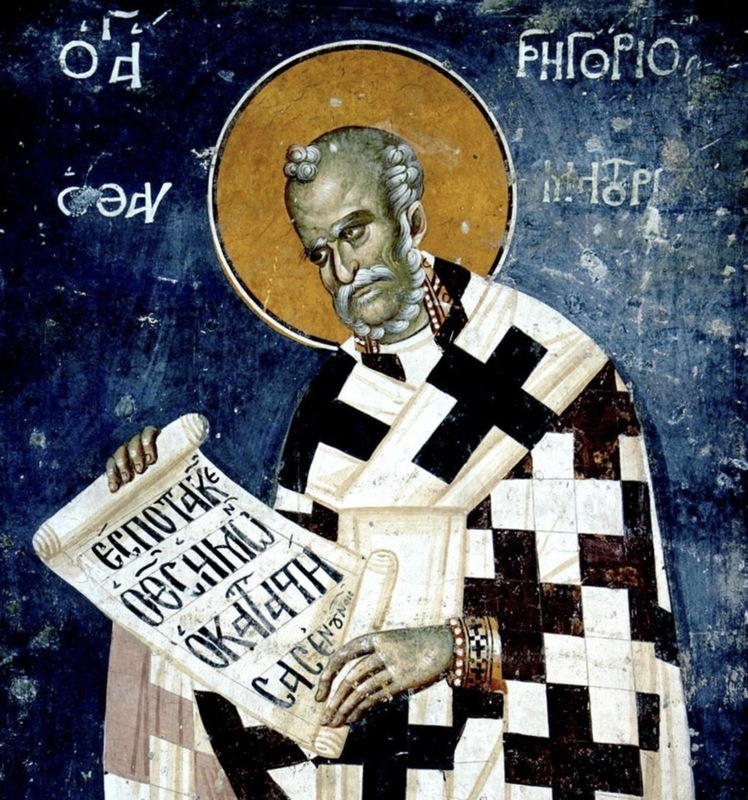
Commemoration Day: November 17 (30)
Biography
On the way to the priesthood
Gregory of Neocaesarea (the Wonderworker) came from a famous and wealthy family; he was a descendant of Greek settlers.
The exact date of his birth is unknown. He is believed to have been born around 213 in Neocaesarea of Pontus. According to tradition, he was originally called Theodore, and he probably received the name Gregory at Baptism.
Theodore's father, far from the Orthodox worldview, raised his son as a pagan raises a pagan. Being a man of means, he sought to give him a good secular education. Meanwhile, at the age of fourteen Theodore lost his father, and much in his intended career came to depend on his relatives and on himself, but above all on the All-wise God.
For some time Theodore studied at the school of a grammarian, then at the school of a rhetorician, and then immersed himself in jurisprudence; preparing to become an advocate, he studied laws and law, and of course the language of law used at that time, Latin. Wishing to learn the foundations of Roman law, he intended to go to Rome. But by the Providence of God his life turned out differently from what he and his pagan father had once planned.
Having accompanied to Caesarea his sister, whose husband had received from the authorities the post of counsellor to the governor of Palestine, Theodore, who arrived there together with his brother Athenodorus, had the opportunity to continue his education in Berytus, where at that time there was a law school well known in the region.
But here something happened that none of his relatives had even imagined. At that time in Caesarea of Palestine there was a theological school organized through the efforts of the famous Christian teacher Origen. Having settled in after their arrival, Theodore and his brother, whether intentionally or out of curiosity, wished to hear the sermons of Origen.
Soon their meeting took place (there is an opinion that bishop Firmilian helped to bring it about). The meeting grew into a personal acquaintance that influenced Theodore's destiny in the most decisive way. Theodore, having heard the ardent and eloquent instructions, was filled with sympathy and respect for Origen, and Origen in his turn offered to take him as his disciple. Theodore was followed by his brother Athenodorus.
At first Origen taught Theodore to discover and gather the seeds of truth contained in philosophical systems, and in general introduced him to the love of wisdom. Then he gradually revealed to him the meaning of the Books of Holy Scripture and taught him to trust supernatural Revelation and Christian teaching.
Having completed his studies with Origen, which are believed to have lasted no less than five years, Theodore joyfully received Baptism, publicly honoured his teacher with a good word, and together with his brother returned to his native land.
Soon (Theodore) Gregory received a letter from Origen in which he urgently called on him to direct his abilities, strength and knowledge to the salvation of his own soul and to the benefit of the Church.
Pastoral ministry
Having found reliable moral guidance in Christianity, Gregory, following the example of many great ascetics, decided to withdraw from the bustle of the world and to devote his life to the service of Him Who in Himself is the True Life.
Around 245 Phaedimus, bishop of Amasea, ordained him bishop of Neocaesarea. At first Gregory, in humble awareness of his own unworthiness, flatly refused to accept so high a rank and dignity.
As a sign of disagreement and unwillingness to occupy the episcopal see, Gregory withdrew, but against his disagreement Phaedimus secured the consent of God. Rightly understanding that the Lord sees him and Gregory equally, Phaedimus, having prayed, laid his word on Gregory instead of his hand and assigned the city to his governance.
Having learned what had happened, and probably having felt an illumination of grace, Gregory was of course amazed. He could not resist so extraordinary an appointment, for it is one thing to object to the bishop of Amasea, and quite another to the bishop's Lord. After Gregory gave his consent, he was consecrated as a hierarch in accordance with the canon.
In his ministry bishop Gregory enjoyed extremely deep respect and authority among his flock. Moreover, the power of his word and personal example had a tremendous effect not only on believers but also on pagans. This is eloquently attested by a fact recorded in tradition: when he began his ministry as a hierarch there were only a few believers in the city, and at the end, when he looked to see whether there was anyone else who needed to turn to the Redeemer, only a few who had gone astray were found.
The fame of Gregory spread far beyond the borders of the region. The holy fathers who lived after him rightly called him the Great and the Renowned. As follows from the addition to his name that became established in the 5th century, "the Wonderworker", for the holiness of his life he was granted by God also the gift of working miracles.
During the persecution of Christianity under Decius, St. Gregory, showing prudent caution, hid from the pagans together with his flock in the surrounding mountains. And God kept him. After the persecution ended, the hierarch initiated the spread of the practice of feasts in honour of the martyrs for Christ.
In 264 bishop Gregory took part in the local Council of Antioch, convened against the heretic Paul of Samosata, who taught falsely about the Most Holy Trinity and denied the Divine dignity of Jesus Christ.
The exact date of the death of Gregory the Wonderworker is not known to us. It is believed that he reposed in the Lord between 270 and 275.
Literary legacy
Despite the rich preaching activity of St. Gregory, the number of his written instructions that have come down to us (whose authenticity is not in doubt) is small.
Among them a special place is held by the Creed that bears his name (the Creed of Gregory the Wonderworker, see: A Declaration of Faith).
There is a tradition that Gregory received the text of this brief exposition of the dogmas of faith before his elevation to the see of Neocaesarea. Once, when he was in prayer and contemplation in an uninhabited wilderness, two unusual persons approached him: a venerable elder and a radiant Woman. At the word of the Woman, her companion taught Gregory the Creed, which he later introduced into the community of Neocaesarea. From ancient times the Woman who appeared has been understood to be the Mother of God, and the elder the Evangelist John the Theologian.
From early times this creed was revered by the Church as one of the best expositions of the dogmas of faith.
Among his other works it is fitting to name: the Oration of Thanksgiving to Origen, a short Discourse on the Soul to Tatian, To Philagrius on Consubstantiality, To Theopompus on the Passibility and Impassibility of God, the Canonical Epistle of St. Gregory of Neocaesarea (262) included among the canons of the holy fathers of the Orthodox Church, a Detailed Exposition of Faith, and the Metaphrase of Ecclesiastes.
Hymnography
Troparion to St. Gregory the Wonderworker, Bishop of Neocaesarea, Tone 8
Watchful in prayer and persevering in the working of miracles, / thou didst acquire thy name through thy deeds; / but pray to Christ God, O father Gregory, // to enlighten our souls, lest we ever sleep unto death.
Kontakion to the hierarch, Bishop of Neocaesarea, Tone 2
Having received the power of many miracles, / thou didst terrify the demons with dread signs / and drive away the diseases of men, O all-wise Gregory; / therefore thou art called the Wonderworker, // receiving thy title from thy deeds.