
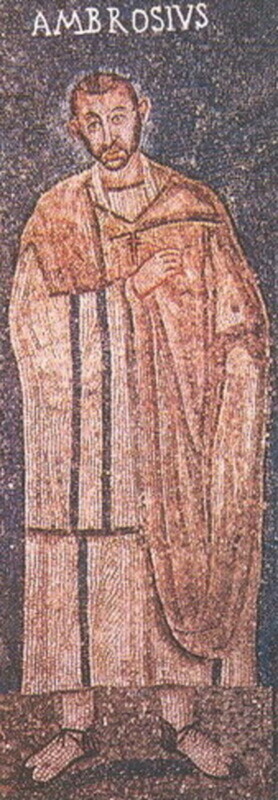
Commemoration Day: December 7(20)
Biography
St. Ambrose of Milan was born in the city of Augusta Treverorum (Trevir; modern Trier). The year 339 is traditionally considered the date of his birth. Ambrose's parents came from Rome and belonged to aristocratic families with long-standing Christian traditions. Among his relatives, alongside consuls, was the Holy Virgin Soteria, who accepted martyrdom during the persecution under Emperor Diocletian. After the death of her husband in 340, Ambrose's mother moved with her young children to Rome.
Ambrose received an excellent education. His first position in the civil service was as an advocate in Sirmium (the praetorian prefecture of Illyricum), and some time later, the Praetorian Prefect, Petronius Probus, appointed him as a councilor. Around 370 AD, Ambrose, upon the recommendation of Probus, was appointed as the consular (governor) of the province of Aemilia-Liguria with its center in Mediolanum (now Milan).
In 374, after the death of Bishop Auxentius I of Milan, Ambrose was elected to the episcopal see of Mediolanum by the local Christian community, even though he had not yet been baptized at that time. At first, St. Ambrose resisted the election, but later agreed to occupy the archepiscopal see. A short time after receiving Baptism, he was consecrated as a bishop. After this, he distributed his property and led a strict lifestyle until the end of his life.
Being not very knowledgeable in matters of theology, St. Ambrose began actively studying the Holy Scripture through the commentaries of well-known Christian writers and soon acquired a substantial body of knowledge in this field. Being a convinced supporter of Nicene Orthodoxy, he opposed Arianism and rather quickly persuaded many wavering and erring believers among his flock. He also fought against its old pagan habits. When Emperor Theodosius the Great showed excessive harshness in suppressing a revolt in Thessalonica, Ambrose, according to tradition, forbade him to approach the Sacraments of the Church. With the respect for church discipline characteristic of him, the emperor obeyed and publicly repented.
Ambrose earned great love from his flock. Tradition reports miracles performed through his prayers. In the last years of his life, he was more engaged in literary work, dictating compositions to his secretary Paulinus. On April 4, 397, the hierarch reposed in the Lord peacefully. Veneration of Ambrose, both in the West and in the East, arose immediately after his death, as evidenced by the Latin and Greek hagiographies that appeared as early as the 5th century.
Ambrose of Milan is known for his rich literary and theological legacy. Among his works are writings of an exegetical, dogmatic, moral-ethical, hymnographic nature, etc.