
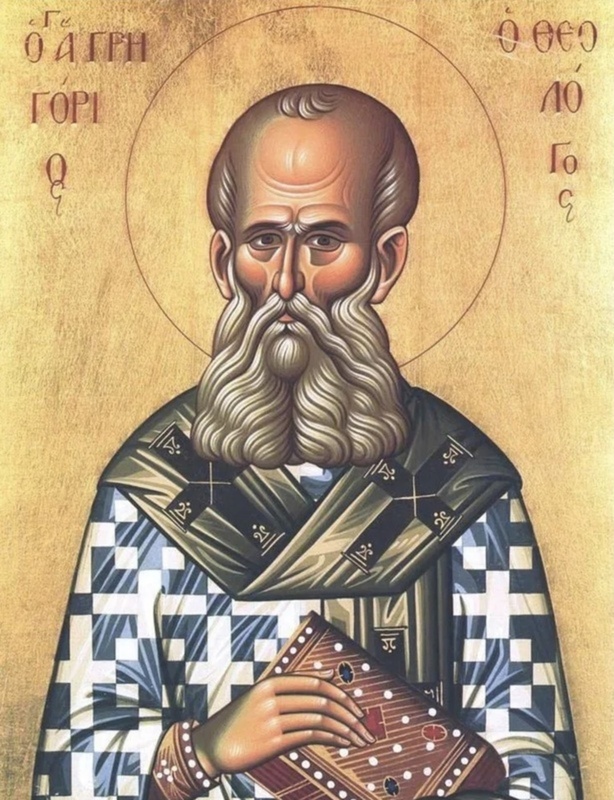
The section with the works of Gregory the Theologian in Greek: go. Switching to other languages is also available at the top, above the list of works.
Commemoration Days: January 25 (February 7), January 30 (February 12) (Synaxis of the Three Holy Hierarchs)
Biography
First steps on the path of Christian life
He was born in the south-western region of Cappadocia, in Arianzus (not far from the city of Nazianzus), around 330.
He came, in the literal sense of the word, from a family of saints: his father Gregory, bishop of Nazianzus, his mother Nonna, his brother Caesarius and his sister Gorgonia were all canonized after their deaths.
His father, Gregory the Elder, had at one time belonged to the adherents of a cult who worshipped God as the Most High but professed a faith made up of a mixture of Christian, Jewish and Persian teachings. He turned to Christ through the prayers of his wife Nonna, a deeply believing and zealous Christian. Under her beneficial influence he received Baptism. Soon he was ordained a priest, and later raised to the episcopal see of Nazianzus.
Even before the birth of Gregory the Younger, the future St. Gregory the Theologian, Nonna fervently prayed to God to grant her a son and promised that, if her prayer were granted, she would dedicate the child to God. A son was granted and the promise was fulfilled.
From childhood Gregory the Younger was brought up in the love of God and of his neighbour. He received his first education, including the foundations of Orthodox doctrine, in his parents' house. Thanks to his mother's influence, already in his youth he resolved to lead a celibate, God-pleasing life.
As he grew up he studied at the best schools of that time: in Caesarea of Cappadocia, in Caesarea of Palestine, in Alexandria and in Athens. His education was not cheap, but his parents' means allowed it.
In Caesarea of Cappadocia Gregory became acquainted with the future ecumenical teacher, St. Basil the Great. Their acquaintance continued during their studies in Athens and grew into a firm friendship.
Having returned from Athens (around 358), Gregory received Baptism, after which he devoted himself to the ascetic life: he spent his life in fasting, prayer, meditation on God and contemplation. During this period he visited Pontus, seeking meetings and common labours with his friend and kindred spirit Basil. One of the fruits of their joint work was the "Philocalia", which included thoughts and extracts from the writings of the famous church teacher Origen.
Around 360 Gregory the Elder, father of Gregory the Theologian, not fully understanding the subtleties of the Arian false teaching that had spread by that time, signed an Arian creed, which provoked the indignation of the Orthodox members of his flock. Many were ready to leave their bishop. At that moment Gregory the Younger managed to explain to his father his mistake and to show the discrepancy between the creed he had signed and the Nicene Creed. As a result Gregory the Elder publicly acknowledged his error, and order was restored among his flock.
Priestly and episcopal ministry
In 361, on the day of the solemn feast of the Nativity of the Saviour, Gregory, against his objections, was ordained a priest. Out of humility he was against this ordination, but again out of humility he did not dare to resist the will of the hierarch, his father. Saddened by this turn of events, Gregory went to Pontus, to Basil. Basil found the right words of consolation and encouraged his old friend.
By Pascha of 362 Father Gregory returned to Nazianzus and set about actively fulfilling his pastoral duty. From that time he remained with the flock entrusted to him and, as far as he could, helped his father, Gregory the Elder, in his episcopal ministry.
When in 370 Basil the Great was raised to archbishop of Caesarea, he began to open new sees in order to govern his flock better and to fight Arianism. At that time he needed zealous, religiously educated pastors.
Following his plan, St. Basil appointed his friend Gregory bishop of Sasima. It was the year 372. Although Gregory the Theologian understood the importance of this step from Basil the Great's point of view, and agreed, nevertheless, as in the case of his ordination to the priesthood, he submitted to this choice reluctantly, and then withdrew to a deserted, solitary place, where he gave himself up to contemplative prayer.
After some time Gregory the Elder persuaded his son to come to Nazianzus. He returned, but on condition that he would not be his father's successor on the see.
In 374 the father of Gregory the Theologian died, and soon after his mother. Having come to the church where both her husband and her loving son had served, and having approached the altar, she suddenly felt the approach of death, said a prayer and gave up her soul to God. All this of course affected Gregory's inner state. For some time he continued his father's work, but soon fell ill, so seriously that some did not even hope for his recovery.
In 375, having recovered from his illness and wishing to devote himself to a solitary life, he withdrew to Seleucia in Isauria. Here he lived as if he had imprisoned himself. The news of the death of Basil the Great (379) brought him terrible grief.
The struggle against heresy. Literary activity
After the death of Valens, who had patronized the Arian "clergy", Theodosius ascended the imperial throne, and he supported the Orthodox.
In 379 the believing citizens of Constantinople appealed to St. Gregory for help. Heeding the advice of his friends and his sense of pastoral duty, he left his solitude and hastened to the capital.
What he saw there filled him with righteous indignation: the churches had been seized by the Arians, there was no unity among the Orthodox, and the morals of the inhabitants were marked by licentiousness and depravity. St. Gregory was forced to look for a more or less safe refuge and found it in a private house.
The zeal for the Lord, devotion to Orthodoxy, sobriety of mind, learning and of course the eloquence of Gregory the Theologian could not fail to find a fitting response in the hearts of the townspeople. Under the influence of his exhortations and sermons people were transformed. Many burned with the desire to see and hear the zealous defender of the faith. Very quickly the fame of the hierarch spread so widely that it began to attract to Constantinople even the inhabitants of distant villages.
All this together aroused hostile, aggressive feelings among the followers of Arius. The heretics were ready not only to intrigue against the hierarch but even made attempts on his life.
The emperor Theodosius, who arrived in Constantinople in 380, used the power of his imperial authority and handed over the churches seized by the heretics to the Orthodox. St. Gregory, understanding the need for his personal presence, agreed to remain in the capital until the planned Council assembled.
The activity of St. Gregory at the Council of Constantinople
It was this Council, held in 381 and given the status of the Second Ecumenical Council, that was to put a final end to the dogmatic disputes of the Arians with the Orthodox, and this was accomplished.
Such outstanding Fathers of the Church as Meletius of Antioch, Gregory of Nyssa and others were present at the Council. In accordance with the wishes of the emperor, of most of the clergy and of the ordinary faithful, St. Gregory was elected to the Patriarchal see of Constantinople, and after the death of Meletius of Antioch he was proclaimed president of the Council.
But here the Egyptian hierarchs who had arrived at the Council, wishing to see their own protégé on the Patriarchal throne, intervened. They stirred up a controversy, and a suitable pretext was found: citing the canon of the Council of Nicaea that forbids a bishop to move from one see to another, they declared the appointment of St. Gregory as bishop of Constantinople unlawful.
Although the force of the canon adopted by the Fathers of the First Ecumenical Council had been overridden by the very election of St. Gregory by the Fathers of the Second Ecumenical Council, this formal pretext was seized upon. As soon as favourable ground for the intrigue had formed, opposition to Gregory came both from those who were dissatisfied with his leniency towards the Arians (as people who had gone astray) and from those who did not wish to put up with his strictness in the struggle for the purity of the faith.
St. Gregory, a stranger to honours and still more to vile intrigues, considered it best to renounce the authority of primate of the Church of Constantinople and to leave the city. Before his departure he delivered a farewell speech to those assembled, in which he set out his Christian position and showed the rightness of his pastoral conduct.
The last period of his earthly life
Some time later Gregory the Theologian arrived in Nazianzus, took charge of the local flock there and led it until bishop Eulalius ascended the see of Nazianzus. This happened in 383.
After this the hierarch moved to his native place, Arianzus, where he devoted himself to prayerful contemplation and writing.
In 389 he peacefully reposed in the Lord.
For the holiness and righteousness of his life, and for his brilliant and flawless exposition in his writings of the teaching on the Most Holy Trinity and the Person of the Lord Jesus Christ, the Ecumenical Orthodox Church honoured him with a name of exceptional significance — the Theologian. Only three saints have entered the history of the Church with this name: besides St. Gregory, the apostle John the Theologian and Symeon the New Theologian.
Literary legacy
St. Gregory the Theologian left behind a rich literary legacy consisting of 245 letters, 507 poems (written at times in imitation of Homer in the forms of hexameters, pentameters and trimeters) and 45 "Orations".
Hymnography
Troparion to St. Gregory the Theologian, Tone 1
The pastoral pipe of thy theology / conquered the trumpets of the orators; / for since thou didst search out the depths of the Spirit, / beauty of speech was also added to thee. / But pray to Christ God, O father Gregory, // that our souls be saved.
Kontakion to St. Gregory the Theologian, Tone 3
With thy theological tongue thou didst undo the entanglements of the orators, O glorious one; / thou didst adorn the Church with the robe of Orthodoxy woven from on high; / wearing it, she cries out with us, thy children: Rejoice, O father, // most supreme mind of theology.