
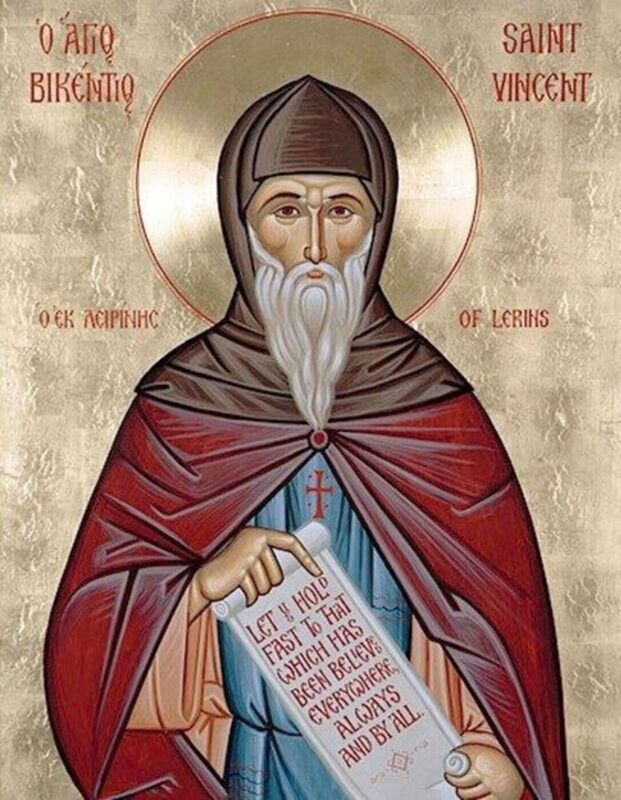
Vincent of Lérins, 5th century

Works of the ancient Holy Fathers and Church Writers

Vincent of Lérins, 5th century

Text prepared by the bibleox community

We want this text to be accessible to everyone — that's why we've prepared this translation. Unfortunately, it's not always possible to find ready-made translations, so we create them ourselves. Both automated tools and humans work on this. You can help too! Some parts might not sound perfect, but we've tried to preserve the accuracy of the meaning. If you notice an inaccuracy or want to improve the text — criticism is welcome! Even better — join the community and suggest your edits. Like Wikipedia materials, this text is freely available under the CC BY-SA license.

Venerable († before 450)
This text is available in other languages:

Commemoration day: May 24 (June 6)

Biography

Information about the life of Saint Vincent is extremely scarce. The primary biographical source about him is the work "De viris illustribus" (On Illustrious Men) by Gennadius of Massilia, composed around 495 AD as a continuation of the work of the same name by Saint Jerome of Stridon.

Vincent was born in the city of Toul in the northeast of modern France. He was the blood brother of Saint Lupus of Troyes. After service in the army (Latin: secularis militia), he entered the Lérins Monastery of Saint Honoratus, where he was tonsured a monk. In 434, under the pseudonym Peregrinus, he wrote his most famous work, "Commonitorium". He reposed during the reign of the emperors Theodosius II and Valentinian III, i.e., in or before 450 AD. Vincent was highly esteemed by his contemporaries; for instance, Saint Eucherius of Lyon called him a holy man, outstanding in eloquence and knowledge.

174
Published by: Rodion Vlasov
Want to fix or add something? Tell us: https://t.me/bibleox_live
Or edit this article by yourself: Edit