
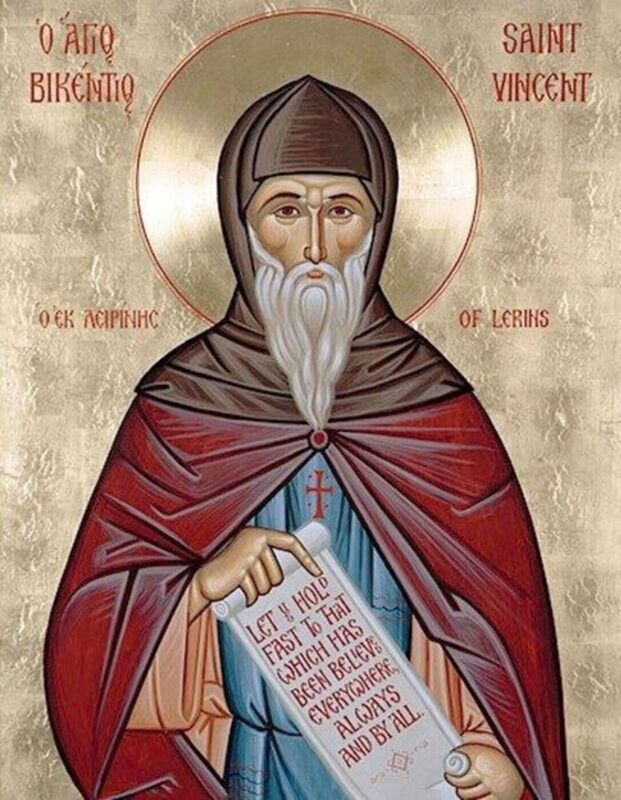
Vincent of Lérins, 5th century

Works of the ancient Holy Fathers and Church Writers

Vincent of Lérins, 5th century

Texto preparado por la comunidad bibleox

Queremos que este texto sea accesible para todos — por eso hemos preparado esta traducción. Lamentablemente, no siempre es posible encontrar traducciones listas, así que las creamos nosotros mismos. Tanto herramientas automáticas como personas trabajan en esto. ¡Tú también puedes ayudar! Algunas partes pueden no sonar perfectas, pero hemos intentado preservar la precisión del significado. Si notas alguna inexactitud o quieres mejorar el texto — ¡se agradece la crítica! Mejor aún — únete a la comunidad y propón tus ediciones. Al igual que los materiales de Wikipedia, este texto se distribuye libremente bajo la licencia CC BY-SA.

Venerable († before 450)
Este texto está disponible en otros idiomas:

Commemoration day: May 24 (June 6)

Biography

Information about the life of Saint Vincent is extremely scarce. The primary biographical source about him is the work "De viris illustribus" (On Illustrious Men) by Gennadius of Massilia, composed around 495 AD as a continuation of the work of the same name by Saint Jerome of Stridon.

Vincent was born in the city of Toul in the northeast of modern France. He was the blood brother of Saint Lupus of Troyes. After service in the army (Latin: secularis militia), he entered the Lérins Monastery of Saint Honoratus, where he was tonsured a monk. In 434, under the pseudonym Peregrinus, he wrote his most famous work, "Commonitorium". He reposed during the reign of the emperors Theodosius II and Valentinian III, i.e., in or before 450 AD. Vincent was highly esteemed by his contemporaries; for instance, Saint Eucherius of Lyon called him a holy man, outstanding in eloquence and knowledge.

79
Publicado por el usuario: Rodion Vlasov
¿Desea corregir o ampliar? Escríbanos: https://t.me/bibleox_live
O edite el artículo usted mismo: Editar